



 Chat with AI
Exam 9: The Muscular System: Skeletal Muscle Tissue and Muscle Organization

Exam 1: Foundations: An Introduction to Anatomy124 Questions
Exam 2: Foundations: The Cell117 Questions
Exam 3: Foundations: Tissues and Early Embryology127 Questions
Exam 4: The Integumentary System127 Questions
Exam 5: The Skeletal System: Osseous Tissue and Skeletal Structure142 Questions
Exam 6: The Skeletal System: Axial Division150 Questions
Exam 7: The Skeletal System: Appendicular Division131 Questions
Exam 8: The Skeletal System: Articulations131 Questions
Exam 9: The Muscular System: Skeletal Muscle Tissue and Muscle Organization145 Questions
Exam 10: The Muscular System: Axial Musculature142 Questions
Exam 11: The Muscular System: Appendicular Musculature135 Questions
Exam 12: Surface Anatomy and Cross-Sectional Anatomy129 Questions
Exam 13: The Nervous System: Neural Tissue127 Questions
Exam 14: The Nervous System: The Spinal Cord and Spinal Nerves131 Questions
Exam 15: The Nervous System: Sensory and Motor Tracts of the Spinal Cord81 Questions
Exam 16: The Nervous System: The Brain and Cranial Nerves132 Questions
Exam 17: The Nervous System: Autonomic Nervous System115 Questions
Exam 18: The Nervous System: General and Special Senses127 Questions
Exam 19: The Endocrine System102 Questions
Exam 20: The Cardiovascular System: Blood71 Questions
Exam 21: The Cardiovascular System: The Heart150 Questions
Exam 22: The Cardiovascular System: Vessels and Circulation129 Questions
Exam 23: The Lymphatic System105 Questions
Exam 24: The Respiratory System128 Questions
Exam 25: The Digestive System132 Questions
Exam 26: The Urinary System135 Questions
Exam 27: The Reproductive System134 Questions
Exam 28: Embryology and Human Development140 Questions
Select questions type


Figure 9.1
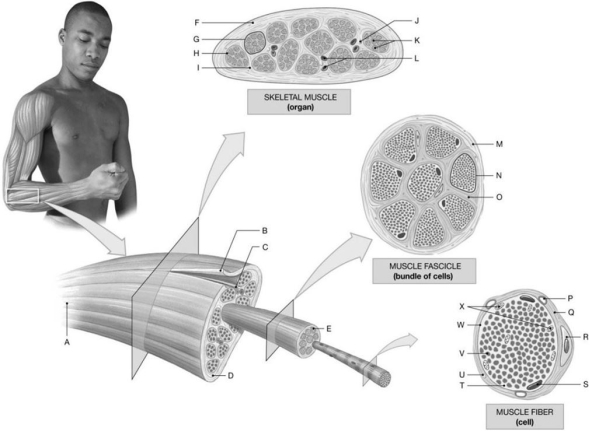 Using the diagrams of the structural organization of skeletal muscle, identify the specified labeled part in each of the following questions.
-Identify the specific structure indicated by Label Q.
Using the diagrams of the structural organization of skeletal muscle, identify the specified labeled part in each of the following questions.
-Identify the specific structure indicated by Label Q. (Multiple Choice)
4.9/5  (84)
(84) Figure 9.4
 Using the above-referenced figures depicting skeletal muscle fiber organization, identify the specific labeled part indicated in each of the following questions.
-Identify the specific structure indicated by Label G.
Using the above-referenced figures depicting skeletal muscle fiber organization, identify the specific labeled part indicated in each of the following questions.
-Identify the specific structure indicated by Label G. (Multiple Choice)
4.8/5 (60)
(60) The muscle fiber typethat contains densely packed myofibrils, large glycogen reserves, and relatively few mitochondria, is called ________.
(Multiple Choice)
4.9/5 (71)
(71) Figure 9.1
Using the diagrams of the structural organization of skeletal muscle, identify the specified labeled part in each of the following questions.
-Identify the specific structure indicated by Label G.
Using the diagrams of the structural organization of skeletal muscle, identify the specified labeled part in each of the following questions.
-Identify the specific structure indicated by Label G. (Multiple Choice)
4.8/5 (77)
(77) A space that separates the expanded tip of the axon at the neuromuscular synapse from the motor end plate is the synaptic vesicle.
(True/False)
4.9/5 (92)
(92) A word in a muscle name that indicates it is a pear-shaped muscle might be ________.
(Multiple Choice)
4.7/5 (80)
(80) The layers of connective tissue surrounding a skeletal muscle from the inside to the outside in correct order are ________.
(Multiple Choice)
4.8/5 (90)
(90) The triceps brachii and biceps brachii are good examples of ________.
(Multiple Choice)
4.8/5 (80)
(80) Typically, the insertion of a muscle is ________ to its origin.
(Multiple Choice)
4.9/5 (85)
(85) The ________ is a dense irregular connective tissue layer that surrounds the entire skeletal muscle.
(Multiple Choice)
4.7/5 (79)
(79) Delayed-onset muscle soreness is potentially caused by microscopic ruptures at the ________ of the sarcomeres.
(Multiple Choice)
4.8/5 (92)
(92) Figure 9.3
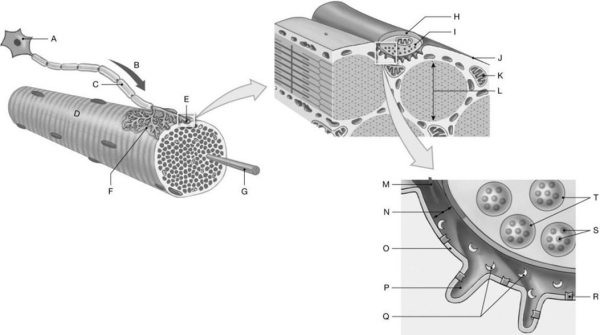 Using the diagrams depicting different views of the neuromuscular synapse, identify the specified labeled part in each of the following questions.
-Identify the specific structure indicated by Label A.
Using the diagrams depicting different views of the neuromuscular synapse, identify the specified labeled part in each of the following questions.
-Identify the specific structure indicated by Label A. (Multiple Choice)
4.8/5 (80)
(80) What types of changes cause muscles to decrease in size and strength during the aging process?
(Essay)
4.7/5 (76)
(76) At the zone of overlap, each thin filament sits in a triangle formed by three thick filaments, and each thick filament is surrounded by six thin filaments.
(True/False)
4.8/5 (80)
(80) The fulcrum lies between the applied force and the resistance in a first-class lever.
(True/False)
4.9/5 (75)
(75) The muscles surrounding the entrances of the digestive and urinary tracts are classified as ________.
(Multiple Choice)
4.8/5 (71)
(71) Figure 9.4
Using the above-referenced figures depicting skeletal muscle fiber organization, identify the specific labeled part indicated in each of the following questions.
-Identify the specific structure indicated by Label F.
Using the above-referenced figures depicting skeletal muscle fiber organization, identify the specific labeled part indicated in each of the following questions.
-Identify the specific structure indicated by Label F. (Multiple Choice)
4.9/5 (81)
(81) Figure 9.3
Using the diagrams depicting different views of the neuromuscular synapse, identify the specified labeled part in each of the following questions.
-Identify the specific structure indicated by Label S.
Using the diagrams depicting different views of the neuromuscular synapse, identify the specified labeled part in each of the following questions.
-Identify the specific structure indicated by Label S. (Multiple Choice)
4.9/5 (74)
(74) The connective tissue surrounding a fascicle is called ________.
(Multiple Choice)
4.9/5 (79)
(79) 
Filters
- Essay(0)
- Multiple Choice(0)
- Short Answer(0)
- True False(0)
- Matching(0)