



 Chat with AI
Exam 9: The Muscular System: Skeletal Muscle Tissue and Muscle Organization

Exam 1: Foundations: An Introduction to Anatomy124 Questions
Exam 2: Foundations: The Cell117 Questions
Exam 3: Foundations: Tissues and Early Embryology127 Questions
Exam 4: The Integumentary System127 Questions
Exam 5: The Skeletal System: Osseous Tissue and Skeletal Structure142 Questions
Exam 6: The Skeletal System: Axial Division150 Questions
Exam 7: The Skeletal System: Appendicular Division131 Questions
Exam 8: The Skeletal System: Articulations131 Questions
Exam 9: The Muscular System: Skeletal Muscle Tissue and Muscle Organization145 Questions
Exam 10: The Muscular System: Axial Musculature142 Questions
Exam 11: The Muscular System: Appendicular Musculature135 Questions
Exam 12: Surface Anatomy and Cross-Sectional Anatomy129 Questions
Exam 13: The Nervous System: Neural Tissue127 Questions
Exam 14: The Nervous System: The Spinal Cord and Spinal Nerves131 Questions
Exam 15: The Nervous System: Sensory and Motor Tracts of the Spinal Cord81 Questions
Exam 16: The Nervous System: The Brain and Cranial Nerves132 Questions
Exam 17: The Nervous System: Autonomic Nervous System115 Questions
Exam 18: The Nervous System: General and Special Senses127 Questions
Exam 19: The Endocrine System102 Questions
Exam 20: The Cardiovascular System: Blood71 Questions
Exam 21: The Cardiovascular System: The Heart150 Questions
Exam 22: The Cardiovascular System: Vessels and Circulation129 Questions
Exam 23: The Lymphatic System105 Questions
Exam 24: The Respiratory System128 Questions
Exam 25: The Digestive System132 Questions
Exam 26: The Urinary System135 Questions
Exam 27: The Reproductive System134 Questions
Exam 28: Embryology and Human Development140 Questions
Select questions type


Figure 9.1
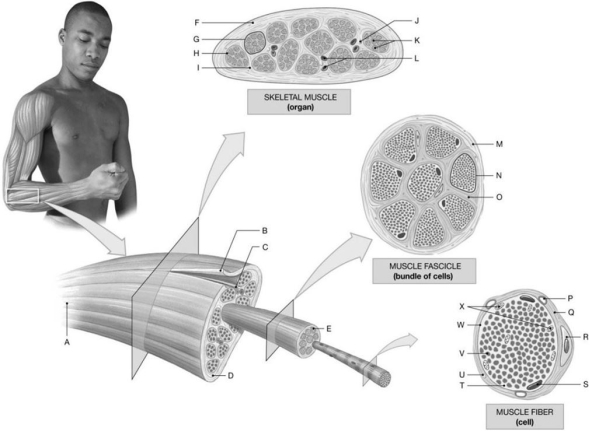 Using the diagrams of the structural organization of skeletal muscle, identify the specified labeled part in each of the following questions.
-Identify the specific structure indicated by Label U.
Using the diagrams of the structural organization of skeletal muscle, identify the specified labeled part in each of the following questions.
-Identify the specific structure indicated by Label U. (Multiple Choice)
4.8/5  (79)
(79) Figure 9.2
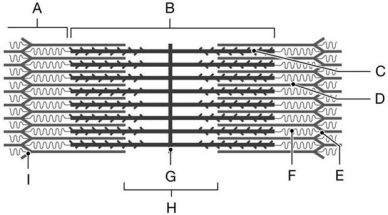 Using the diagram of a sarcomere, identify the specified labeled part in each of the following questions.
-Identify the specific structure indicated by Label F.
Using the diagram of a sarcomere, identify the specified labeled part in each of the following questions.
-Identify the specific structure indicated by Label F. (Multiple Choice)
4.9/5 (75)
(75) Figure 9.1
Using the diagrams of the structural organization of skeletal muscle, identify the specified labeled part in each of the following questions.
-Identify the specific structure indicated by Label E.
Using the diagrams of the structural organization of skeletal muscle, identify the specified labeled part in each of the following questions.
-Identify the specific structure indicated by Label E. (Multiple Choice)
5.0/5 (74)
(74) Figure 9.1
Using the diagrams of the structural organization of skeletal muscle, identify the specified labeled part in each of the following questions.
-Identify the specific structure indicated by Label W.
Using the diagrams of the structural organization of skeletal muscle, identify the specified labeled part in each of the following questions.
-Identify the specific structure indicated by Label W. (Multiple Choice)
4.9/5 (80)
(80) Which of the following events occurs in a muscle that is relaxing?
(Multiple Choice)
4.9/5 (90)
(90) The Z line is comprised of thick filaments attached to interconnecting proteins, delineating the ends of the sarcomere.
(True/False)
4.7/5 (82)
(82) Why does a skeletal muscle fiber have more than one nucleus?
(Multiple Choice)
4.8/5 (71)
(71) Figure 9.4
 Using the above-referenced figures depicting skeletal muscle fiber organization, identify the specific labeled part indicated in each of the following questions.
-Identify the specific structure indicated by Label H.
Using the above-referenced figures depicting skeletal muscle fiber organization, identify the specific labeled part indicated in each of the following questions.
-Identify the specific structure indicated by Label H. (Multiple Choice)
4.8/5 (89)
(89) Figure 9.3
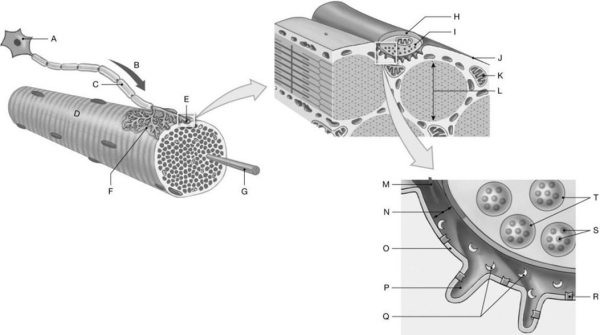 Using the diagrams depicting different views of the neuromuscular synapse, identify the specified labeled part in each of the following questions.
-Identify the specific structure indicated by Label C.
Using the diagrams depicting different views of the neuromuscular synapse, identify the specified labeled part in each of the following questions.
-Identify the specific structure indicated by Label C. (Multiple Choice)
4.8/5 (69)
(69) When acetylcholine binds to receptors on the motor end plate, ________ occurs immediately.
(Multiple Choice)
4.9/5 (87)
(87) Light staining areas of a muscle fiber viewed under polarized light are called I bands.
(True/False)
4.9/5 (63)
(63) Which of the following molecules or ions are absent following death and leads to rigor mortis?
(Multiple Choice)
4.8/5 (76)
(76) What is the significance of the change in membrane potential of the T tubules within the sarcolemma?
(Multiple Choice)
4.8/5 (86)
(86) The motor neuron releases acetylcholine, which then binds to receptors sites on a special region of the sarcolemma called ________.
(Multiple Choice)
5.0/5 (80)
(80) When a resting muscle contracts only enough to produce tension without movement, this is an example of ________.
(Multiple Choice)
5.0/5 (79)
(79) 
Filters
- Essay(0)
- Multiple Choice(0)
- Short Answer(0)
- True False(0)
- Matching(0)