



 Chat with AI
Exam 7: Global Markets in Action

Exam 1: What Is Economics483 Questions
Exam 2: The Economic Problem440 Questions
Exam 3: Demand and Supply515 Questions
Exam 4: Elasticity530 Questions
Exam 5: Efficiency and Equity450 Questions
Exam 6: Government Actions in Markets412 Questions
Exam 7: Global Markets in Action205 Questions
Exam 8: Utility and Demand366 Questions
Exam 10: Organizing Production385 Questions
Exam 11: Output and Costs493 Questions
Exam 12: Perfect Competition487 Questions
Exam 13: Monopoly599 Questions
Exam 14: Monopolistic Competition318 Questions
Exam 15: Oligopoly276 Questions
Exam 16: Public Choices, Public Goods, and Healthcare205 Questions
Exam 17: Externalities437 Questions
Exam 18: Markets for Factors of Production382 Questions
Exam 19: Economic Inequality351 Questions
Exam 20: Uncertainty and Information233 Questions
Select questions type


"When countries specialize in producing the good in which they have a comparative advantage and then trade with each other, only the country with the absolute advantage gains." Is the previous statement correct or incorrect? Briefly explain your answer.
(Essay)
4.7/5  (94)
(94) Some people assert that protection from foreign competition prevents rich countries from exploiting developing countries. What is this argument in more detail and what is its flaw?
(Essay)
4.7/5 (74)
(74) Economics demonstrates that opening up unrestricted free international trade is beneficial to all nations. However, are there any losers from such a policy change?
(Essay)
4.8/5 (92)
(92) Trade war occurs when, after a tariff is imposed, other countries retaliate with their own tariff.
(True/False)
4.8/5 (79)
(79) When a foreign firm sells its exports at a lower price than its cost of production, the firm is
(Multiple Choice)
4.8/5 (81)
(81) A tariff is a tax that is imposed by the ________ country when an ________ good crosses its international boundary.
(Multiple Choice)
4.7/5 (73)
(73) The activities in which U.S. workers are relatively more productive
(Multiple Choice)
4.8/5 (85)
(85) Which of the following reasons explains why rich countries persistently restrict textile imports from poor countries?
(Multiple Choice)
4.7/5 (71)
(71) 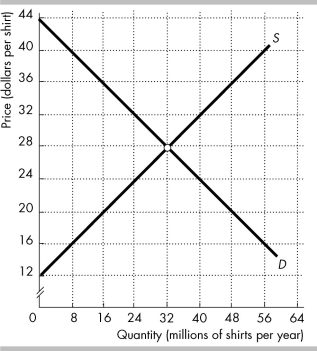 The figure shows the market for shirts in the United States, where D is the U.S demand curve and S is the U.S. supply curve. The world price is $20 per shirt. The United States imposes a tariff on imported shirts, $4 per shirt.
-In the figure above, the tariff ________ the domestic production of shirts in the United States by ________ per year.
The figure shows the market for shirts in the United States, where D is the U.S demand curve and S is the U.S. supply curve. The world price is $20 per shirt. The United States imposes a tariff on imported shirts, $4 per shirt.
-In the figure above, the tariff ________ the domestic production of shirts in the United States by ________ per year. (Multiple Choice)
4.9/5 (68)
(68) During the first 6 months of 2008, the United States imported from Africa, Asia, and Latin America more than 1.6 billion pounds of coffee and did not export any coffee. Based on this, we know definitively that
(Multiple Choice)
4.9/5 (81)
(81) A tariff is imposed on a good. This will ________ the domestic producer surplus, ________ the domestic consumer surplus, and ________ total surplus in the home country.
(Multiple Choice)
4.9/5 (92)
(92) A country opens up to trade and becomes an importer of a sugar. In the sugar market, consumer surplus will ________, producer surplus will ________, and total surplus will ________.
(Multiple Choice)
5.0/5 (65)
(65) A country opens up to trade and exports computer chips. In the computer chip market, surplus has been redistributed from
(Multiple Choice)
4.9/5 (76)
(76) Usually the imposition of trade barriers affecting a particular good benefits ________ people domestically, each of whom gains a ________.
(Multiple Choice)
4.9/5 (95)
(95) 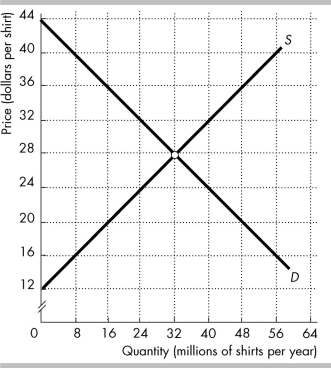 The figure shows the market for shirts in the United States, where D is the domestic demand curve and S is the domestic supply curve. The world price is $20 per shirt.
-In the figure above, international trade ________ total surplus in the United States by ________.
The figure shows the market for shirts in the United States, where D is the domestic demand curve and S is the domestic supply curve. The world price is $20 per shirt.
-In the figure above, international trade ________ total surplus in the United States by ________. (Multiple Choice)
4.9/5 (86)
(86) When the United States imposes a tariff on a good, the amount of the ________ in U.S. consumer surplus is ________ the amount of the ________ in U.S. producer surplus.
(Multiple Choice)
4.9/5 (92)
(92) 
Filters
- Essay(0)
- Multiple Choice(0)
- Short Answer(0)
- True False(0)
- Matching(0)