



 Chat with AI
Exam 7: Global Markets in Action

Exam 1: What Is Economics483 Questions
Exam 2: The Economic Problem440 Questions
Exam 3: Demand and Supply515 Questions
Exam 4: Elasticity530 Questions
Exam 5: Efficiency and Equity450 Questions
Exam 6: Government Actions in Markets412 Questions
Exam 7: Global Markets in Action205 Questions
Exam 8: Utility and Demand366 Questions
Exam 10: Organizing Production385 Questions
Exam 11: Output and Costs493 Questions
Exam 12: Perfect Competition487 Questions
Exam 13: Monopoly599 Questions
Exam 14: Monopolistic Competition318 Questions
Exam 15: Oligopoly276 Questions
Exam 16: Public Choices, Public Goods, and Healthcare205 Questions
Exam 17: Externalities437 Questions
Exam 18: Markets for Factors of Production382 Questions
Exam 19: Economic Inequality351 Questions
Exam 20: Uncertainty and Information233 Questions
Select questions type


If the United States imposes a tariff on $1 per imported shirt, the tariff will
(Multiple Choice)
4.8/5  (73)
(73) A tax that is imposed by the importing country when an imported good crosses its international boundary is called
(Multiple Choice)
4.9/5 (93)
(93) The U.S.-Colombia Trade Promotion Agreement was signed on November 22, 2006, in Washington, D.C. This comprehensive trade agreement eliminated tariffs and other barriers to goods and services. Colombia will immediately eliminate tariffs on wheat, barley, peanuts, and many other products in which Columbia does not have a comparative advantage. This policy means that the price of peanuts in Columbia will become
(Multiple Choice)
4.8/5 (80)
(80) Which of the following are TRUE regarding the argument that trade barriers protect U.S. workers from cheap foreign labor? I. Low-wage foreigners are just as productive as U.S. workers.
II) U.S. workers have a comparative advantage in low-wage jobs.
(Multiple Choice)
4.8/5 (76)
(76) Prior to international trade, the price of good X is lower in country A than in country B. This means that we know that
(Multiple Choice)
4.7/5 (82)
(82) A payment by the government to the producer of an exported good is called
(Multiple Choice)
4.8/5 (81)
(81) The United States imports cars from Japan. If the United States imposes a tariff on cars imported from Japan
(Multiple Choice)
4.9/5 (73)
(73) Give a brief description of the history of tariffs in the United States.
(Essay)
4.8/5 (92)
(92) Consider a market in which there is an import tariff. Which of the following is TRUE?
(Multiple Choice)
4.8/5 (90)
(90) 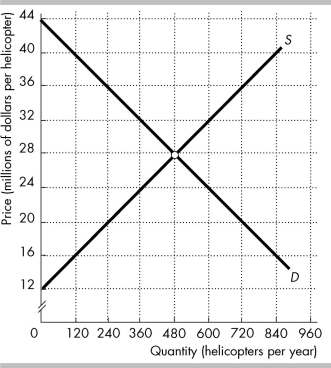 The figure shows the market for helicopters in the United States, where D is the domestic demand curve and S is the domestic supply curve. The United States trades helicopters with the rest of the world at a price of $36 million per helicopter.
-In the figure above, international trade ________ consumer surplus in the United States by ________.
The figure shows the market for helicopters in the United States, where D is the domestic demand curve and S is the domestic supply curve. The United States trades helicopters with the rest of the world at a price of $36 million per helicopter.
-In the figure above, international trade ________ consumer surplus in the United States by ________. (Multiple Choice)
4.7/5 (79)
(79) 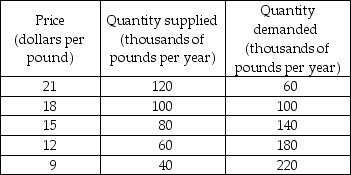 -The United States imports cheese from a variety of countries. The table above gives the domestic supply of, and demand for, cheese in the United States. The world price of cheese is $12 per pound, and trade is unrestricted.
a) How many pounds of cheese are consumed in the United States?
b) How many pounds of cheese are produced in the United States?
c) How many pounds of cheese are imported into the United States?
If a $3 per pound tariff is imposed,
d) How many pounds of cheese are consumed in the United States?
e) How many pounds of cheese are produced in the United States?
f) How many pounds of cheese are imported into the United States?
g) How much will the U.S. government collect in tariff revenue?
h) Who benefits from the tariff? Who loses?
-The United States imports cheese from a variety of countries. The table above gives the domestic supply of, and demand for, cheese in the United States. The world price of cheese is $12 per pound, and trade is unrestricted.
a) How many pounds of cheese are consumed in the United States?
b) How many pounds of cheese are produced in the United States?
c) How many pounds of cheese are imported into the United States?
If a $3 per pound tariff is imposed,
d) How many pounds of cheese are consumed in the United States?
e) How many pounds of cheese are produced in the United States?
f) How many pounds of cheese are imported into the United States?
g) How much will the U.S. government collect in tariff revenue?
h) Who benefits from the tariff? Who loses? (Essay)
4.9/5 (87)
(87) Japan imposes a tariff on imported rice. In Japan, surplus will be redistributed from
(Multiple Choice)
4.8/5 (75)
(75) The goods and services that our country sells to other countries are termed
(Multiple Choice)
4.9/5 (83)
(83) Selling a product in a foreign nation at a price less than its cost of production is called
(Multiple Choice)
4.8/5 (75)
(75) When a firms "dumps" some of its products in another country, it
(Multiple Choice)
4.8/5 (86)
(86) If the United States imposes a tariff on imported steel, the tariff will
(Multiple Choice)
4.7/5 (87)
(87) 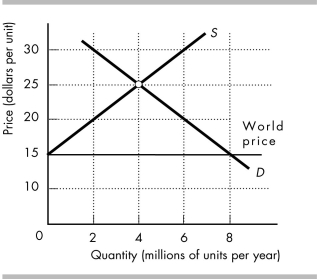 -The above figure shows the domestic supply of and domestic demand for an imported good. The world price is $15 per unit.
a) At the world price of $15 per unit, what is the domestic consumption and domestic production?
b) At the world price of $15 per unit, what is the quantity imported?
c) If the government imposes a tariff of $5 per unit, what is the domestic consumption and domestic production?
d) With the $5 per unit tariff, what is the quantity imported?
e) How much revenue does the government collect with a tariff of $5 per unit?
-The above figure shows the domestic supply of and domestic demand for an imported good. The world price is $15 per unit.
a) At the world price of $15 per unit, what is the domestic consumption and domestic production?
b) At the world price of $15 per unit, what is the quantity imported?
c) If the government imposes a tariff of $5 per unit, what is the domestic consumption and domestic production?
d) With the $5 per unit tariff, what is the quantity imported?
e) How much revenue does the government collect with a tariff of $5 per unit? (Essay)
5.0/5 (74)
(74) Almost all economists support protectionist policies because protection
(Multiple Choice)
4.8/5 (76)
(76) 
Filters
- Essay(0)
- Multiple Choice(0)
- Short Answer(0)
- True False(0)
- Matching(0)