



 Chat with AI
Exam 7: Global Markets in Action

Exam 1: What Is Economics483 Questions
Exam 2: The Economic Problem440 Questions
Exam 3: Demand and Supply515 Questions
Exam 4: Elasticity530 Questions
Exam 5: Efficiency and Equity450 Questions
Exam 6: Government Actions in Markets412 Questions
Exam 7: Global Markets in Action205 Questions
Exam 8: Utility and Demand366 Questions
Exam 10: Organizing Production385 Questions
Exam 11: Output and Costs493 Questions
Exam 12: Perfect Competition487 Questions
Exam 13: Monopoly599 Questions
Exam 14: Monopolistic Competition318 Questions
Exam 15: Oligopoly276 Questions
Exam 16: Public Choices, Public Goods, and Healthcare205 Questions
Exam 17: Externalities437 Questions
Exam 18: Markets for Factors of Production382 Questions
Exam 19: Economic Inequality351 Questions
Exam 20: Uncertainty and Information233 Questions
Select questions type


Suppose sugar is exported from a nation. In the sugar market who does NOT benefit from the exports?
(Multiple Choice)
4.7/5  (93)
(93) It is possible for the United States to compete against cheap foreign labor because expensive domestic workers
(Multiple Choice)
4.7/5 (84)
(84) Define comparative advantage and discuss its role in international trade.
(Essay)
4.8/5 (76)
(76) Belize, a country in Central America, has a small coffee industry. Suppose Belize does not have free trade but it has comparative advantage in coffee production. If Belize allowed international trade, what would be the gains from trade?
(Multiple Choice)
4.8/5 (73)
(73) Suppose the world price of a good is $4. Based on the table below, the country would 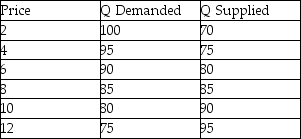
(Multiple Choice)
4.8/5 (66)
(66) Consider a market that is initially in equilibrium with quantity demanded equal to quantity supplied at a price of $20. If the world price of the good is $10 and the country opens up to international trade then in this market then
(Multiple Choice)
4.9/5 (78)
(78) When considering rent seeking, which of the following is TRUE?
(Multiple Choice)
4.8/5 (83)
(83) An assumption behind the infant-industry argument for tariff protection is that
(Multiple Choice)
4.7/5 (81)
(81) The gains from free trade are enjoyed by a ________ number of people and the costs of free trade are imposed by ________ number of people.
(Multiple Choice)
4.8/5 (87)
(87) The (false) idea that an industry should be protected because of learning-by-doing until it is large enough to compete successfully in world markets is the ________ argument for protection.
(Multiple Choice)
4.9/5 (79)
(79) During the first 6 months of 2008, the United States imported from Africa, Asia, and Latin America more than 1.6 billion pounds of coffee and did not export any coffee. How is the gain from imports distributed between consumers and domestic producers?
(Multiple Choice)
4.8/5 (77)
(77) Between August 2007 and July 2008, Brazil exported more than 3.5 billion pounds of coffee to the rest of the world. These exports mean that
(Multiple Choice)
4.8/5 (86)
(86) Tariffs ________ a deadweight loss and import quotas ________ a deadweight loss.
(Multiple Choice)
4.9/5 (81)
(81) 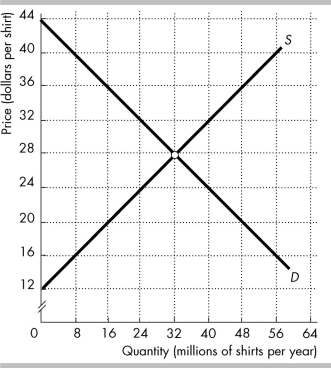 The figure shows the market for shirts in the United States, where D is the domestic demand curve and S is the domestic supply curve. The world price is $20 per shirt.
-In the figure above, international trade ________ consumer surplus in the United States by ________.
The figure shows the market for shirts in the United States, where D is the domestic demand curve and S is the domestic supply curve. The world price is $20 per shirt.
-In the figure above, international trade ________ consumer surplus in the United States by ________. (Multiple Choice)
4.8/5 (91)
(91) How does a tariff affect the government's revenue? How does an import quota affect the government's revenue?
(Essay)
4.7/5 (82)
(82) Which of the statements about the gains from international trade is CORRECT?
(Multiple Choice)
4.8/5 (81)
(81) When the United States exports a good, U.S. consumer surplus ________ and U.S. total surplus ________.
(Multiple Choice)
4.8/5 (78)
(78) The winners from a Japanese tariff on imported cars are I. Japanese car producers.
II) Japanese car consumers.
III) the Japanese government.
(Multiple Choice)
4.8/5 (79)
(79) 
Filters
- Essay(0)
- Multiple Choice(0)
- Short Answer(0)
- True False(0)
- Matching(0)