



 Chat with AI
Exam 7: Global Markets in Action

Exam 1: What Is Economics483 Questions
Exam 2: The Economic Problem440 Questions
Exam 3: Demand and Supply515 Questions
Exam 4: Elasticity530 Questions
Exam 5: Efficiency and Equity450 Questions
Exam 6: Government Actions in Markets412 Questions
Exam 7: Global Markets in Action205 Questions
Exam 8: Utility and Demand366 Questions
Exam 10: Organizing Production385 Questions
Exam 11: Output and Costs493 Questions
Exam 12: Perfect Competition487 Questions
Exam 13: Monopoly599 Questions
Exam 14: Monopolistic Competition318 Questions
Exam 15: Oligopoly276 Questions
Exam 16: Public Choices, Public Goods, and Healthcare205 Questions
Exam 17: Externalities437 Questions
Exam 18: Markets for Factors of Production382 Questions
Exam 19: Economic Inequality351 Questions
Exam 20: Uncertainty and Information233 Questions
Select questions type


Tariffs and import quotas both decrease the amount of a good consumed and raise the price paid by domestic residents for the good.
(True/False)
4.9/5  (71)
(71) Discuss reasons why we see trade restrictions. Are any of these reasons valid?
(Essay)
4.9/5 (88)
(88) A country specializes in the production of goods for which it has a comparative advantage, so
(Multiple Choice)
4.8/5 (85)
(85) Most economists agree that valid reasons for protecting trade include which of the following? I. The economies of scale argument
II) The saving jobs argument
III) The protection of high wages argument
(Multiple Choice)
4.8/5 (78)
(78) A country opens up to trade and becomes an exporter of wheat. In the wheat market, consumer surplus will ________, producer surplus will ________, and total surplus will ________.
(Multiple Choice)
4.8/5 (70)
(70) How does a tariff affect the domestic price of the import, the domestic consumption, the domestic production, and the quantity imported?
(Essay)
4.8/5 (84)
(84) 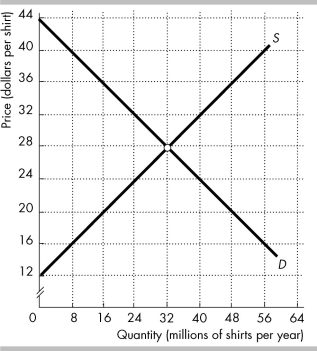 The figure shows the market for shirts in the United States, where D is the U.S demand curve and S is the U.S. supply curve. The world price is $20 per shirt. The United States imposes a tariff on imported shirts, $4 per shirt.
-In the figure above, with the tariff the United States imports ________ million shirts per year.
The figure shows the market for shirts in the United States, where D is the U.S demand curve and S is the U.S. supply curve. The world price is $20 per shirt. The United States imposes a tariff on imported shirts, $4 per shirt.
-In the figure above, with the tariff the United States imports ________ million shirts per year. (Multiple Choice)
4.8/5 (71)
(71) When NAFTA was approved, Congress attempted to soften the losses suffered by some industries by
(Multiple Choice)
4.8/5 (80)
(80) Tariffs ________ the domestic price of the good and import quotas ________ the domestic price of the good.
(Multiple Choice)
4.9/5 (75)
(75) Which of the following is an explanation for the existence of trade restrictions?
(Multiple Choice)
5.0/5 (81)
(81) The goods and services that our country buys from other countries are termed
(Multiple Choice)
4.8/5 (79)
(79) Which of the following is an effective counter argument to the claim that protectionism saves domestic jobs?
(Multiple Choice)
4.9/5 (74)
(74) Suppose the country of Mooland imposes a tariff on imported beef from the country of Aqualand. As a result of the tariff, the
(Multiple Choice)
4.7/5 (92)
(92) A situation in which when one country raises its tariff, other countries retaliate with increases of their own, which trigger yet further increases of tariffs from the first country, is termed
(Multiple Choice)
4.9/5 (79)
(79) Dumping occurs when a foreign firm sells its exports at a lower price than it costs to produce them.
(True/False)
4.7/5 (75)
(75) The Smoot-Hawley tariff triggered a trade war during the Great Depression of the 1930s.
(True/False)
4.9/5 (66)
(66)  -Suppose that elimination of tariffs on agricultural products means that 1,000 farm workers lose jobs that pay an average of $20,000 per year. At the same time, because of the importation of relatively cheaper foreign vegetables, 150 million consumers save $2 per year on their grocery bills.
a) What is the total income lost by farm workers because of the free trade?
b) What is the total dollar amount saved by all consumers combined?
c) Which is greater, the lost income or the consumer savings? Do the benefits of free trade out-weigh the costs in this simple example?
d) Which group is most likely to become politically involved over the issue of removing the tariffs, the farm workers or the consumers? Why?
-Suppose that elimination of tariffs on agricultural products means that 1,000 farm workers lose jobs that pay an average of $20,000 per year. At the same time, because of the importation of relatively cheaper foreign vegetables, 150 million consumers save $2 per year on their grocery bills.
a) What is the total income lost by farm workers because of the free trade?
b) What is the total dollar amount saved by all consumers combined?
c) Which is greater, the lost income or the consumer savings? Do the benefits of free trade out-weigh the costs in this simple example?
d) Which group is most likely to become politically involved over the issue of removing the tariffs, the farm workers or the consumers? Why? (Essay)
5.0/5 (87)
(87) 
Filters
- Essay(0)
- Multiple Choice(0)
- Short Answer(0)
- True False(0)
- Matching(0)