



 Chat with AI
Exam 54: Community Ecology

Exam 1: Evolution, the Themes of Biology, and Scientific Inquiry51 Questions
Exam 2: The Chemical Context of Life61 Questions
Exam 3: Water and Life55 Questions
Exam 4: Carbon and the Molecular Diversity of Life58 Questions
Exam 5: The Structure and Function of Large Biological Molecules70 Questions
Exam 6: A Tour of the Cell66 Questions
Exam 7: Membrane Structure and Function68 Questions
Exam 8: An Introduction to Metabolism67 Questions
Exam 9: Cellular Respiration and Fermentation68 Questions
Exam 10: Photosynthesis65 Questions
Exam 11: Cell Communication65 Questions
Exam 12: The Cell Cycle66 Questions
Exam 13: Meiosis and Sexual Life Cycles64 Questions
Exam 14: Mendel and the Gene Idea62 Questions
Exam 15: The Chromosomal Basis of Inheritance58 Questions
Exam 16: The Molecular Basis of Inheritance65 Questions
Exam 17: Gene Expression: From Gene to Protein67 Questions
Exam 18: Regulation of Gene Expression66 Questions
Exam 19: Viruses54 Questions
Exam 20: DNA Tools and Biotechnology57 Questions
Exam 21: Genomes and Their Evolution44 Questions
Exam 22: Descent with Modification: A Darwinian View of Life60 Questions
Exam 23: The Evolution of Populations64 Questions
Exam 24: The Origin of Species67 Questions
Exam 25: The History of Life on Earth59 Questions
Exam 26: Phylogeny and the Tree of Life75 Questions
Exam 27: Bacteria and Archaea75 Questions
Exam 28: Protists79 Questions
Exam 29: Plant Diversity I: How Plants Colonized Land82 Questions
Exam 30: Plant Diversity II: The Evolution of Seed Plants80 Questions
Exam 31: Fungi75 Questions
Exam 32: An Overview of Animal Diversity67 Questions
Exam 33: An Introduction to Invertebrates83 Questions
Exam 34: The Origin and Evolution of Vertebrates82 Questions
Exam 35: Vascular Plant Structure, Growth, and Development65 Questions
Exam 36: Resource Acquisition and Transport in Vascular Plants74 Questions
Exam 37: Soil and Plant Nutrition52 Questions
Exam 38: Angiosperm Reproduction and Biotechnology60 Questions
Exam 39: Plant Responses to Internal and External Signals61 Questions
Exam 40: Basic Principles of Animal Form and Function68 Questions
Exam 41: Animal Nutrition64 Questions
Exam 42: Circulation and Gas Exchange67 Questions
Exam 43: The Immune System69 Questions
Exam 44: Osmoregulation and Excretion64 Questions
Exam 45: Hormones and the Endocrine System66 Questions
Exam 46: Animal Reproduction68 Questions
Exam 47: Animal Development70 Questions
Exam 48: Neurons, Synapses, and Signaling68 Questions
Exam 49: Nervous Systems65 Questions
Exam 50: Sensory and Motor Mechanisms67 Questions
Exam 51: Animal Behavior69 Questions
Exam 52: An Introduction to Ecology and the Biosphere68 Questions
Exam 53: Population Ecology69 Questions
Exam 54: Community Ecology71 Questions
Exam 55: Ecosystems and Restoration Ecology68 Questions
Exam 56: Conservation Biology and Global Change69 Questions
Select questions type


Use the following diagram of five islands formed at around the same time near a particular mainland, as well as MacArthur and Wilson's island equilibrium model principles to answer the question.
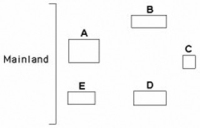 Which island would likely have the lowest extinction rate?
 (Multiple Choice)
4.9/5  (79)
(79) The symbols +, -, and 0 are used to show the results of interactions between individuals and groups of individuals. The symbol + denotes a positive interaction, - denotes a negative interaction, and 0 denotes interactions in which individuals are not affected. The first symbol refers to the first organism mentioned. Which fact is correct when describing species interactions?
(Multiple Choice)
4.9/5 (93)
(93) As you study two closely related predatory insect species, the two-spot and the three-spot avenger beetles, you notice that each species seeks prey at dawn in areas without the other species. However, where their ranges overlap, the two-spot avenger beetle hunts at night and the three-spot hunts in the morning. When you bring them into the laboratory and isolate the two different species, you discover that the offspring of both species are found to be nocturnal. You have discovered an example of ________.
(Multiple Choice)
4.7/5 (88)
(88) Use the figure to answer the following question.
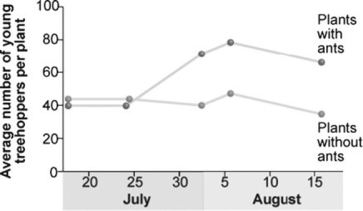 Treehoppers (a type of insect)produce honeydew, which ants use for food. Treehoppers have a major predator, the jumping spider. Researchers hypothesized that the ants would protect the treehoppers from the spiders. During a one-year study, researchers found no difference in treehopper populations in any of their control and experimental groups. What could they measure during the second year to gain information about why this might have occurred?
 (Multiple Choice)
4.9/5 (79)
(79) Use the figure to answer the following question.
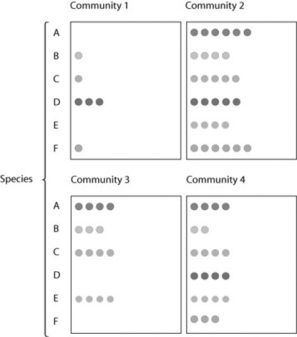 In the figure, imagine that community 4 represents a marine community off the coast of Florida, where overfishing of a particular trophy fish (imagine a species G)for two decades gradually shifted it to resemble community 3. The species that was overfished was likely
 (Multiple Choice)
4.8/5 (85)
(85) Keystone predators can maintain species diversity in a community if they ________.
(Multiple Choice)
4.7/5 (68)
(68) Use the graph to answer the following question.
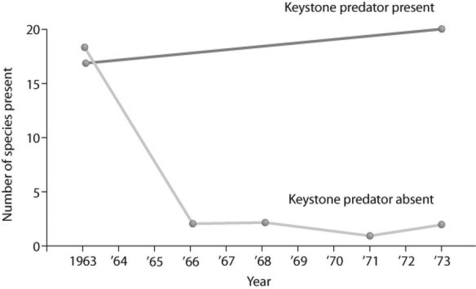 What does the graph tell you about the effect of a keystone species?
 (Multiple Choice)
4.9/5 (78)
(78) Use the following diagram of a hypothetical food web to answer the question. The arrows represent the transfer of energy between the various trophic levels.
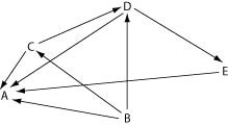 Which letter represents an organism that could be a producer?
 (Multiple Choice)
4.7/5 (70)
(70) Approximately how many kilograms (kg)of carnivore (secondary consumer)biomass can be supported by a field plot containing 1000 kg of plant material?
(Multiple Choice)
4.9/5 (81)
(81) Recall that Clements's view of biological communities is that of a highly predictable and interrelated structure, while Gleason's view of biological communities is that individual species operate independently. If we set up many identical sterilized ponds in the same area and allowed them to be colonized, what result should we expect Gleason had a more accurate view of communities than did Clement's hypothesis?
(Multiple Choice)
4.9/5 (73)
(73) 
Filters
- Essay(0)
- Multiple Choice(0)
- Short Answer(0)
- True False(0)
- Matching(0)