



 Chat with AI
Exam 54: Community Ecology

Exam 1: Evolution, the Themes of Biology, and Scientific Inquiry51 Questions
Exam 2: The Chemical Context of Life61 Questions
Exam 3: Water and Life55 Questions
Exam 4: Carbon and the Molecular Diversity of Life58 Questions
Exam 5: The Structure and Function of Large Biological Molecules70 Questions
Exam 6: A Tour of the Cell66 Questions
Exam 7: Membrane Structure and Function68 Questions
Exam 8: An Introduction to Metabolism67 Questions
Exam 9: Cellular Respiration and Fermentation68 Questions
Exam 10: Photosynthesis65 Questions
Exam 11: Cell Communication65 Questions
Exam 12: The Cell Cycle66 Questions
Exam 13: Meiosis and Sexual Life Cycles64 Questions
Exam 14: Mendel and the Gene Idea62 Questions
Exam 15: The Chromosomal Basis of Inheritance58 Questions
Exam 16: The Molecular Basis of Inheritance65 Questions
Exam 17: Gene Expression: From Gene to Protein67 Questions
Exam 18: Regulation of Gene Expression66 Questions
Exam 19: Viruses54 Questions
Exam 20: DNA Tools and Biotechnology57 Questions
Exam 21: Genomes and Their Evolution44 Questions
Exam 22: Descent with Modification: A Darwinian View of Life60 Questions
Exam 23: The Evolution of Populations64 Questions
Exam 24: The Origin of Species67 Questions
Exam 25: The History of Life on Earth59 Questions
Exam 26: Phylogeny and the Tree of Life75 Questions
Exam 27: Bacteria and Archaea75 Questions
Exam 28: Protists79 Questions
Exam 29: Plant Diversity I: How Plants Colonized Land82 Questions
Exam 30: Plant Diversity II: The Evolution of Seed Plants80 Questions
Exam 31: Fungi75 Questions
Exam 32: An Overview of Animal Diversity67 Questions
Exam 33: An Introduction to Invertebrates83 Questions
Exam 34: The Origin and Evolution of Vertebrates82 Questions
Exam 35: Vascular Plant Structure, Growth, and Development65 Questions
Exam 36: Resource Acquisition and Transport in Vascular Plants74 Questions
Exam 37: Soil and Plant Nutrition52 Questions
Exam 38: Angiosperm Reproduction and Biotechnology60 Questions
Exam 39: Plant Responses to Internal and External Signals61 Questions
Exam 40: Basic Principles of Animal Form and Function68 Questions
Exam 41: Animal Nutrition64 Questions
Exam 42: Circulation and Gas Exchange67 Questions
Exam 43: The Immune System69 Questions
Exam 44: Osmoregulation and Excretion64 Questions
Exam 45: Hormones and the Endocrine System66 Questions
Exam 46: Animal Reproduction68 Questions
Exam 47: Animal Development70 Questions
Exam 48: Neurons, Synapses, and Signaling68 Questions
Exam 49: Nervous Systems65 Questions
Exam 50: Sensory and Motor Mechanisms67 Questions
Exam 51: Animal Behavior69 Questions
Exam 52: An Introduction to Ecology and the Biosphere68 Questions
Exam 53: Population Ecology69 Questions
Exam 54: Community Ecology71 Questions
Exam 55: Ecosystems and Restoration Ecology68 Questions
Exam 56: Conservation Biology and Global Change69 Questions
Select questions type


Why is a pathogen generally more virulent in a new habitat?
(Multiple Choice)
4.7/5  (95)
(95) Use the following diagram of a hypothetical food web to answer the question. The arrows represent the transfer of energy between the various trophic levels.
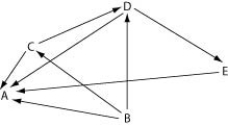 Which letter represents an organism that could only be a primary consumer?
 (Multiple Choice)
4.8/5 (90)
(90) How might an ecologist test whether a species is occupying all of its fundamental niche or only a portion of it?
(Multiple Choice)
4.8/5 (86)
(86) Resource partitioning would be most likely to occur between ________.
(Multiple Choice)
4.9/5 (74)
(74) Based on the intermediate disturbance hypothesis, a community's species diversity is increased by ________.
(Multiple Choice)
4.9/5 (90)
(90) Which of the following is a widely supported explanation for the tendency of tropical communities to have greater species diversity than temperate or polar communities?
(Multiple Choice)
4.8/5 (77)
(77) According to the island equilibrium model, species richness would be greatest on an island that is
(Multiple Choice)
5.0/5 (74)
(74) If two species are close competitors, and one species is experimentally removed from the community, the remaining species would be expected to ________.
(Multiple Choice)
4.8/5 (83)
(83) Bouchard and Brooks studied the effect of insect flight on dispersal and speciation in rain forest insects. They sampled all of the insects in the study area and found that 60 insect species are flightless and 19 are able to fly. What can you conclude so far about this study?
(P) Bouchard and D. R. Brooks. 2004. Effect of vagility potential on dispersal and speciation in rainforest insects. Journal of Evolutionary Biology 17:994-1006.)
(Multiple Choice)
4.7/5 (75)
(75) The feeding relationships among the species in a community determine the community's
(Multiple Choice)
4.7/5 (78)
(78) The symbols +, -, and 0 are used to show the results of interactions between individuals and groups of individuals. The symbol + denotes a positive interaction, - denotes a negative interaction, and 0 denotes interactions in which individuals are not affected. The first symbol refers to the first organism mentioned. What interactions exist between a lion pride and African wild dogs, if the dogs are found to typically avoid areas with lions?
(Multiple Choice)
4.9/5 (66)
(66) Imagine five forest communities, each with one hundred individuals distributed among four different tree species (W, X, Y, and Z). Which forest community would be most diverse?
(Multiple Choice)
4.9/5 (83)
(83) Scientists interested in how populations interact within communities are attempting to determine the species diversity of an island under study. What kind of data would be most helpful to the scientists in determining diversity?
(Multiple Choice)
4.8/5 (73)
(73) Use the figure to answer the following question.
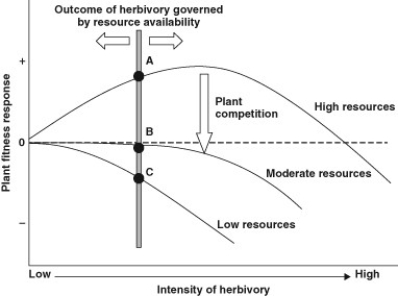 The figure proposes a combination of a top-down and bottom-up model (a hypothesis)to describe the variable effects of biological control herbivores on the fitness (growth and reproduction)of an invasive, non-native plant, spotted knapweed (Centaurea stoebe). These herbivores include multiple insects that were first studied in the plant's native home range in eastern Europe, where the plant is not dominant in grassland communities and does not pose a problem to land managers and conservationists. Many insects there were found to consume the plant's tissues, including stems, leaves, and seeds, and some were very host specific and were not found to attack plants other than C. stoebe. Several insects were subsequently transported and released in an attempt to reduce densities of this non-native and problematic weed in the United States. The y-axis shows C. stoebe plant fitness, and the x-axis represents the intensity of herbivory by the insects, from low to high. As the vertical shaded bar is moved along the x-axis, the ultimate effect of herbivory (now A, B, and C)on plant fitness can change based on its intensity and also may depend on the other factors. The horizontal dashed line represents no predicted change in fitness under the effects of varying intensity of herbivory, plant competition, and soil resources available to the plant (such as nitrogen or water), while the three solid lines represent other possible outcomes.
(D)G. Knochel and T.R. Seastedt. 2011. Reconciling contradictory findings of herbivore impacts on spotted knapweed (Centaurea stoebe)growth and reproduction. Ecological Applications 20(7):1903-1912.
What portion of the model would be characterized as bottom-up?
The figure proposes a combination of a top-down and bottom-up model (a hypothesis)to describe the variable effects of biological control herbivores on the fitness (growth and reproduction)of an invasive, non-native plant, spotted knapweed (Centaurea stoebe). These herbivores include multiple insects that were first studied in the plant's native home range in eastern Europe, where the plant is not dominant in grassland communities and does not pose a problem to land managers and conservationists. Many insects there were found to consume the plant's tissues, including stems, leaves, and seeds, and some were very host specific and were not found to attack plants other than C. stoebe. Several insects were subsequently transported and released in an attempt to reduce densities of this non-native and problematic weed in the United States. The y-axis shows C. stoebe plant fitness, and the x-axis represents the intensity of herbivory by the insects, from low to high. As the vertical shaded bar is moved along the x-axis, the ultimate effect of herbivory (now A, B, and C)on plant fitness can change based on its intensity and also may depend on the other factors. The horizontal dashed line represents no predicted change in fitness under the effects of varying intensity of herbivory, plant competition, and soil resources available to the plant (such as nitrogen or water), while the three solid lines represent other possible outcomes.
(D)G. Knochel and T.R. Seastedt. 2011. Reconciling contradictory findings of herbivore impacts on spotted knapweed (Centaurea stoebe)growth and reproduction. Ecological Applications 20(7):1903-1912.
What portion of the model would be characterized as bottom-up? (Multiple Choice)
4.9/5 (85)
(85) Use the figures to answer the following question.
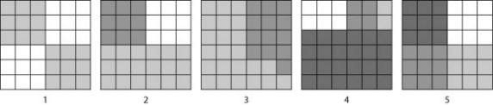 According to the Shannon Diversity Index, which of the five blocks above, with each containing 36 squares, would show the greatest diversity? The different shades represent different species, and more squares of a shade represent higher abundance.
 (Multiple Choice)
4.8/5 (82)
(82) Use the figure to answer the following question.
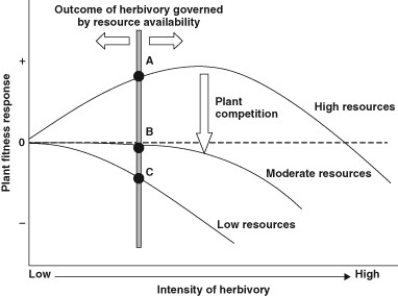 The figure proposes a combination of a top-down and bottom-up model (a hypothesis)to describe the variable effects of biological control herbivores on the fitness (growth and reproduction)of an invasive, non-native plant, spotted knapweed (Centaurea stoebe). These herbivores include multiple insects that were first studied in the plant's native home range in eastern Europe, where the plant is not dominant in grassland communities and does not pose a problem to land managers and conservationists. Many insects there were found to consume the plant's tissues, including stems, leaves, and seeds, and some were very host specific and were not found to attack plants other than C. stoebe. Several insects were subsequently transported and released in an attempt to reduce densities of this non-native and problematic weed in the United States. The y-axis shows C. stoebe plant fitness, and the x-axis represents the intensity of herbivory by the insects, from low to high. As the vertical shaded bar is moved along the x-axis, the ultimate effect of herbivory (now A, B, and C)on plant fitness can change based on its intensity and also may depend on the other factors. The horizontal dashed line represents no predicted change in fitness under the effects of varying intensity of herbivory, plant competition, and soil resources available to the plant (such as nitrogen or water), while the three solid lines represent other possible outcomes.
(D)G. Knochel and T.R. Seastedt. 2011. Reconciling contradictory findings of herbivore impacts on spotted knapweed (Centaurea stoebe)growth and reproduction. Ecological Applications 20(7):1903-1912.
What is the model's prediction for C. stoebe plant fitness when growing under high soil resource conditions?
The figure proposes a combination of a top-down and bottom-up model (a hypothesis)to describe the variable effects of biological control herbivores on the fitness (growth and reproduction)of an invasive, non-native plant, spotted knapweed (Centaurea stoebe). These herbivores include multiple insects that were first studied in the plant's native home range in eastern Europe, where the plant is not dominant in grassland communities and does not pose a problem to land managers and conservationists. Many insects there were found to consume the plant's tissues, including stems, leaves, and seeds, and some were very host specific and were not found to attack plants other than C. stoebe. Several insects were subsequently transported and released in an attempt to reduce densities of this non-native and problematic weed in the United States. The y-axis shows C. stoebe plant fitness, and the x-axis represents the intensity of herbivory by the insects, from low to high. As the vertical shaded bar is moved along the x-axis, the ultimate effect of herbivory (now A, B, and C)on plant fitness can change based on its intensity and also may depend on the other factors. The horizontal dashed line represents no predicted change in fitness under the effects of varying intensity of herbivory, plant competition, and soil resources available to the plant (such as nitrogen or water), while the three solid lines represent other possible outcomes.
(D)G. Knochel and T.R. Seastedt. 2011. Reconciling contradictory findings of herbivore impacts on spotted knapweed (Centaurea stoebe)growth and reproduction. Ecological Applications 20(7):1903-1912.
What is the model's prediction for C. stoebe plant fitness when growing under high soil resource conditions? (Multiple Choice)
4.8/5 (84)
(84) 
Filters
- Essay(0)
- Multiple Choice(0)
- Short Answer(0)
- True False(0)
- Matching(0)