



 Chat with AI
Exam 9: Cellular Respiration and Fermentation

Exam 1: Evolution, the Themes of Biology, and Scientific Inquiry51 Questions
Exam 2: The Chemical Context of Life61 Questions
Exam 3: Water and Life55 Questions
Exam 4: Carbon and the Molecular Diversity of Life58 Questions
Exam 5: The Structure and Function of Large Biological Molecules70 Questions
Exam 6: A Tour of the Cell66 Questions
Exam 7: Membrane Structure and Function68 Questions
Exam 8: An Introduction to Metabolism67 Questions
Exam 9: Cellular Respiration and Fermentation68 Questions
Exam 10: Photosynthesis65 Questions
Exam 11: Cell Communication65 Questions
Exam 12: The Cell Cycle66 Questions
Exam 13: Meiosis and Sexual Life Cycles64 Questions
Exam 14: Mendel and the Gene Idea62 Questions
Exam 15: The Chromosomal Basis of Inheritance58 Questions
Exam 16: The Molecular Basis of Inheritance65 Questions
Exam 17: Gene Expression: From Gene to Protein67 Questions
Exam 18: Regulation of Gene Expression66 Questions
Exam 19: Viruses54 Questions
Exam 20: DNA Tools and Biotechnology57 Questions
Exam 21: Genomes and Their Evolution44 Questions
Exam 22: Descent with Modification: A Darwinian View of Life60 Questions
Exam 23: The Evolution of Populations64 Questions
Exam 24: The Origin of Species67 Questions
Exam 25: The History of Life on Earth59 Questions
Exam 26: Phylogeny and the Tree of Life75 Questions
Exam 27: Bacteria and Archaea75 Questions
Exam 28: Protists79 Questions
Exam 29: Plant Diversity I: How Plants Colonized Land82 Questions
Exam 30: Plant Diversity II: The Evolution of Seed Plants80 Questions
Exam 31: Fungi75 Questions
Exam 32: An Overview of Animal Diversity67 Questions
Exam 33: An Introduction to Invertebrates83 Questions
Exam 34: The Origin and Evolution of Vertebrates82 Questions
Exam 35: Vascular Plant Structure, Growth, and Development65 Questions
Exam 36: Resource Acquisition and Transport in Vascular Plants74 Questions
Exam 37: Soil and Plant Nutrition52 Questions
Exam 38: Angiosperm Reproduction and Biotechnology60 Questions
Exam 39: Plant Responses to Internal and External Signals61 Questions
Exam 40: Basic Principles of Animal Form and Function68 Questions
Exam 41: Animal Nutrition64 Questions
Exam 42: Circulation and Gas Exchange67 Questions
Exam 43: The Immune System69 Questions
Exam 44: Osmoregulation and Excretion64 Questions
Exam 45: Hormones and the Endocrine System66 Questions
Exam 46: Animal Reproduction68 Questions
Exam 47: Animal Development70 Questions
Exam 48: Neurons, Synapses, and Signaling68 Questions
Exam 49: Nervous Systems65 Questions
Exam 50: Sensory and Motor Mechanisms67 Questions
Exam 51: Animal Behavior69 Questions
Exam 52: An Introduction to Ecology and the Biosphere68 Questions
Exam 53: Population Ecology69 Questions
Exam 54: Community Ecology71 Questions
Exam 55: Ecosystems and Restoration Ecology68 Questions
Exam 56: Conservation Biology and Global Change69 Questions
Select questions type


In liver cells, the inner mitochondrial membranes are about five times the area of the outer mitochondrial membranes. What purpose must this serve?
(Multiple Choice)
4.9/5  (73)
(73) Yeast cells that have defective mitochondria incapable of respiration will be able to grow by catabolizing which of the following carbon sources for energy?
(Multiple Choice)
4.7/5 (79)
(79) Which of the following processes generates a proton-motive force in mitochondria?
(Multiple Choice)
4.8/5 (80)
(80) Starting with one molecule of glucose, glycolysis results in the net production of which of the following sets of energy-containing products?
(Multiple Choice)
4.9/5 (83)
(83) Fatty acids usually have an even number of carbons in their structures. Catabolism of fatty acids produces two-carbon fragments that are converted to acetyl CoA molecules. What is the most likely way in which these acetyl CoA molecules would be metabolized in aerobic cellular respiration?
(Multiple Choice)
4.7/5 (93)
(93) In chemiosmosis, what is the most direct source of energy that is used to convert ADP +  ᵢ to ATP?
 (Multiple Choice)
4.7/5 (77)
(77) Following glycolysis and the citric acid cycle, but before the electron transport chain and oxidative phosphorylation, the carbon skeleton of glucose has been broken down to CO₂ with some net gain of ATP. Most of the energy from the original glucose molecule at that point in the process, however, is stored in the form of which of the following molecules?
(Multiple Choice)
4.8/5 (75)
(75) Which metabolic pathway is common to both fermentation and cellular respiration of a glucose molecule?
(Multiple Choice)
4.9/5 (88)
(88) Which kind of metabolic poison would most directly interfere with glycolysis?
(Multiple Choice)
4.8/5 (69)
(69) What kinds of cells carry out ATP synthesis by chemiosmosis?
(Multiple Choice)
4.9/5 (64)
(64) The enzyme phosphofructokinase (PFK)catalyzes a key step in glycolysis. About 10% of Springer spaniels suffer from canine PFK deficiency. Given its critical role in glycolysis, which of the following conditions would be a likely consequence for dogs afflicted with this disorder?
(Multiple Choice)
4.8/5 (86)
(86) Which of the following statements describes a primary function of both alcohol fermentation and lactic acid fermentation?
(Multiple Choice)
4.8/5 (86)
(86) Water is one of the end products of aerobic respiration. What is the source of the oxygen atom used in formation of the water?
(Multiple Choice)
4.7/5 (84)
(84) When a molecule of NAD⁺ (nicotinamide adenine dinucleotide)gains a hydrogen atom (not a proton), the molecule becomes ________.
(Multiple Choice)
4.8/5 (75)
(75) What is the oxidizing agent in the following reaction?
Pyruvate + NADH + H⁺ → Lactate + NAD⁺
(Multiple Choice)
4.9/5 (86)
(86) During which of the following metabolic processes is most of the CO₂ from the catabolism of glucose is released?
(Multiple Choice)
4.8/5 (75)
(75) Use the following information to answer the question below.
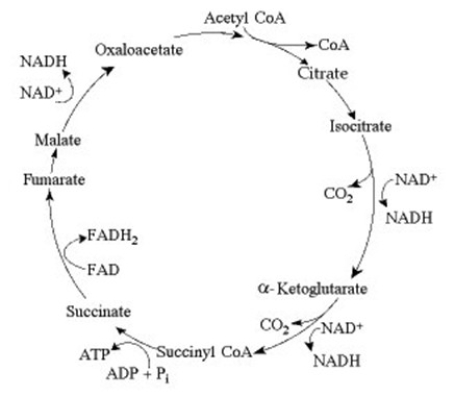 The citric acid cycle.
If you were to add one of the eight citric acid cycle intermediates to the culture medium of yeast growing in the laboratory, what do you think would happen to the rates of ATP and carbon dioxide production?
The citric acid cycle.
If you were to add one of the eight citric acid cycle intermediates to the culture medium of yeast growing in the laboratory, what do you think would happen to the rates of ATP and carbon dioxide production? (Multiple Choice)
4.7/5 (81)
(81) If glucose is the sole energy source, what fraction of the carbon dioxide exhaled by animals is generated only by the reactions involved in oxidation of pyruvate to acetyl CoA?
(Multiple Choice)
4.9/5 (77)
(77) Use the following information to answer the question below.
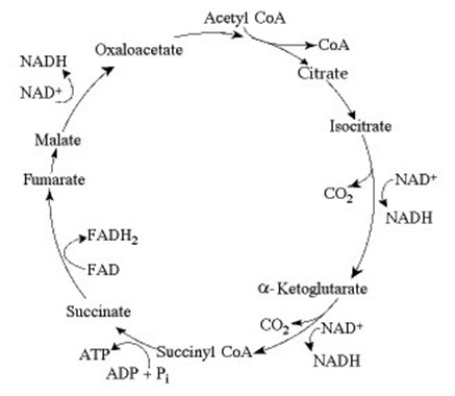 The citric acid cycle.
If pyruvate oxidation is blocked, what will happen to the levels of oxaloacetate and citric acid in the citric acid cycle shown in the accompanying figure?
The citric acid cycle.
If pyruvate oxidation is blocked, what will happen to the levels of oxaloacetate and citric acid in the citric acid cycle shown in the accompanying figure? (Multiple Choice)
4.8/5 (76)
(76) In the absence of oxygen, yeast cells can obtain energy by fermentation, which results in the production of which of the following sets of molecules?
(Multiple Choice)
4.9/5 (76)
(76) 
Filters
- Essay(0)
- Multiple Choice(0)
- Short Answer(0)
- True False(0)
- Matching(0)