



 Chat with AI
Exam 6: Work and Kinetic Energy

Exam 2: Motion Along a Straight Line55 Questions
Exam 3: Motion in Two or Three Dimensions59 Questions
Exam 4: Newtons Laws of Motion50 Questions
Exam 5: Applying Newtons Laws139 Questions
Exam 6: Work and Kinetic Energy109 Questions
Exam 7: Potential Energy and Energy Conservation50 Questions
Exam 8: Momentum, Impulse, and Collisions99 Questions
Exam 9: Rotation of Rigid Bodies26 Questions
Exam 10: Dynamics of Rotational Motion49 Questions
Exam 11: Equilibrium and Elasticity50 Questions
Exam 12: Fluid Mechanics54 Questions
Exam 13: Gravitation52 Questions
Exam 14: Periodic Motion109 Questions
Exam 15: Mechanical Waves50 Questions
Exam 16: Sound and Hearing121 Questions
Exam 17: Temperature and Heat60 Questions
Exam 18: Thermal Properties of Matter41 Questions
Exam 19: The First Law of Thermodynamics55 Questions
Exam 20: The Second Law of Thermodynamics52 Questions
Exam 21: Electric Charge and Electric Field54 Questions
Exam 22: Gausss Law54 Questions
Exam 23: Electric Potential88 Questions
Exam 24: Capacitance and Dielectrics70 Questions
Exam 25: Current, Resistance, and Electromotive Force44 Questions
Exam 26: Direct-Current Circuits51 Questions
Exam 27: Magnetic Field and Magnetic Forces105 Questions
Exam 28: Sources of Magnetic Field82 Questions
Exam 29: Electromagnetic Induction51 Questions
Exam 30: Inductance88 Questions
Exam 31: Alternating Current51 Questions
Exam 32: Electromagnetic Waves Optics53 Questions
Exam 33: The Nature and Propagation of Light31 Questions
Exam 34: Geometric Optics89 Questions
Exam 35: Interference59 Questions
Select questions type


Force and potential energy: A potential energy function is given by U(x) = (3.00 N/m)x - (1.00 N/m3)x3. At what position or positions is the force equal to zero?
(Multiple Choice)
4.8/5  (92)
(92) Work: In the figure, a constant external force P = 160 N is applied to a 20.0-kg box, which is on a rough horizontal surface. While the force pushes the box a distance of 8.00 m, the speed changes from 0.500 m/s to 2.60 m/s. The work done by friction during this process is closest to 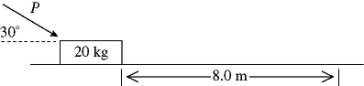
(Multiple Choice)
4.8/5 (76)
(76) Force and potential energy: A potential energy function is given by U(x) = (3.00 J/m)x + (1.00 J/m3)x3. What is the force function F(x) that is associated with this potential energy function?
(Short Answer)
4.7/5 (65)
(65) Hooke's law: Which of the graphs in the figure represents a spring that gets less stiff the more it is stretched? 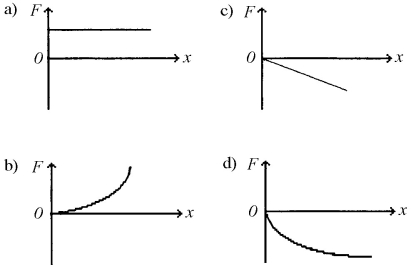
(Multiple Choice)
4.8/5 (89)
(89) Kinetic energy: The coefficient of the restitution of an object is defined as the ratio of its outgoing to incoming speed when the object collides with a rigid surface. For an object with a coefficient of 0.78, what fraction of the object's kinetic energy is lost during a single collision?
(Multiple Choice)
4.8/5 (85)
(85) Work-energy theorem: Two objects, one of mass m and the other of mass 2m, are dropped from the top of a building. When they hit the ground
(Multiple Choice)
4.9/5 (68)
(68) Force and potential energy: The only force acting on an object moving along the x-axis is the conservative force given by F(x) = (2.00 N/m)x + (1.00 N/m3)x3.
(a) What is the change in potential energy when the object moves from x = 1.00 m to x = 2.00 m?
(b) What is the change in kinetic energy when the object moves from x = 1.00 m to x = 2.00 m?
(Essay)
4.9/5 (74)
(74) Energy conservation with conservative forces: In the figure, a stunt car driver negotiates the frictionless track shown in such a way that the car is barely in contact with the track at the top of the loop. The radius of the track is 9.9 m and the mass of the car is 1800 kg. Find the magnitude of the force of the car on the track when the car is at point A. You can treat the car as a point mass. 
(Short Answer)
4.7/5 (90)
(90) Force and potential energy: A force on an object is given by F(x) = (-4.00 N/m)x + ( 2.00 N/m3)x3. What is the change in potential energy in moving from x = 1.00 m to x = 2.00 m?
(Multiple Choice)
4.8/5 (70)
(70) 
Filters
- Essay(0)
- Multiple Choice(0)
- Short Answer(0)
- True False(0)
- Matching(0)