



 Chat with AI
Exam 31: Alternating Current

Exam 2: Motion Along a Straight Line55 Questions
Exam 3: Motion in Two or Three Dimensions59 Questions
Exam 4: Newtons Laws of Motion50 Questions
Exam 5: Applying Newtons Laws139 Questions
Exam 6: Work and Kinetic Energy109 Questions
Exam 7: Potential Energy and Energy Conservation50 Questions
Exam 8: Momentum, Impulse, and Collisions99 Questions
Exam 9: Rotation of Rigid Bodies26 Questions
Exam 10: Dynamics of Rotational Motion49 Questions
Exam 11: Equilibrium and Elasticity50 Questions
Exam 12: Fluid Mechanics54 Questions
Exam 13: Gravitation52 Questions
Exam 14: Periodic Motion109 Questions
Exam 15: Mechanical Waves50 Questions
Exam 16: Sound and Hearing121 Questions
Exam 17: Temperature and Heat60 Questions
Exam 18: Thermal Properties of Matter41 Questions
Exam 19: The First Law of Thermodynamics55 Questions
Exam 20: The Second Law of Thermodynamics52 Questions
Exam 21: Electric Charge and Electric Field54 Questions
Exam 22: Gausss Law54 Questions
Exam 23: Electric Potential88 Questions
Exam 24: Capacitance and Dielectrics70 Questions
Exam 25: Current, Resistance, and Electromotive Force44 Questions
Exam 26: Direct-Current Circuits51 Questions
Exam 27: Magnetic Field and Magnetic Forces105 Questions
Exam 28: Sources of Magnetic Field82 Questions
Exam 29: Electromagnetic Induction51 Questions
Exam 30: Inductance88 Questions
Exam 31: Alternating Current51 Questions
Exam 32: Electromagnetic Waves Optics53 Questions
Exam 33: The Nature and Propagation of Light31 Questions
Exam 34: Geometric Optics89 Questions
Exam 35: Interference59 Questions
Select questions type


Probability: The square of the wave function of a particle, |ψ(x)|2, gives the probability of finding the particle at the point x.

Free
(True/False)
4.8/5  (88)
(88) Correct Answer: Verified
False
Particle in a box: One fairly crude method of determining the size of a molecule is to treat the molecule as an infinite square well (a box) with an electron trapped inside, and to measure the wavelengths of emitted photons. If the photon emitted during the n = 2 to n = 1 transition has wavelength 1940 nm, what is the width of the molecule? (c = 3.00 × 10⁸ m/s, h = 6.626 × 10⁻³⁴ J ∙ s, mel = 9.11 × 10⁻³¹ kg)
Free
(Multiple Choice)
4.8/5 (92)
(92) Correct Answer:Verified
VerifiedA
Harmonic oscillator: A lithium atom, mass 1.17 × 10⁻²⁶ kg, vibrates with simple harmonic motion in a crystal lattice, where the effective force constant of the forces on the atom is k =  (c = 3.00 × 10⁸ m/s, h = 6.626 × 10⁻³⁴ J ∙ s, ħ = 1.055 × 10⁻³⁴ J ∙ s, 1 eV = 1.60 × 10⁻¹⁹ J)
(a) What is the ground state energy of this system, in eV?
(b) What is the wavelength of the photon that could excite this system from the ground state to the first excited state?
(c = 3.00 × 10⁸ m/s, h = 6.626 × 10⁻³⁴ J ∙ s, ħ = 1.055 × 10⁻³⁴ J ∙ s, 1 eV = 1.60 × 10⁻¹⁹ J)
(a) What is the ground state energy of this system, in eV?
(b) What is the wavelength of the photon that could excite this system from the ground state to the first excited state?Free
(Essay)
4.9/5 (85)
(85) Correct Answer:Verified
Verified(a) 2.14 × 10⁻² eV
(b) 2.91 × 10⁻⁵ m
Tunneling: A 3.10-eV electron is incident on a 0.40-nm barrier that is 5.67 eV high. What is the probability that this electron will tunnel through the barrier? (1 eV = 1.60 × 10⁻¹⁹ J, mel = 9.11 × 10⁻³¹ kg, ħ = 1.055 × 10⁻³⁴ J ∙ s, h = 6.626 × 10⁻³⁴ J ∙ s)
(Multiple Choice)
4.9/5 (82)
(82) Particle in a box: An electron in an infinite potential well (a box) makes a transition from the n = 3 level to the ground state and in so doing emits a photon of wavelength 20.9 nm. (c = 3.00 × 10⁸ m/s, h = 6.626 × 10⁻³⁴ J ∙ s, mel = 9.11 × 10⁻³¹ kg)
(a) What is the width of this well?
(b) What wavelength photon would be required to excite the electron from its original level to the next higher one?
(Essay)
4.7/5 (70)
(70) Particle in a box: The lowest energy level of a particle confined to a one-dimensional region of space (a box, or infinite well) with fixed length L is E0. If an identical particle is confined to a similar region with fixed length L/ 6, what is the energy of the lowest energy level that the particles have in common? Express your answer in terms of E0.
(Short Answer)
5.0/5 (70)
(70) Particle in a box: A particle trapped in a one-dimensional finite potential well with U0 = 0 in the region 0 < x < L, and finite U0 everywhere else, has a ground state wavenumber, k. The ground state wavenumber for the same particle in an infinite one-dimensional potential well of width L, would be
(Multiple Choice)
4.9/5 (96)
(96) Three dimensional potential well: Model a hydrogen atom as a three-dimensional potential well with U0 = 0 in the region 0 < x < L, 0 < y < L, and 0 < z < L, and infinite otherwise, with L = 1.0 × 10⁻¹⁰ m. Which of the following is NOT one of the lowest three energy levels of an electron in this model?
(Multiple Choice)
4.9/5 (88)
(88) Quantum enganglement: Two entangled fermions each have equal probabilities of being in one of two states (state 1 or state 2). The fermions are separated so that no forces act between them. One of the fermions is then studied and found to be in state 1. What is the probability that, when studied, the second particle will also be found in state 1?
(Multiple Choice)
4.7/5 (71)
(71) Harmonic oscillator: The energy of a particle in the second EXCITED state of a harmonic oscillator potential is  What is the classical angular frequency of oscillation of this particle? (1 eV = 1.60 × 10⁻¹⁹ J, ħ = 1.055 × 10⁻³⁴ J ∙ s, h = 6.626 × 10⁻³⁴ J ∙ s)
 (Multiple Choice)
4.8/5 (90)
(90) Tunneling: The energy of a proton is 1.0 MeV below the top of a 1.2-MeV-high energy barrier that is 6.8 fm wide. What is the probability that the proton will tunnel through the barrier? (1 eV = 1.60 × 10⁻¹⁹ J, mproton = 1.67 × 10⁻²⁷ kg, ħ = 1.055 × 10⁻³⁴ J ∙ s, h = 6.626 × 10⁻³⁴ J ∙ s)
(Multiple Choice)
4.8/5 (77)
(77) Tunneling: An 80-eV electron impinges upon a potential barrier 100 eV high and 0.20 nm thick. What is the probability the electron will tunnel through the barrier? (1 eV = 1.60 × 10⁻¹⁹ J, mproton = 1.67 × 10⁻²⁷ kg, ħ = 1.055 × 10⁻³⁴ J ∙ s, h = 6.626 × 10⁻³⁴ J ∙ s)
(Multiple Choice)
4.9/5 (88)
(88) Particle in a box: A one-dimensional finite potential well has potential energy U0 = 0 in the region 0 < x < 0.2 nm, and U0 = 15 eV everywhere else. A particle with which of the energies listed below would be localized (trapped) within the potential well? (Select all correct answers.)
(Multiple Choice)
4.7/5 (69)
(69) Harmonic oscillator: Find the wavelength of the photon emitted during the transition from the second EXCITED state to the ground state in a harmonic oscillator with a classical frequency of 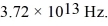 (c = 3.00 × 10⁸ m/s, 1 eV = 1.60 × 10⁻¹⁹ J, ħ = 1.055 × 10⁻³⁴ J ∙ s, h = 6.626 × 10⁻³⁴ J ∙ s)
 (Multiple Choice)
4.8/5 (90)
(90) Harmonic oscillator: The lowest energy level of a certain quantum harmonic oscillator is 5.00 eV. What is the energy of the next higher level?
(Multiple Choice)
4.9/5 (86)
(86) Particle in a box: An electron is trapped in an infinite square well (a box) of width  Find the wavelength of photons emitted when the electron drops from the n = 5 state to the n = 1 state in this system. (c = 3.00 × 10⁸ m/s, h = 6.626 × 10⁻³⁴ J ∙ s, mel = 9.11 × 10⁻³¹ kg)
 (Multiple Choice)
4.8/5 (72)
(72) Particle in a box: An electron is in an infinite square well (a box) that is 2.0 nm wide. The electron makes a transition from the  to the
 state, what is the wavelength of the emitted photon? (h = 6.626 × 10⁻³⁴ J ∙ s, mel = 9.11 × 10⁻³¹ kg, 1 eV = 1.60 × 10⁻¹⁹ J)
to the state, what is the wavelength of the emitted photon? (h = 6.626 × 10⁻³⁴ J ∙ s, mel = 9.11 × 10⁻³¹ kg, 1 eV = 1.60 × 10⁻¹⁹ J) (Multiple Choice)
4.8/5 (77)
(77) Particle in a box: You want to confine an electron in a box (an infinite well) so that its ground state energy is 5.0 × 10⁻¹⁸ J. What should be the length of the box? (h = 6.626 × 10⁻³⁴ J ∙ s, mel = 9.11 × 10⁻³¹ kg)
(Multiple Choice)
4.9/5 (77)
(77) Normalization: A set of five possible wave functions is given below, where L is a positive real number. ψ1(x) = Ae-x, for all x ψ2(x) = A cos x, for all x
Ψ3(x) = 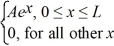 ψ4(x) =
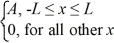 ψ5(x) =
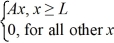 Which of the five possible wave functions are normalizable? (There may be more than one correct choice.)
ψ4(x) = ψ5(x) = Which of the five possible wave functions are normalizable? (There may be more than one correct choice.) (Multiple Choice)
4.8/5 (78)
(78) Particle in a box: An electron is in the ground state of an infinite well (a box) where its energy is 5.00 eV. In the next higher level, what would its energy be? (1 eV = 1.60 × 10⁻¹⁹ J)
(Multiple Choice)
4.7/5 (76)
(76) 
Filters
- Essay(0)
- Multiple Choice(0)
- Short Answer(0)
- True False(0)
- Matching(0)