



 Chat with AI
Exam 31: Alternating Current

Exam 2: Motion Along a Straight Line55 Questions
Exam 3: Motion in Two or Three Dimensions59 Questions
Exam 4: Newtons Laws of Motion50 Questions
Exam 5: Applying Newtons Laws139 Questions
Exam 6: Work and Kinetic Energy109 Questions
Exam 7: Potential Energy and Energy Conservation50 Questions
Exam 8: Momentum, Impulse, and Collisions99 Questions
Exam 9: Rotation of Rigid Bodies26 Questions
Exam 10: Dynamics of Rotational Motion49 Questions
Exam 11: Equilibrium and Elasticity50 Questions
Exam 12: Fluid Mechanics54 Questions
Exam 13: Gravitation52 Questions
Exam 14: Periodic Motion109 Questions
Exam 15: Mechanical Waves50 Questions
Exam 16: Sound and Hearing121 Questions
Exam 17: Temperature and Heat60 Questions
Exam 18: Thermal Properties of Matter41 Questions
Exam 19: The First Law of Thermodynamics55 Questions
Exam 20: The Second Law of Thermodynamics52 Questions
Exam 21: Electric Charge and Electric Field54 Questions
Exam 22: Gausss Law54 Questions
Exam 23: Electric Potential88 Questions
Exam 24: Capacitance and Dielectrics70 Questions
Exam 25: Current, Resistance, and Electromotive Force44 Questions
Exam 26: Direct-Current Circuits51 Questions
Exam 27: Magnetic Field and Magnetic Forces105 Questions
Exam 28: Sources of Magnetic Field82 Questions
Exam 29: Electromagnetic Induction51 Questions
Exam 30: Inductance88 Questions
Exam 31: Alternating Current51 Questions
Exam 32: Electromagnetic Waves Optics53 Questions
Exam 33: The Nature and Propagation of Light31 Questions
Exam 34: Geometric Optics89 Questions
Exam 35: Interference59 Questions
Select questions type


Particle in a box: An electron is confined in a one-dimensional box (an infinite well). Two adjacent allowed energies of the electron are 1.068 × 10⁻¹⁸ J and 1.352 × 10⁻¹⁸ J. What is the length of the box? (h = 6.626 × 10⁻³⁴ J ∙ s, mel = 9.11 × 10⁻³¹ kg)
(Multiple Choice)
4.7/5  (67)
(67) Particle in a box: The wave function of an electron in a rigid box (infinite well) is shown in the figure. If the electron energy 98.0 eV, what is the energy of the electron's ground state? ( mel = 9.11 × 10⁻³¹ kg) 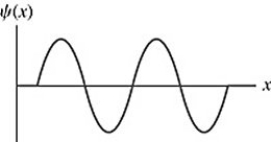
(Multiple Choice)
4.9/5 (91)
(91) Particle in a box: You want to have an electron in an energy level where its speed is no more than 66 m/s. What is the length of the smallest box (an infinite well) in which you can do this? (h = 6.626 × 10⁻³⁴ J ∙ s, mel = 9.11 × 10⁻³¹ kg)
(Multiple Choice)
4.8/5 (91)
(91) Tunneling: An 80-eV electron impinges upon a potential barrier 100 eV high and 0.20 nm thick. What is the probability the electron will tunnel through the barrier? (1 eV = 1.60 × 10⁻¹⁹ J, mproton = 1.67 × 10⁻²⁷ kg, ħ = 1.055 × 10⁻³⁴ J ∙ s, h = 6.626 × 10⁻³⁴ J ∙ s)
(Multiple Choice)
4.8/5 (81)
(81) Harmonic oscillator: Calculate the ground state energy of a harmonic oscillator with a classical frequency of 3.68 × 10¹⁵ Hz. (1 eV = 1.60 × 10⁻¹⁹ J, ħ = 1.055 × 10⁻³⁴ J ∙ s, h = 6.626 × 10⁻³⁴ J ∙ s)
(Multiple Choice)
4.9/5 (91)
(91) Particle in a box: An electron is in an infinite square well (a box) that is 8.9 nm wide. What is the ground state energy of the electron? (h = 6.626 × 10⁻³⁴ J ∙ s, mel = 9.11 × 10⁻³¹ kg, 1 eV = 1.60 × 10⁻¹⁹ J)
(Multiple Choice)
4.8/5 (83)
(83) Normalization: The wave function for a particle must be normalizable because
(Multiple Choice)
4.7/5 (68)
(68) Tunneling: An electron with kinetic energy 2.80 eV encounters a potential barrier of height 4.70 eV. If the barrier width is 0.40 nm, what is the probability that the electron will tunnel through the barrier? (1 eV = 1.60 × 10⁻¹⁹ J, mel = 9.11 × 10⁻³¹ kg, ħ = 1.055 × 10⁻³⁴ J ∙ s, h = 6.626 × 10⁻³⁴ J ∙ s)
(Multiple Choice)
4.8/5 (90)
(90) Harmonic oscillator: An electron is confined in a harmonic oscillator potential well. A photon is emitted when the electron undergoes a 3→1 quantum jump. What is the wavelength of the emission if the net force on the electron behaves as though it has a spring constant of  (mel = 9.11 × 10⁻³¹ kg, c = 3.00 × 10⁸ m/s, 1 eV = 1.60 × 10⁻¹⁹ J, ħ = 1.055 × 10⁻³⁴ J ∙ s, h = 6.626 × 10⁻³⁴ J ∙ s)
 (Multiple Choice)
4.9/5 (71)
(71) Particle in a box: The smallest kinetic energy that an electron in a box (an infinite well) can have is zero.
(True/False)
4.8/5 (87)
(87) Normalization: Find the value of A to normalize the wave function ψ(x) = 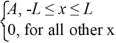
(Multiple Choice)
4.8/5 (71)
(71) 
Filters
- Essay(0)
- Multiple Choice(0)
- Short Answer(0)
- True False(0)
- Matching(0)