



 Chat with AI
Exam 31: Alternating Current

Exam 2: Motion Along a Straight Line55 Questions
Exam 3: Motion in Two or Three Dimensions59 Questions
Exam 4: Newtons Laws of Motion50 Questions
Exam 5: Applying Newtons Laws139 Questions
Exam 6: Work and Kinetic Energy109 Questions
Exam 7: Potential Energy and Energy Conservation50 Questions
Exam 8: Momentum, Impulse, and Collisions99 Questions
Exam 9: Rotation of Rigid Bodies26 Questions
Exam 10: Dynamics of Rotational Motion49 Questions
Exam 11: Equilibrium and Elasticity50 Questions
Exam 12: Fluid Mechanics54 Questions
Exam 13: Gravitation52 Questions
Exam 14: Periodic Motion109 Questions
Exam 15: Mechanical Waves50 Questions
Exam 16: Sound and Hearing121 Questions
Exam 17: Temperature and Heat60 Questions
Exam 18: Thermal Properties of Matter41 Questions
Exam 19: The First Law of Thermodynamics55 Questions
Exam 20: The Second Law of Thermodynamics52 Questions
Exam 21: Electric Charge and Electric Field54 Questions
Exam 22: Gausss Law54 Questions
Exam 23: Electric Potential88 Questions
Exam 24: Capacitance and Dielectrics70 Questions
Exam 25: Current, Resistance, and Electromotive Force44 Questions
Exam 26: Direct-Current Circuits51 Questions
Exam 27: Magnetic Field and Magnetic Forces105 Questions
Exam 28: Sources of Magnetic Field82 Questions
Exam 29: Electromagnetic Induction51 Questions
Exam 30: Inductance88 Questions
Exam 31: Alternating Current51 Questions
Exam 32: Electromagnetic Waves Optics53 Questions
Exam 33: The Nature and Propagation of Light31 Questions
Exam 34: Geometric Optics89 Questions
Exam 35: Interference59 Questions
Select questions type


Probability: The probability density for an electron that has passed through an experimental apparatus is shown in the figure. If 4100 electrons pass through the apparatus, what is the expected number that will land in a 0.10 mm-wide strip centered at x = 0.00 mm? 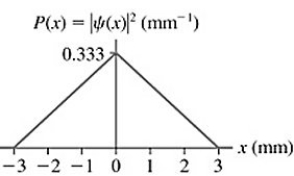
(Multiple Choice)
4.9/5  (73)
(73) Three dimensional potential well: A three-dimensional potential well has potential U0 = 0 in the region 0 < x < L, 0 < y < L, and 0 < z < L and infinite potential otherwise. The ground state energy of a particle in the well is E0. What is the energy of the first excited state, and what is the degeneracy of that state?
(Multiple Choice)
4.9/5 (93)
(93) Harmonic oscillator: An electron is confined in a harmonic oscillator potential well. What is the longest wavelength of light that the electron can absorb if the net force on the electron behaves as though it has a spring constant of 74 N/m? (mel = 9.11 × 10⁻³¹ kg, c = 3.00 × 10⁸ m/s, 1 eV = 1.60 × 10⁻¹⁹ J, ħ = 1.055 × 10⁻³⁴ J ∙ s, h = 6.626 × 10⁻³⁴ J ∙ s)
(Multiple Choice)
4.8/5 (78)
(78) Particle in a box: An electron is in an infinite square well that is 2.6 nm wide. What is the smallest value of the state quantum number n for which the energy level exceeds 100 eV? (h = 6.626 × 10⁻³⁴ J ∙ s, mel = 9.11 × 10⁻³¹ kg, 1 eV = 1.60 × 10⁻¹⁹ J)
(Multiple Choice)
5.0/5 (77)
(77) Normalization: The wave function for an electron that is confined to x ≥ 0 nm is
ψ(x) = 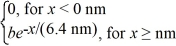 a) What must be the value of b?
(b) What is the probability of finding the electron in a 0.010 nm-wide region centered at x = 1.0 nm?
a) What must be the value of b?
(b) What is the probability of finding the electron in a 0.010 nm-wide region centered at x = 1.0 nm? (Essay)
4.9/5 (86)
(86) Normalization: The wave function for an electron that is confined to x ≥ 0 nm is
ψ(x) = 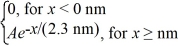 (a) What must be the value of A?
(b) What is the probability of finding the electron in the interval 1.15 nm ≤ x ≤ 1.84 nm?
(a) What must be the value of A?
(b) What is the probability of finding the electron in the interval 1.15 nm ≤ x ≤ 1.84 nm? (Essay)
4.9/5 (72)
(72) Particle in a box: A 10.0-g bouncy ball is confined in a 8.3-cm-long box (an infinite well). If we model the ball as a point particle, what is the minimum kinetic energy of the ball? (h = 6.626 × 10⁻³⁴ J ∙ s)
(Multiple Choice)
4.9/5 (73)
(73) Particle in a box: A particle is confined to a one-dimensional box (an infinite well) on the x-axis between x = 0 and x = L. The potential height of the walls of the box is infinite. The normalized wave function of the particle, which is in the ground state, is given by ψ(x) =  sin
 , with 0 ≤ x ≤ L. What is the maximum probability per unit length of finding the particle?
sin , with 0 ≤ x ≤ L. What is the maximum probability per unit length of finding the particle? (Multiple Choice)
4.8/5 (85)
(85) Particle in a box: The ground state energy of a particle in a one-dimensional infinite potential well of width 1.5 nm is 20 eV. The ground state energy of the same particle in a one-dimensional finite potential well with U0 = 0 in the region 0 < x < 1.5 nm, and U0 = 50 eV everywhere else, would be
(Multiple Choice)
4.9/5 (91)
(91) Tunneling: An electron with kinetic energy 2.80 eV encounters a potential barrier of height 4.70 eV. If the barrier width is 0.40 nm, what is the probability that the electron will tunnel through the barrier? (1 eV = 1.60 × 10⁻¹⁹ J, mel = 9.11 × 10⁻³¹ kg, h = 6.626 × 10⁻³⁴ J ∙ s)
(Multiple Choice)
4.7/5 (76)
(76) Harmonic oscillator: The atoms in a nickel crystal vibrate as harmonic oscillators with an angular frequency of 2.3 × 10¹³ rad/s. The mass of a nickel atom is 9.75 × 10⁻²⁶ kg. What is the difference in energy between adjacent vibrational energy levels of nickel? (h = 6.626 × 10⁻³⁴ J ∙ s, ħ = 1.055 × 10⁻³⁴ J ∙ s, 1 eV = 1.60 × 10⁻¹⁹ J)
(Multiple Choice)
4.8/5 (69)
(69) Particle in a box: A particle is confined to a one-dimensional box (an infinite well) on the x-axis between x = 0 and x = L. The potential height of the walls of the box is infinite. The normalized wave function of the particle, which is in the ground state, is given by ψ(x) =  sin
 , with 0 ≤ x ≤ L. What is the probability of finding the particle between x = 0 and x = L/3?
sin , with 0 ≤ x ≤ L. What is the probability of finding the particle between x = 0 and x = L/3? (Multiple Choice)
4.8/5 (77)
(77) Tunneling: The energy of a proton is 1.0 MeV below the top of a 6.8-fm-wide energy barrier. What is the probability that the proton will tunnel through the barrier? (1 eV = 1.60 × 10⁻¹⁹ J, mproton = 1.67 × 10⁻²⁷ kg, ħ = 1.055 × 10⁻³⁴ J ∙ s, h = 6.626 × 10⁻³⁴ J ∙ s)
(Multiple Choice)
4.8/5 (66)
(66) Particle in a box: An electron is bound in an infinite square-well potential (a box) on the x-axis. The width of the well is L and the well extends from x = 0.00 nm to  In its present state, the normalized wave function of the electron is given by: ψ(x) =
 sin (2πx/L). What is the energy of the electron in this state? (h = 6.626 × 10⁻³⁴ J ∙ s, mel = 9.11 × 10⁻³¹ kg, 1 eV = 1.60 × 10⁻¹⁹ J)
In its present state, the normalized wave function of the electron is given by: ψ(x) =
sin (2πx/L). What is the energy of the electron in this state? (h = 6.626 × 10⁻³⁴ J ∙ s, mel = 9.11 × 10⁻³¹ kg, 1 eV = 1.60 × 10⁻¹⁹ J) (Multiple Choice)
4.7/5 (76)
(76) Particle in a box: An electron is bound in an infinite well (a box) of width 0.10 nm. If the electron is initially in the n = 8 state and falls to the n = 7 state, find the wavelength of the emitted photon. (c = 3.00 × 10⁸ m/s, h = 6.626 × 10⁻³⁴ J ∙ s, mel = 9.11 × 10⁻³¹ kg)
(Short Answer)
5.0/5 (75)
(75) Harmonic oscillator: If an atom in a crystal is acted upon by a restoring force that is directly proportional to the distance of the atom from its equilibrium position in the crystal, then it is impossible for the atom to have zero kinetic energy.
(True/False)
5.0/5 (75)
(75) Particle in a box: A particle confined in a rigid one-dimensional box (an infinite well) of length 17.0 fm has an energy level 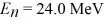 and an adjacent energy level En+1 = 37.5 MeV. What is the value of the ground state energy? (1 eV = 1.60 × 10⁻¹⁹ J)
 (Multiple Choice)
4.7/5 (81)
(81) Three dimensional potential well: A three-dimensional potential well has potential U0 = 0 in the region 0 < x < L, 0 < y < L, and 0 < z < 2L and infinite potential otherwise. The ground state energy of a particle in the well is E0. What is the energy of the first excited state, and what is the degeneracy of that state?
(Multiple Choice)
4.9/5 (61)
(61) Normalization: Find the value of A to normalize the wave function ψ(x) = 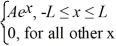
(Multiple Choice)
4.8/5 (88)
(88) Tunneling: A 3.10-eV electron is incident on a 0.40-nm barrier that is 5.67 eV high. What is the probability that this electron will tunnel through the barrier? (1 eV = 1.60 × 10⁻¹⁹ J, mel = 9.11 × 10⁻³¹ kg, ħ = 1.055 × 10⁻³⁴ J ∙ s, h = 6.626 × 10⁻³⁴ J ∙ s)
(Multiple Choice)
4.7/5 (84)
(84) 
Filters
- Essay(0)
- Multiple Choice(0)
- Short Answer(0)
- True False(0)
- Matching(0)