



 Chat with AI
Exam 6: Work and Kinetic Energy

Exam 2: Motion Along a Straight Line55 Questions
Exam 3: Motion in Two or Three Dimensions59 Questions
Exam 4: Newtons Laws of Motion50 Questions
Exam 5: Applying Newtons Laws139 Questions
Exam 6: Work and Kinetic Energy109 Questions
Exam 7: Potential Energy and Energy Conservation50 Questions
Exam 8: Momentum, Impulse, and Collisions99 Questions
Exam 9: Rotation of Rigid Bodies26 Questions
Exam 10: Dynamics of Rotational Motion49 Questions
Exam 11: Equilibrium and Elasticity50 Questions
Exam 12: Fluid Mechanics54 Questions
Exam 13: Gravitation52 Questions
Exam 14: Periodic Motion109 Questions
Exam 15: Mechanical Waves50 Questions
Exam 16: Sound and Hearing121 Questions
Exam 17: Temperature and Heat60 Questions
Exam 18: Thermal Properties of Matter41 Questions
Exam 19: The First Law of Thermodynamics55 Questions
Exam 20: The Second Law of Thermodynamics52 Questions
Exam 21: Electric Charge and Electric Field54 Questions
Exam 22: Gausss Law54 Questions
Exam 23: Electric Potential88 Questions
Exam 24: Capacitance and Dielectrics70 Questions
Exam 25: Current, Resistance, and Electromotive Force44 Questions
Exam 26: Direct-Current Circuits51 Questions
Exam 27: Magnetic Field and Magnetic Forces105 Questions
Exam 28: Sources of Magnetic Field82 Questions
Exam 29: Electromagnetic Induction51 Questions
Exam 30: Inductance88 Questions
Exam 31: Alternating Current51 Questions
Exam 32: Electromagnetic Waves Optics53 Questions
Exam 33: The Nature and Propagation of Light31 Questions
Exam 34: Geometric Optics89 Questions
Exam 35: Interference59 Questions
Select questions type


Energy conservation with conservative forces: A projectile is fired from ground level at an angle of 40.0° above horizontal at a speed of 30.0 m/s. What is the speed of the projectile when it has reached a height equal to 50.0% of its maximum height?
(Multiple Choice)
4.8/5  (83)
(83) Kinetic energy: How much energy is needed to change the speed of a 1600 kg sport utility vehicle from 15.0 m/s to 40.0 m/s?
(Multiple Choice)
4.8/5 (79)
(79) Energy conservation with conservative forces: A 2.0 g bead slides along a frictionless wire, as shown in the figure. At point A, the bead is moving to the right but with negligible speed.  (a) What is the potential energy of the bead at point A?
(b) What is the kinetic energy of the bead at point B?
(c) What is the speed of the bead at point B?
(d) What is the speed of the bead at point C?
(a) What is the potential energy of the bead at point A?
(b) What is the kinetic energy of the bead at point B?
(c) What is the speed of the bead at point B?
(d) What is the speed of the bead at point C? (Essay)
4.9/5 (85)
(85) Hooke's law: Consider a plot of the displacement (x) as a function of the applied force (F) for an ideal elastic spring. The slope of the curve would be
(Multiple Choice)
4.9/5 (78)
(78) Hooke's law: In the figure, two identical ideal massless springs have unstretched lengths of 0.25 m and spring constants of 700 N/m. The springs are attached to a small cube and stretched to a length L of 0.30 m as in Figure A. An external force P pulls the cube a distance D = 0.020 m to the right and holds it there. (See Figure B.) The external force P, that holds the cube in place in Figure B, is closest to 
(Multiple Choice)
4.9/5 (71)
(71) Work: An airplane flies 120 km at a constant altitude in a direction 30.0° north of east. A wind is blowing that results in a net horizontal force on the plane due to the air of 2.40 kN in a direction 10.0° south of west. How much work is done on the plane by the air?
(Multiple Choice)
4.9/5 (83)
(83) Energy conservation with conservative forces: A small hockey puck slides without friction over the icy hill shown in the figure and lands 6.20 m from the foot of the cliff with no air resistance. What was its speed v0 at the bottom of the hill? 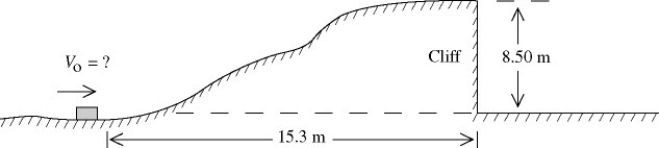
(Multiple Choice)
4.8/5 (77)
(77) Energy conservation with conservative forces: Two stones, one of mass m and the other of mass 2m, are thrown directly upward with the same velocity at the same time from ground level and feel no air resistance. Which statement about these stones is true?
(Multiple Choice)
4.7/5 (77)
(77) Energy conservation with conservative forces: A 60.0-kg person drops from rest a distance of 1.20 m to a platform of negligible mass supported by an ideal stiff spring of negligible mass. The platform drops 6.00 cm before the person comes to rest. What is the spring constant of the spring?
(Multiple Choice)
4.8/5 (83)
(83) Work done by variable forces: A person pushes horizontally on a heavy box and slides it across the level floor at constant velocity. The person pushes with a 60.0 N force for the first  at which time he begins to tire. The force he exerts then starts to decrease linearly from 60.0 N to 0.00 N across the remaining
 How much total work did the person do on the box?
at which time he begins to tire. The force he exerts then starts to decrease linearly from 60.0 N to 0.00 N across the remaining How much total work did the person do on the box? (Multiple Choice)
4.8/5 (85)
(85) Energy conservation with conservative forces: In the figure, a 4.0-kg ball is on the end of a 1.6-m rope that is fixed at 0. The ball is held at point A, with the rope horizontal, and is given an initial downward velocity. The ball moves through three quarters of a circle with no friction and arrives at B, with the rope barely under tension. The initial velocity of the ball, at point A, is closest to 
(Multiple Choice)
4.7/5 (81)
(81) Energy conservation with nonconservative forces: When an object is solely under the influence of conservative forces, the sum of its kinetic and potential energies does not change.
(True/False)
4.8/5 (83)
(83) Work done by variable forces: A force F = bx3 acts in the x direction, where the value of b is 3.7 N/m3. How much work is done by this force in moving an object from  to

to (Multiple Choice)
4.9/5 (83)
(83) Power: A 1500-kg car accelerates from 0 to 25 m/s in 7.0 s with negligible friction and air resistance. What is the average power delivered by the engine? (1 hp = 746 W)
(Multiple Choice)
4.8/5 (75)
(75) Force and potential energy: A potential energy function for system 1 is given by U1(x) = Cx2 + Bx3. The potential energy function for system 2 is given by U2(x) = A + Cx2 + Bx3, where A is a positive quantity. How does the force on system 1 relate to the force on system 2 at a given position?
(Multiple Choice)
4.9/5 (73)
(73) Work-energy theorem: You slam on the brakes of your car in a panic, and skid a certain distance on a straight, level road. If you had been traveling twice as fast, what distance would the car have skidded, under identical conditions?
(Multiple Choice)
4.8/5 (80)
(80) Hooke's law: A spring stretches by  when a
 object is attached. What is the weight of a fish that would stretch the spring by

when a object is attached. What is the weight of a fish that would stretch the spring by (Multiple Choice)
4.8/5 (83)
(83) Energy conservation with nonconservative forces: A 1.86-kg block is held in place against the spring by a 81-N horizontal external force (see the figure). The external force is removed, and the block is projected with a velocity v1 = 1.2 m/s upon separation from the spring. The block descends a ramp and has a velocity  at the bottom. The track is frictionless between points A and B. The block enters a rough section at B, extending to E. The coefficient of kinetic friction over this section is 0.28. The velocity of the block is v3 = 1.4 m/s at C. The block moves on to D, where it stops. The height h of the ramp is closest to
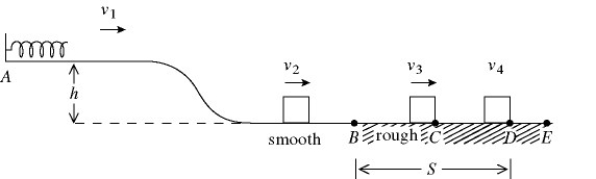
at the bottom. The track is frictionless between points A and B. The block enters a rough section at B, extending to E. The coefficient of kinetic friction over this section is 0.28. The velocity of the block is v3 = 1.4 m/s at C. The block moves on to D, where it stops. The height h of the ramp is closest to (Multiple Choice)
4.9/5 (76)
(76) Work-energy theorem: A worker lifts a 20.0-kg bucket of concrete from the ground up to the top of a 20.0-m tall building. The bucket is initially at rest, but is traveling at 4.0 m/s when it reaches the top of the building. What is the minimum amount of work that the worker did in lifting the bucket?
(Multiple Choice)
4.8/5 (60)
(60) Energy conservation with conservative forces: A spring-loaded dart gun is used to shoot a dart straight up into the air, and the dart reaches a maximum height of 24 meters above its point of release. The same dart is shot up a second time from the same gun, but this time the spring is compressed only half as far (compared to the first shot). How far up does the dart go this time? (Neglect friction and assume the spring is ideal and massless.)
(Multiple Choice)
4.8/5 (73)
(73) 
Filters
- Essay(0)
- Multiple Choice(0)
- Short Answer(0)
- True False(0)
- Matching(0)