



 Chat with AI
Exam 6: Work and Kinetic Energy

Exam 2: Motion Along a Straight Line55 Questions
Exam 3: Motion in Two or Three Dimensions59 Questions
Exam 4: Newtons Laws of Motion50 Questions
Exam 5: Applying Newtons Laws139 Questions
Exam 6: Work and Kinetic Energy109 Questions
Exam 7: Potential Energy and Energy Conservation50 Questions
Exam 8: Momentum, Impulse, and Collisions99 Questions
Exam 9: Rotation of Rigid Bodies26 Questions
Exam 10: Dynamics of Rotational Motion49 Questions
Exam 11: Equilibrium and Elasticity50 Questions
Exam 12: Fluid Mechanics54 Questions
Exam 13: Gravitation52 Questions
Exam 14: Periodic Motion109 Questions
Exam 15: Mechanical Waves50 Questions
Exam 16: Sound and Hearing121 Questions
Exam 17: Temperature and Heat60 Questions
Exam 18: Thermal Properties of Matter41 Questions
Exam 19: The First Law of Thermodynamics55 Questions
Exam 20: The Second Law of Thermodynamics52 Questions
Exam 21: Electric Charge and Electric Field54 Questions
Exam 22: Gausss Law54 Questions
Exam 23: Electric Potential88 Questions
Exam 24: Capacitance and Dielectrics70 Questions
Exam 25: Current, Resistance, and Electromotive Force44 Questions
Exam 26: Direct-Current Circuits51 Questions
Exam 27: Magnetic Field and Magnetic Forces105 Questions
Exam 28: Sources of Magnetic Field82 Questions
Exam 29: Electromagnetic Induction51 Questions
Exam 30: Inductance88 Questions
Exam 31: Alternating Current51 Questions
Exam 32: Electromagnetic Waves Optics53 Questions
Exam 33: The Nature and Propagation of Light31 Questions
Exam 34: Geometric Optics89 Questions
Exam 35: Interference59 Questions
Select questions type


Work-energy theorem: In the figure, a 900-kg crate is on a rough surface inclined at 30°. A constant external force  is applied horizontally to the crate. While this force pushes the crate a distance of 3.0 m up the incline, its velocity changes from 1.2 m/s to 2.3 m/s. How much work does friction do during this process?

is applied horizontally to the crate. While this force pushes the crate a distance of 3.0 m up the incline, its velocity changes from 1.2 m/s to 2.3 m/s. How much work does friction do during this process? (Multiple Choice)
4.9/5  (83)
(83) Energy conservation with conservative forces: In the figure, a 5.00-kg block is moving at 5.00 m/s along a horizontal frictionless surface toward an ideal massless spring that is attached to a wall. After the block collides with the spring, the spring is compressed a maximum distance of 0.68 m. What is the speed of the block when it has moved so that the spring is compressed to only one-half of the maximum distance? 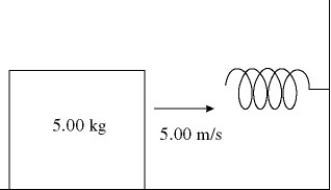
(Short Answer)
4.9/5 (87)
(87) Work: A student slides her 80.0-kg desk across the level floor of her dormitory room a distance 4.00 m at constant speed. If the coefficient of kinetic friction between the desk and the floor is 0.400, how much work did she do?
(Multiple Choice)
4.9/5 (80)
(80) Force and potential energy: When a particle is a distance r from the origin, its potential energy function is given by the equation U(r) = kr, where k is a constant and r =  (a) What are the SI units of k?
(b) Find a mathematical expression in terms of x, y, and z for the y component of the force on the particle.
(c) If U = 3.00 J when the particle is 2.00 m from the origin, find the numerical value of the y component of the force on this particle when it is at the point (-1.00 m, 2.00 m, 3.00 m).
(a) What are the SI units of k?
(b) Find a mathematical expression in terms of x, y, and z for the y component of the force on the particle.
(c) If U = 3.00 J when the particle is 2.00 m from the origin, find the numerical value of the y component of the force on this particle when it is at the point (-1.00 m, 2.00 m, 3.00 m). (Essay)
4.9/5 (84)
(84) Gravitational potential energy: An 8.0-kg block is released from rest, with v1 = 0.00 m/s, on a rough incline, as shown in the figure. The block moves a distance of 1.6-m down the incline, in a time interval of 0.80 s, and acquires a velocity of v2 = 4.0 m/s. How much work does gravity do on the block during this process? 
(Multiple Choice)
4.9/5 (90)
(90) Work: Find the net work done by friction on the body of a snake slithering in a complete circle of  radius. The coefficient of friction between the ground and the snake is 0.25, and the snake's weight is

radius. The coefficient of friction between the ground and the snake is 0.25, and the snake's weight is (Multiple Choice)
4.9/5 (80)
(80) Work: A 3.00-kg ball swings rapidly in a complete vertical circle of radius 2.00 m by a light string that is fixed at one end. The ball moves so fast that the string is always taut and perpendicular to the velocity of the ball. As the ball swings from its lowest point to its highest point
(Multiple Choice)
4.9/5 (99)
(99) Power: A car needs to generate  in order to maintain a constant velocity of
 on a flat road. What is the magnitude of the total resistive force acting on the car (due to friction, air resistance, etc.)? (1 hp = 746 W)
in order to maintain a constant velocity of on a flat road. What is the magnitude of the total resistive force acting on the car (due to friction, air resistance, etc.)? (1 hp = 746 W) (Multiple Choice)
4.8/5 (79)
(79) Force and potential energy: A force on an object is given by F(x) = (2.00 N/m)x - (3.00 N/m3)x3. What is a potential energy function U(x) for this conservative force?
(Essay)
4.8/5 (77)
(77) Energy conservation with conservative forces: A tennis ball bounces on the floor three times. If each time it loses 22.0% of its energy due to heating, how high does it rise after the third bounce, provided we released it  from the floor?
 (Multiple Choice)
4.9/5 (78)
(78) Work: Two men, Joel and Jerry, push against a wall. Jerry stops after 10 min, while Joel is able to push for 5.0 min longer. Compare the work they do
(Multiple Choice)
5.0/5 (79)
(79) Energy conservation with conservative forces: A car on a roller coaster starts at zero speed at an elevation above the ground of 26 m. It coasts down a slope, and then climbs a hill. The top of the hill is at an elevation of 16 m. What is the speed of the car at the top of the hill? Neglect any frictional effects.
(Multiple Choice)
4.8/5 (79)
(79) Power: Calculate the minimum average power output necessary for a  person to run up a 12.0 m long hillside, which is inclined at 25.0° above the horizontal, in 3.00 s. You can neglect the person's kinetic energy. Express your answer in horsepower. (1 hp = 746 W)
 (Multiple Choice)
5.0/5 (74)
(74) Energy conservation with conservative forces: A mass is pressed against (but is not attached to) an ideal horizontal spring on a frictionless horizontal surface. After being released from rest, the mass acquires a maximum speed v and a maximum kinetic energy K. If instead the mass initially compresses the spring twice as far:
(Multiple Choice)
4.9/5 (80)
(80) Energy conservation with nonconservative forces: A ball drops some distance and gains 30 J of kinetic energy. Do NOT ignore air resistance. How much gravitational potential energy did the ball lose?
(Multiple Choice)
4.8/5 (78)
(78) Power: If electricity costs 6.00¢/kWh (kilowatt-hour), how much would it cost you to run a 120 W stereo system 4.0 hours per day for 4.0 weeks?
(Multiple Choice)
4.9/5 (86)
(86) Energy conservation with nonconservative forces: Block 1 and block 2 have the same mass, m, and are released from the top of two inclined planes of the same height making 30° and 60° angles with the horizontal direction, respectively. If the coefficient of friction is the same in both cases, which of the blocks is going faster when it reaches the bottom of its respective incline?
(Multiple Choice)
4.8/5 (81)
(81) Work: You carry a 7.0 kg bag of groceries  above the level floor at a constant velocity of 75 cm/s across a room that is
 across. How much work do you do on the bag in the process?
above the level floor at a constant velocity of 75 cm/s across a room that is across. How much work do you do on the bag in the process? (Multiple Choice)
4.9/5 (65)
(65) Work: A graph of the force on an object as a function of its position is shown in the figure. Determine the amount of work done by this force on an object that moves from x = 1.0 m to x = 6.0 m. (Assume an accuracy of 2 significant figures for the numbers on the graph.) 
(Multiple Choice)
4.7/5 (64)
(64) Gravitational potential energy: Is it possible for a system to have negative potential energy?
(Multiple Choice)
4.8/5 (74)
(74) 
Filters
- Essay(0)
- Multiple Choice(0)
- Short Answer(0)
- True False(0)
- Matching(0)