



 Chat with AI
Exam 6: Work and Kinetic Energy

Exam 2: Motion Along a Straight Line55 Questions
Exam 3: Motion in Two or Three Dimensions59 Questions
Exam 4: Newtons Laws of Motion50 Questions
Exam 5: Applying Newtons Laws139 Questions
Exam 6: Work and Kinetic Energy109 Questions
Exam 7: Potential Energy and Energy Conservation50 Questions
Exam 8: Momentum, Impulse, and Collisions99 Questions
Exam 9: Rotation of Rigid Bodies26 Questions
Exam 10: Dynamics of Rotational Motion49 Questions
Exam 11: Equilibrium and Elasticity50 Questions
Exam 12: Fluid Mechanics54 Questions
Exam 13: Gravitation52 Questions
Exam 14: Periodic Motion109 Questions
Exam 15: Mechanical Waves50 Questions
Exam 16: Sound and Hearing121 Questions
Exam 17: Temperature and Heat60 Questions
Exam 18: Thermal Properties of Matter41 Questions
Exam 19: The First Law of Thermodynamics55 Questions
Exam 20: The Second Law of Thermodynamics52 Questions
Exam 21: Electric Charge and Electric Field54 Questions
Exam 22: Gausss Law54 Questions
Exam 23: Electric Potential88 Questions
Exam 24: Capacitance and Dielectrics70 Questions
Exam 25: Current, Resistance, and Electromotive Force44 Questions
Exam 26: Direct-Current Circuits51 Questions
Exam 27: Magnetic Field and Magnetic Forces105 Questions
Exam 28: Sources of Magnetic Field82 Questions
Exam 29: Electromagnetic Induction51 Questions
Exam 30: Inductance88 Questions
Exam 31: Alternating Current51 Questions
Exam 32: Electromagnetic Waves Optics53 Questions
Exam 33: The Nature and Propagation of Light31 Questions
Exam 34: Geometric Optics89 Questions
Exam 35: Interference59 Questions
Select questions type


Energy conservation with conservative forces: A box of mass m is pressed against (but is not attached to) an ideal spring of force constant k and negligible mass, compressing the spring a distance x. After it is released, the box slides up a frictionless incline as shown in the figure and eventually stops. If we repeat this experiment with a box of mass 2m 
(Multiple Choice)
4.9/5  (95)
(95) Energy conservation with conservative forces: A 2.0 kg mass is moving along the x-axis. The potential energy curve as a function of position is shown in the figure. The kinetic energy of the object at the origin is 12 J. The system is conservative, and there is no friction.  (a) What will be the kinetic energy at 2.0 m along the +x-axis?
(b) What will be the speed of the object at 6.0 m along the +x-axis?
(a) What will be the kinetic energy at 2.0 m along the +x-axis?
(b) What will be the speed of the object at 6.0 m along the +x-axis? (Essay)
4.8/5 (89)
(89) Energy conservation with conservative forces: A block slides down a frictionless inclined ramp. If the ramp angle is 17.0° and its length is  find the speed of the block as it reaches the bottom of the ramp, assuming it started sliding from rest at the top.
 (Multiple Choice)
4.8/5 (72)
(72) Work-energy theorem: A 1000 kg car experiences a net force of 9500 N while decelerating from 30.0 m/s to 23.4 m/s. How far does it travel while slowing down?
(Multiple Choice)
4.8/5 (68)
(68) Energy conservation with conservative forces: An object is attached to a hanging unstretched ideal and massless spring and slowly lowered to its equilibrium position, a distance of 6.4 cm below the starting point. If instead of having been lowered slowly the object was dropped from rest, how far then would it then stretch the spring at maximum elongation?
(Multiple Choice)
4.8/5 (62)
(62) Work-energy theorem: A constant horizontal pull acts on a sled on a horizontal frictionless ice pond. The sled starts from rest. When the pull acts over a distance x, the sled acquires a speed v and a kinetic energy K. If the same pull instead acts over twice this distance:
(Multiple Choice)
4.9/5 (76)
(76) Work: Three forces: F1 = 20.0 N, F2 = 40.0 N, and F3 = 10.0 N act on an object with a mass of 2.00 kg which can move along a frictionless inclined plane as shown in the figure. The questions refer to the instant when the object has moved through a distance of 0.600 m along the surface of the inclined plane in the upward direction. Calculate the amount of work done by
(a) F1
(b) F2
(c) F3 
(Essay)
4.7/5 (77)
(77) Work-energy theorem: If a force always acts perpendicular to an object's direction of motion, that force cannot change the object's kinetic energy.
(True/False)
4.8/5 (84)
(84) Work: A graph of the force on an object as a function of its position is shown in the figure. Determine the amount of work done by this force on the object during a displacement from x = -2.00 m to x = 2.00 m. (Assume an accuracy of 3 significant figures for the numbers on the graph.) 
(Multiple Choice)
4.8/5 (70)
(70) Hooke's law: Which of the graphs in the figure illustrates Hooke's Law? 
(Multiple Choice)
4.8/5 (79)
(79) Work: A crane lifts a 425 kg steel beam vertically a distance of  How much work does the crane do on the beam if the beam accelerates upward at 1.8 m/s2? Neglect frictional forces.
 (Multiple Choice)
4.9/5 (92)
(92) Energy conservation with conservative forces: In the figure, a very small toy race car of mass m is released from rest on the loop-the-loop track. If it is released at a height 2R above the floor, how high is it above the floor when it leaves the track, neglecting friction? 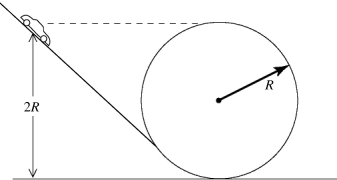
(Multiple Choice)
4.9/5 (69)
(69) Work done by variable forces: It requires 49 J of work to stretch an ideal very light spring from a length of 1.4 m to a length of 2.9 m. What is the value of the spring constant of this spring?
(Multiple Choice)
4.8/5 (80)
(80) Hooke's law: Block A (0.40 kg) and block B (0.30 kg) are on a frictionless table (see figure). Spring 1 connects block A to a frictionless peg at 0 and spring 2 connects block A and block B. When the blocks are in uniform circular motion about 0, the springs have lengths of 0.60 m and 0.40 m, as shown. The springs are ideal and massless, and the linear speed of block B is 2.0 m/s. If the spring constant of spring 1 is equal to 30 N/m, the unstretched length of spring 1 is closest to 
(Multiple Choice)
4.9/5 (87)
(87) Energy conservation with nonconservative forces: Which, if any, of the following statements concerning the work done by a conservative force is NOT true?
(Multiple Choice)
4.8/5 (81)
(81) Energy conservation with nonconservative forces: A 1.37-kg block is held in place against the spring by a 74-N horizontal external force (see the figure). The external force is removed, and the block is projected with a velocity v1 = 1.2 m/s upon separation from the spring. The block descends a ramp and has a velocity  at the bottom. The track is frictionless between points A and B. The block enters a rough section at B, extending to E. The coefficient of kinetic friction over this section is 0.24. The velocity of the block is
 at C. The block moves on to D, where it stops. The initial compression of the spring is closest to
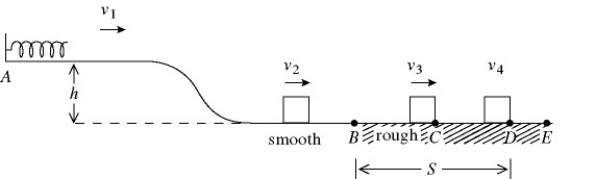
at the bottom. The track is frictionless between points A and B. The block enters a rough section at B, extending to E. The coefficient of kinetic friction over this section is 0.24. The velocity of the block is at C. The block moves on to D, where it stops. The initial compression of the spring is closest to (Multiple Choice)
4.8/5 (82)
(82) Power: How long will it take a 7.08 hp motor to lift a 250 kg beam directly upward at constant velocity from the ground to a height of 45.0 m? Assume frictional forces are negligible. (1 hp = 746 W)
(Multiple Choice)
4.9/5 (85)
(85) Force and potential energy: The potential energy for a certain mass moving in one dimension is given by U(x) = (2.0 J/m3)x3 - (15 J/m2)x2 + (36 J/m)x - 23 J. Find the location(s) where the force on the mass is zero.
(Multiple Choice)
4.8/5 (68)
(68) Energy conservation with nonconservative forces: A ball drops some distance and loses 30 J of gravitational potential energy. Do NOT ignore air resistance. How much kinetic energy did the ball gain?
(Multiple Choice)
4.9/5 (92)
(92) Work-energy theorem: The force on a 3.00-kg object as a function of position is shown in the figure. If an object is moving at 2.50 m/s when it is located at x = 2.00 m, what will its speed be when it reaches x = 8.00 m? (Assume that the numbers on the graph are accurate to 3 significant figures.) 
(Multiple Choice)
4.8/5 (90)
(90) 
Filters
- Essay(0)
- Multiple Choice(0)
- Short Answer(0)
- True False(0)
- Matching(0)