



 Chat with AI
Exam 6: Work and Kinetic Energy

Exam 2: Motion Along a Straight Line55 Questions
Exam 3: Motion in Two or Three Dimensions59 Questions
Exam 4: Newtons Laws of Motion50 Questions
Exam 5: Applying Newtons Laws139 Questions
Exam 6: Work and Kinetic Energy109 Questions
Exam 7: Potential Energy and Energy Conservation50 Questions
Exam 8: Momentum, Impulse, and Collisions99 Questions
Exam 9: Rotation of Rigid Bodies26 Questions
Exam 10: Dynamics of Rotational Motion49 Questions
Exam 11: Equilibrium and Elasticity50 Questions
Exam 12: Fluid Mechanics54 Questions
Exam 13: Gravitation52 Questions
Exam 14: Periodic Motion109 Questions
Exam 15: Mechanical Waves50 Questions
Exam 16: Sound and Hearing121 Questions
Exam 17: Temperature and Heat60 Questions
Exam 18: Thermal Properties of Matter41 Questions
Exam 19: The First Law of Thermodynamics55 Questions
Exam 20: The Second Law of Thermodynamics52 Questions
Exam 21: Electric Charge and Electric Field54 Questions
Exam 22: Gausss Law54 Questions
Exam 23: Electric Potential88 Questions
Exam 24: Capacitance and Dielectrics70 Questions
Exam 25: Current, Resistance, and Electromotive Force44 Questions
Exam 26: Direct-Current Circuits51 Questions
Exam 27: Magnetic Field and Magnetic Forces105 Questions
Exam 28: Sources of Magnetic Field82 Questions
Exam 29: Electromagnetic Induction51 Questions
Exam 30: Inductance88 Questions
Exam 31: Alternating Current51 Questions
Exam 32: Electromagnetic Waves Optics53 Questions
Exam 33: The Nature and Propagation of Light31 Questions
Exam 34: Geometric Optics89 Questions
Exam 35: Interference59 Questions
Select questions type


Work-energy theorem: An unusual spring has a restoring force of magnitude F = (2.00 N/m)x + (1.00 N/m2)x2, where x is the stretch of the spring from its equilibrium length. A 3.00-kg object is attached to this spring and released from rest after stretching the spring 1.50 m. If the object slides over a frictionless horizontal surface, how fast is it moving when the spring returns to its equilibrium length?
(Multiple Choice)
4.7/5  (75)
(75) Energy conservation with conservative forces: A roller coaster of mass 80.0 kg is moving with a speed of 20.0 m/s at position A as shown in the figure. The vertical height above ground level at position A is 200 m. Neglect friction.  (a) What is the total mechanical energy of the roller coaster at point A?
(b) What is the total mechanical energy of the roller coaster at point B?
(c) What is the speed of the roller coaster at point B?
(d) What is the speed of the roller coaster at point C?
(a) What is the total mechanical energy of the roller coaster at point A?
(b) What is the total mechanical energy of the roller coaster at point B?
(c) What is the speed of the roller coaster at point B?
(d) What is the speed of the roller coaster at point C? (Essay)
4.9/5 (70)
(70) Energy conservation with nonconservative forces: A 2.5-kg box, sliding on a rough horizontal surface, has a speed of 1.2 m/s when it makes contact with a spring (see the figure). The block comes to a momentary halt when the compression of the spring is 5.0 cm. The work done by the friction, from the instant the block makes contact with the spring until is comes to a momentary halt, is -0.50 J. 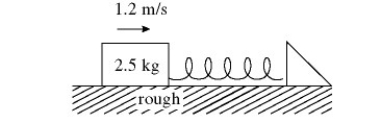 (a) What is the spring constant of the spring?
(b) What is the coefficient of kinetic friction between the box and the rough surface?
(a) What is the spring constant of the spring?
(b) What is the coefficient of kinetic friction between the box and the rough surface? (Essay)
4.7/5 (69)
(69) Work: An object is acted upon by a force that represented by the force vs. position graph in the figure. What is the work done as the object moves
(a) from 4 m to 6 m?
(b) from 6 m to 12 m? 
(Essay)
4.8/5 (82)
(82) Power: A child pulls on a wagon with a horizontal force of  If the wagon moves horizontally a total of
 in
 what is the average power generated by the child?
If the wagon moves horizontally a total of in what is the average power generated by the child? (Multiple Choice)
4.8/5 (79)
(79) Work-energy theorem: A 4.00-kg mass is attached to a very light ideal spring hanging vertically and hangs at rest in the equilibrium position. The spring constant of the spring is 1.00 N/cm. The mass is pulled downward 2.00 cm and released. What is the speed of the mass when it is 1.00 cm above the point from which it was released?
(Multiple Choice)
4.9/5 (97)
(97) Elastic potential energy: An athlete stretches a spring an extra 40.0 cm beyond its initial length. How much energy has he transferred to the spring, if the spring constant is 52.9 N/cm?
(Multiple Choice)
4.8/5 (77)
(77) Energy conservation with conservative forces: A 2.0-kg object is moving without friction along the x-axis. The potential energy curve as a function of position is shown in the figure, and the system is conservative. If the speed of the object at the origin is 4.0 m/s, what will be its speed at 7.0 m along the +x-axis? 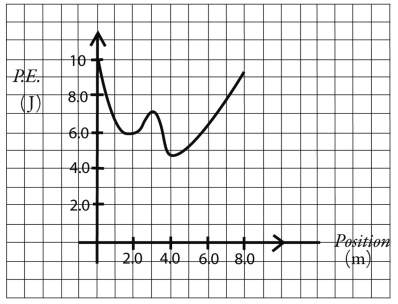
(Multiple Choice)
4.9/5 (79)
(79) Energy conservation with conservative forces: Consider the motion of a 1.00-kg particle that moves with potential energy given by U(x) = (-2.00 J ∙ m)/x + (4.00 J∙m2)/x2. Suppose the particle is moving with a speed of 3.00 m/s when it is located at x = 1.00 m. What is the speed of the object when it is located at x = 5.00 m?
(Multiple Choice)
4.8/5 (76)
(76) Work-energy theorem: A 7.0-kg rock is subject to a variable force given by the equation
F(x) = 6.0 N - (2.0 N/m)x + (6.0 N/m2)x2
If the rock initially is at rest at the origin, find its speed when it has moved 9.0 m.
(Short Answer)
4.8/5 (72)
(72) Hooke's law: An object attached to an ideal massless spring is pulled across a frictionless surface. If the spring constant is 45 N/m and the spring is stretched by 0.88 m when the object is accelerating at  what is the mass of the object?
 (Multiple Choice)
4.9/5 (76)
(76) Work: In the figure, a 700-kg crate is on a rough surface inclined at 30°. A constant external force P = 5600 N is applied horizontally to the crate. As the force pushes the crate a distance of 3.00 m up the incline, the speed changes from 1.40 m/s to 2.50 m/s. How much work does gravity do on the crate during this process? 
(Multiple Choice)
4.9/5 (87)
(87) Energy conservation with nonconservative forces: An object of mass 4.0 kg starts at rest from the top of a rough inclined plane of height 10 m as shown in the figure. If the speed of the object at the bottom of the inclined plane is 10 m/s, how much work does friction do on this object as it slides down the incline? 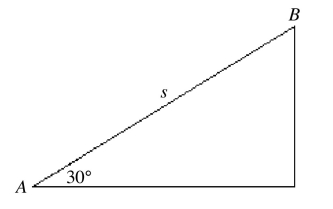
(Short Answer)
4.8/5 (93)
(93) Work-energy theorem: A ball is thrown upward at an angle with a speed and direction such that it reaches a maximum height of 16.0 m above the point it was released, with no appreciable air resistance. At its maximum height it has a speed of 18.0 m/s. With what speed was the ball released?
(Multiple Choice)
4.7/5 (81)
(81) Energy conservation with conservative forces: Two identical balls are thrown directly upward, ball A at speed v and ball B at speed 2v, and they feel no air resistance. Which statement about these balls is correct?
(Multiple Choice)
4.7/5 (72)
(72) Kinetic energy: A 1000.0 kg car is moving at  If a
 truck has 18 times the kinetic energy of the car, how fast is the truck moving?
If a truck has 18 times the kinetic energy of the car, how fast is the truck moving? (Multiple Choice)
4.8/5 (71)
(71) Force and potential energy: A particle experiences a force given by F(x) = α - βx3. Find the potential field U(x) the particle is in. (Assume that the zero of potential energy is located at x = 0.)
(Multiple Choice)
4.9/5 (93)
(93) Work-energy theorem: A 4.0-kg object is moving with speed 2.0 m/s. A 1.0-kg object is moving with speed 4.0 m/s. Both objects encounter the same constant braking force, and are brought to rest. Which object travels the greater distance before stopping?
(Multiple Choice)
4.9/5 (89)
(89) Energy conservation with nonconservative forces: In the figure, a block of mass m is moving along the horizontal frictionless surface with a speed of 5.70 m/s. If the slope is 11.0° and the coefficient of kinetic friction between the block and the incline is 0.260, how far does the block travel up the incline? 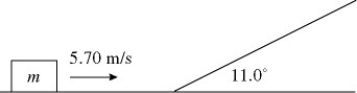
(Short Answer)
4.9/5 (81)
(81) Energy conservation with nonconservative forces: An 0.80-kg block is held in place against the spring by a 67-N horizontal external force (see the figure). The external force is removed, and the block is projected with a velocity v1 = 1.2 m/s upon separation from the spring. The block descends a ramp and has a velocity v2 = 1.9 m/s at the bottom. The track is frictionless between points A and B. The block enters a rough section at B, extending to E. The coefficient of kinetic friction over this section is 0.39. The velocity of the block is v3 = 1.4 m/s at C. The block moves on to D, where it stops. The spring constant of the spring is closest to 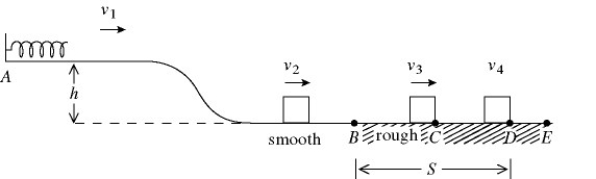
(Multiple Choice)
4.8/5 (85)
(85) 
Filters
- Essay(0)
- Multiple Choice(0)
- Short Answer(0)
- True False(0)
- Matching(0)