



 Chat with AI
Exam 25: Electric Potential

Exam 1: Physics and Measurement25 Questions
Exam 2: Motion in One Dimension66 Questions
Exam 3: Vectors47 Questions
Exam 4: Motion in Two Dimensions79 Questions
Exam 5: The Laws of Motion113 Questions
Exam 6: Circular Motion and Other Applications of Newtons Laws55 Questions
Exam 7: Energy of a System74 Questions
Exam 8: Conservation of Energy84 Questions
Exam 9: Linear Momentum and Collisions89 Questions
Exam 10: Rotation of a Rigid Object About a Fixed Axis82 Questions
Exam 11: Angular Momentum46 Questions
Exam 12: Static Equilibrium and Elasticity34 Questions
Exam 13: Universal Gravitation47 Questions
Exam 14: Fluid Mechanics53 Questions
Exam 15: Oscillatory Motion41 Questions
Exam 16: Wave Motion82 Questions
Exam 18: Superposition and Standing Waves72 Questions
Exam 19: Temperature47 Questions
Exam 20: The First Law of Thermodynamics61 Questions
Exam 21: The Kinetic Theory of Gases38 Questions
Exam 22: Heat Engines, Entropy, and the Second Law of Thermodynamics55 Questions
Exam 23: Electric Fields67 Questions
Exam 24: Gausss Law82 Questions
Exam 25: Electric Potential111 Questions
Exam 26: Capacitance and Dielectrics63 Questions
Exam 27: Current and Resistance34 Questions
Exam 28: Direct-Current Circuits84 Questions
Exam 29: Magnetic Fields80 Questions
Exam 30: Sources of the Magnetic Field95 Questions
Exam 31: Faradays Law62 Questions
Exam 32: Inductance23 Questions
Exam 33: Alternating-Current Circuits65 Questions
Exam 34: Electromagnetic Waves40 Questions
Exam 35: The Nature of Light and the Principles of Ray Optics37 Questions
Exam 36: Image Formation43 Questions
Exam 37: Wave Optics48 Questions
Exam 38: Diffraction Patterns and Polarization47 Questions
Exam 39: Relativity34 Questions
Exam 40: Introduction to Quantum Physics48 Questions
Exam 41: Quantum Mechanics33 Questions
Exam 42: Atomic Physics59 Questions
Exam 43: Molecules and Solids46 Questions
Exam 44: Nuclear Structure89 Questions
Exam 46: Particle Physics and Cosmology34 Questions
Select questions type


A charge of 20 nC is distributed uniformly along the y axis from y = 0 to y = 4 m. Which of the following integrals is correct for the electric potential (relative to zero at infinity) at the point x = +3 m on the x axis?
(Multiple Choice)
4.9/5  (89)
(89) Four identical point charges (+6.0 nC) are placed at the corners of a rectangle which measures 6.0 m × 8.0 m. If the electric potential is taken to be zero at infinity, what is the potential at the geometric center of this rectangle?
(Multiple Choice)
4.9/5 (87)
(87) A series of 3 uncharged concentric spherical conducting shells surround a small central charge q. The potential at a point outside the third shell, at distance r from the center, and relative to V = 0 at ∞, is
(Multiple Choice)
4.7/5 (82)
(82) Points A [at (2, 3) m] and B [at (5, 7) m] are in a region where the electric field is uniform and given by  N/C. What is the potential difference VA − VB?
 (Multiple Choice)
4.8/5 (86)
(86) A linear charge of nonuniform density λ = bx, where b = 2.1 nC/m2, is distributed along the x axis from x = 2.0 m to x = 3.0 m. Determine the electric potential (relative to zero at infinity) of the point y = 4.0 m on the y axis.
(Multiple Choice)
4.7/5 (85)
(85) Through what potential difference must an electron (starting from rest) be accelerated if it is to reach a speed of 3.0 × 10⁷ m/s?
(Multiple Choice)
4.7/5 (64)
(64) Two large parallel conducting plates are 8.0 cm apart and carry equal but opposite charges on their facing surfaces. The magnitude of the surface charge density on either of the facing surfaces is 2.0 nC/m2. Determine the magnitude of the electric potential difference between the plates.
(Multiple Choice)
4.9/5 (67)
(67) What is the speed of a proton that has been accelerated from rest through a potential difference of 4.0 kV?
(Multiple Choice)
4.8/5 (85)
(85) A particle (m = 2.0 μg, q = −5.0 μC) has a speed of 30 m/s at point A and moves (with only electric forces acting on it) to point B where its speed is 80 m/s. Determine the electric potential difference VA − VB.
(Multiple Choice)
4.8/5 (75)
(75) Point charges q and Q are positioned as shown. If q = +2.0 nC, Q = −2.0 nC, a = 3.0 m, and b = 4.0 m, what is the electric potential difference, VA − VB? 
(Multiple Choice)
4.9/5 (73)
(73) Three charged particles are positioned in the xy plane: a 50-nC charge at y = 6 m on the y axis, a −80-nC charge at x = −4 m on the x axis, and a 70-nc charge at y = −6 m on the y axis. What is the electric potential (relative to a zero at infinity) at the point x = 8 m on the x axis?
(Multiple Choice)
4.7/5 (60)
(60) Charge of uniform density 12 nC/m is distributed along the x axis from x = 2.0 m to x = 5.0 m. What is the electric potential (relative to zero at infinity) at the origin (x = 0)?
(Multiple Choice)
4.8/5 (77)
(77) A particle (charge = 40 μC) moves directly toward a second particle (charge = 80 μC) which is held in a fixed position. At an instant when the distance between the two particles is 2.0 m, the kinetic energy of the moving particle is 16 J. Determine the distance separating the two particles when the moving particle is momentarily stopped.
(Multiple Choice)
4.9/5 (90)
(90) A rod (length = 2.0 m) is uniformly charged and has a total charge of 5.0 nC. What is the electric potential (relative to zero at infinity) at a point which lies along the axis of the rod and is 3.0 m from the center of the rod?
(Multiple Choice)
4.9/5 (73)
(73) A charge of uniform density (0.80 nC/m) is distributed along the x axis from the origin to the point x = 10 cm. What is the electric potential (relative to zero at infinity) at a point, x = 18 cm, on the x axis?
(Multiple Choice)
4.9/5 (85)
(85) Two identical particles, each with a mass of 2.0 μg and a charge of 25 nC, are released simultaneously from rest when the two are 4.0 cm apart. What is the speed of either particle at the instant when the two are separated by 10 cm?
(Multiple Choice)
4.7/5 (76)
(76) A solid conducting sphere (radius = 5.0 cm) has a charge of 0.25 nC distributed uniformly on its surface. If point A is located at the center of the sphere and point B is 15 cm from the center, what is the magnitude of the electric potential difference between these two points?
(Multiple Choice)
4.8/5 (62)
(62) A positive point charge q is placed off center inside an uncharged metal sphere insulated from the ground as shown. Where is the induced charge density greatest in magnitude and what is its sign? 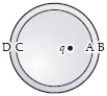
(Multiple Choice)
4.9/5 (78)
(78) Two particles, each having a mass of 3.0 μg and having equal but opposite charges of magnitude 5.0 nC, are released simultaneously from rest when the two are 5.0 cm apart. What is the speed of either particle at the instant when the two are separated by 2.0 cm?
(Multiple Choice)
4.8/5 (81)
(81) An astronaut is in an all-metal chamber outside the space station when a solar storm results in the deposit of a large positive charge on the station. Which statement is correct?
(Multiple Choice)
4.9/5 (70)
(70) 
Filters
- Essay(0)
- Multiple Choice(0)
- Short Answer(0)
- True False(0)
- Matching(0)