



 Chat with AI
Exam 25: Electric Potential

Exam 1: Physics and Measurement25 Questions
Exam 2: Motion in One Dimension66 Questions
Exam 3: Vectors47 Questions
Exam 4: Motion in Two Dimensions79 Questions
Exam 5: The Laws of Motion113 Questions
Exam 6: Circular Motion and Other Applications of Newtons Laws55 Questions
Exam 7: Energy of a System74 Questions
Exam 8: Conservation of Energy84 Questions
Exam 9: Linear Momentum and Collisions89 Questions
Exam 10: Rotation of a Rigid Object About a Fixed Axis82 Questions
Exam 11: Angular Momentum46 Questions
Exam 12: Static Equilibrium and Elasticity34 Questions
Exam 13: Universal Gravitation47 Questions
Exam 14: Fluid Mechanics53 Questions
Exam 15: Oscillatory Motion41 Questions
Exam 16: Wave Motion82 Questions
Exam 18: Superposition and Standing Waves72 Questions
Exam 19: Temperature47 Questions
Exam 20: The First Law of Thermodynamics61 Questions
Exam 21: The Kinetic Theory of Gases38 Questions
Exam 22: Heat Engines, Entropy, and the Second Law of Thermodynamics55 Questions
Exam 23: Electric Fields67 Questions
Exam 24: Gausss Law82 Questions
Exam 25: Electric Potential111 Questions
Exam 26: Capacitance and Dielectrics63 Questions
Exam 27: Current and Resistance34 Questions
Exam 28: Direct-Current Circuits84 Questions
Exam 29: Magnetic Fields80 Questions
Exam 30: Sources of the Magnetic Field95 Questions
Exam 31: Faradays Law62 Questions
Exam 32: Inductance23 Questions
Exam 33: Alternating-Current Circuits65 Questions
Exam 34: Electromagnetic Waves40 Questions
Exam 35: The Nature of Light and the Principles of Ray Optics37 Questions
Exam 36: Image Formation43 Questions
Exam 37: Wave Optics48 Questions
Exam 38: Diffraction Patterns and Polarization47 Questions
Exam 39: Relativity34 Questions
Exam 40: Introduction to Quantum Physics48 Questions
Exam 41: Quantum Mechanics33 Questions
Exam 42: Atomic Physics59 Questions
Exam 43: Molecules and Solids46 Questions
Exam 44: Nuclear Structure89 Questions
Exam 46: Particle Physics and Cosmology34 Questions
Select questions type


When introduced into a region where an electric field is present, a proton with initial velocity  will eventually move
 (Multiple Choice)
4.7/5  (75)
(75) The gap between electrodes in a spark plug is 0.06 cm. In order to produce an electric spark in a gasoline-air mixture, the electric field must reach a value of 3 × 10⁶ V/m. What minimum voltage must be supplied by the ignition circuit when starting the car?
(Short Answer)
4.9/5 (75)
(75) An uncharged metal sphere is placed on an insulating puck on a frictionless table. While being held parallel to the table, a rod with a charge q is brought close to the sphere, but does not touch it. As the rod is brought in, the sphere
(Multiple Choice)
4.8/5 (77)
(77) A point charge of 6.0 nC is placed at the center of a hollow spherical conductor (inner radius = 1.0 cm, outer radius = 2.0 cm) which has a net charge of −4.0 nC. Determine the resulting charge density on the inner surface of the conducting sphere.
(Multiple Choice)
4.7/5 (77)
(77) When a charged particle is moved along an electric field line,
(Multiple Choice)
4.8/5 (83)
(83) The electric potential inside a charged solid spherical conductor in equilibrium
(Multiple Choice)
4.8/5 (89)
(89) When a negative charge is released and moves along an electric field line, it moves to a position of
(Multiple Choice)
5.0/5 (83)
(83) Identical point charges (+20 μC) are placed at the corners of an equilateral triangle with sides of 2.0-m length. How much external energy is required to bring a charge of 45 μC from infinity to the midpoint of one side of the triangle?
(Multiple Choice)
4.8/5 (68)
(68) A proton (mass = 1.67 × 10⁻²⁷ kg, charge = 1.60 × 10⁻¹⁹ C) moves from point A to point B under the influence of an electrostatic force only. At point A the proton moves with a speed of 60 km/s. At point B the speed of the proton is 80 km/s. Determine the potential difference VB − VA.
(Multiple Choice)
4.8/5 (75)
(75) Two charges lie on the x axis, +2q at the origin, and −3q at x = 5.0 m. The point on the x axis where the electric potential has a zero value (when the value at infinity is also zero) is
(Multiple Choice)
4.9/5 (73)
(73) When introduced into a region where an electric field is present, an electron with initial velocity  will eventually move
 (Multiple Choice)
4.9/5 (84)
(84) A system consisting of a positively-charged particle and an electric field
(Multiple Choice)
4.9/5 (90)
(90) Identical 4.0-μC charges are placed on the y axis at y = ±4.0 m. Point A is on the x axis at x = +3.0 m. Determine the electric potential of point A (relative to zero at the origin).
(Multiple Choice)
4.8/5 (76)
(76) A charge of 20 nC is distributed uniformly along the x axis from x = −2.0 m to x = +2.0 m. What is the electric potential (relative to zero at infinity) at the point x = 5.0 m on the x axis?
(Multiple Choice)
4.9/5 (85)
(85) Two charges lie on the x axis, +3q at the origin, and −2q at x = 5.0 m. The point on the x axis where the electric potential has a zero value (when the value at infinity is also zero) is
(Multiple Choice)
4.8/5 (101)
(101) A particle (mass = 6.7 × 10⁻²⁷ kg, charge = 3.2 × 10⁻¹⁹ C) moves along the positive x axis with a speed of 4.8 × 10⁵ m/s. It enters a region of uniform electric field parallel to its motion and comes to rest after moving 2.0 m into the field. What is the magnitude of the electric field?
(Multiple Choice)
4.7/5 (71)
(71) Four electrons move from point A to point B in a uniform electric field as shown below. Rank the electrons in diagrams I through IV by the changes in potential energy from most positive to most negative when traveling from A to B. 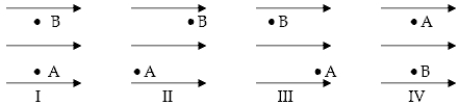
(Multiple Choice)
4.8/5 (60)
(60) The Bohr model pictures a hydrogen atom in its ground state as a proton and an electron separated by the distance a0 = 0.529 × 10⁻¹⁰ m. The electric potential created by the electron at the position of the proton is
(Multiple Choice)
4.8/5 (84)
(84) A nonconducting sphere of radius 10 cm is charged uniformly with a density of 100 nC/m3. What is the magnitude of the potential difference between the center and a point 4.0 cm away?
(Multiple Choice)
4.8/5 (73)
(73) A particle (charge 7.5 μC) is released from rest at a point on the x axis, x = 10 cm. It begins to move due to the presence of a 2.0-μC charge which remains fixed at the origin. What is the kinetic energy of the particle at the instant it passes the point x = 1.0 m?
(Multiple Choice)
4.9/5 (82)
(82) 
Filters
- Essay(0)
- Multiple Choice(0)
- Short Answer(0)
- True False(0)
- Matching(0)