



 Chat with AI
Exam 29: Magnetic Fields

Exam 1: Physics and Measurement25 Questions
Exam 2: Motion in One Dimension66 Questions
Exam 3: Vectors47 Questions
Exam 4: Motion in Two Dimensions79 Questions
Exam 5: The Laws of Motion113 Questions
Exam 6: Circular Motion and Other Applications of Newtons Laws55 Questions
Exam 7: Energy of a System74 Questions
Exam 8: Conservation of Energy84 Questions
Exam 9: Linear Momentum and Collisions89 Questions
Exam 10: Rotation of a Rigid Object About a Fixed Axis82 Questions
Exam 11: Angular Momentum46 Questions
Exam 12: Static Equilibrium and Elasticity34 Questions
Exam 13: Universal Gravitation47 Questions
Exam 14: Fluid Mechanics53 Questions
Exam 15: Oscillatory Motion41 Questions
Exam 16: Wave Motion82 Questions
Exam 18: Superposition and Standing Waves72 Questions
Exam 19: Temperature47 Questions
Exam 20: The First Law of Thermodynamics61 Questions
Exam 21: The Kinetic Theory of Gases38 Questions
Exam 22: Heat Engines, Entropy, and the Second Law of Thermodynamics55 Questions
Exam 23: Electric Fields67 Questions
Exam 24: Gausss Law82 Questions
Exam 25: Electric Potential111 Questions
Exam 26: Capacitance and Dielectrics63 Questions
Exam 27: Current and Resistance34 Questions
Exam 28: Direct-Current Circuits84 Questions
Exam 29: Magnetic Fields80 Questions
Exam 30: Sources of the Magnetic Field95 Questions
Exam 31: Faradays Law62 Questions
Exam 32: Inductance23 Questions
Exam 33: Alternating-Current Circuits65 Questions
Exam 34: Electromagnetic Waves40 Questions
Exam 35: The Nature of Light and the Principles of Ray Optics37 Questions
Exam 36: Image Formation43 Questions
Exam 37: Wave Optics48 Questions
Exam 38: Diffraction Patterns and Polarization47 Questions
Exam 39: Relativity34 Questions
Exam 40: Introduction to Quantum Physics48 Questions
Exam 41: Quantum Mechanics33 Questions
Exam 42: Atomic Physics59 Questions
Exam 43: Molecules and Solids46 Questions
Exam 44: Nuclear Structure89 Questions
Exam 46: Particle Physics and Cosmology34 Questions
Select questions type


A particle (mass = 6.0 mg) moves with a speed of 4.0 km/s in a direction that makes an angle of 37° above the positive x axis in the xy plane. At the instant it enters a magnetic field of (5.0  ) mT it experiences an acceleration of (8.0
 ) m/s2. What is the charge of the particle?
) mT it experiences an acceleration of (8.0 ) m/s2. What is the charge of the particle?
Free
(Multiple Choice)
4.9/5  (85)
(85) Correct Answer: Verified
C
A charged particle (mass = 4.0 μg, charge = 5.0 μC) moves in a region where the only force on it is magnetic. What is the magnitude of the acceleration of the particle at a point where the speed of the particle is 5.0 km/s, the magnitude of the magnetic field is 8.0 mT, and the angle between the direction of the magnetic field and the velocity of the particle is 60°?
Free
(Multiple Choice)
4.8/5 (76)
(76) Correct Answer:Verified
VerifiedB
An electron moves in a region where the magnetic field is uniform, has a magnitude of 60 μT, and points in the positive x direction. At t = 0 the electron has a velocity that has an x component of 30 km/s, a y component of 40 km/s, and a z component of zero. What is the pitch of the resulting helical path?
Free
(Multiple Choice)
4.8/5 (84)
(84) Correct Answer:Verified
VerifiedD
A particle (q = 5.0 nC, m = 3.0 μg) moves in a region where the magnetic field has components Bx = 2.0 mT, By = 3.0 mT, and Bz = −4.0 mT. At an instant when the speed of the particle is 5.0 km/s and the direction of its velocity is 120° relative to the magnetic field, what is the magnitude of the acceleration of the particle?
(Multiple Choice)
4.9/5 (85)
(85) A 2.0-C charge moves with a velocity of ( 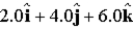 ) m/s and experiences a magnetic force of (
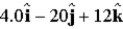 ) N. The x component of the magnetic field is equal to zero. Determine the y component of the magnetic field.
) m/s and experiences a magnetic force of ( ) N. The x component of the magnetic field is equal to zero. Determine the y component of the magnetic field. (Multiple Choice)
4.8/5 (81)
(81) The diagram below shows the position of a long straight wire perpendicular to the page and a set of directions labeled A through H. When the current in the wire is directed up out of the page, the direction of the magnetic field at point P is 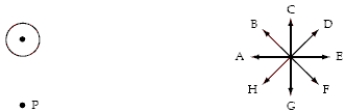
(Multiple Choice)
4.8/5 (78)
(78) The boundary shown is that of a uniform magnetic field directed in the positive z direction. An electron enters the magnetic field with a velocity pointing along the x axis and exits 0.63 μs later at point A. What is the magnitude of the magnetic field? 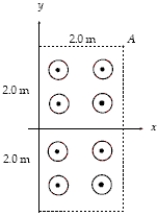
(Multiple Choice)
4.9/5 (78)
(78) A proton is accelerated from rest through a potential difference of 2.5 kV and then moves perpendicularly through a uniform 0.60-T magnetic field. What is the radius of the resulting path?
(Multiple Choice)
4.8/5 (80)
(80) A charged particle (mass = M, charge = Q > 0) moves in a region of space where the magnetic field has a constant magnitude of B and a downward direction. What is the magnetic force on the particle at an instant when it is moving horizontally toward the north with a speed V?
(Multiple Choice)
4.9/5 (76)
(76) An electron has a velocity of 6.0 × 10⁶ m/s in the positive x direction at a point where the magnetic field has the components Bx = 3.0 T, By = 1.5 T, and Bz = 2.0 T. What is the magnitude of the acceleration of the electron at this point?
(Multiple Choice)
4.8/5 (92)
(92) A current of 4.0 A is maintained in a single circular loop having a circumference of 80 cm. An external magnetic field of 2.0 T is directed so that the angle between the field and the plane of the loop is 20°. Determine the magnitude of the torque exerted on the loop by the magnetic forces acting upon it.
(Multiple Choice)
4.8/5 (64)
(64) Two single charged ions moving perpendicularly to a uniform magnetic field (B = 0.40 T) with speeds of 5 000 km/s follow circular paths that differ in diameter by 5.0 cm. What is the difference in the mass of these two ions?
(Multiple Choice)
4.8/5 (68)
(68) A charged particle (mass = M, charge = Q > 0) moves in a region of space where the magnetic field has a constant magnitude of B and a downward direction. What is the magnetic force on the particle at an instant when it is moving horizontally toward the north with speed V?
(Multiple Choice)
4.8/5 (82)
(82) Three particles of equal charge, X, Y, and Z, enter a uniform magnetic field B. X has velocity of magnitude v parallel to the field. Y has velocity of magnitude v perpendicular to the field. Z has equal velocity components v parallel and perpendicular to the field. Rank the radii of their orbits from least to greatest.
(Multiple Choice)
4.8/5 (76)
(76) At what speed would a proton need to circle the Earth at a height of 1 000 km above the equator if the Earth's magnetic field is horizontal and directed north-south, with an intensity of 4.00 × 10⁻⁸ T? (The radius of the Earth is 6 400 km and the charge and mass of the proton are q = 1.60 × 10⁻¹⁹ C and mp = 1.67 × 10⁻²⁷ kg. Ignore relativistic corrections.)
(Short Answer)
4.8/5 (76)
(76) What is the magnitude of the magnetic force on a charged particle (Q = 5.0 μC) moving with a speed of 80 km/s in the positive x direction at a point where Bx = 5.0 T, By = −4.0 T, and Bz = 3.0 T?
(Multiple Choice)
4.8/5 (84)
(84) A 500-eV electron and a 300-eV electron trapped in a uniform magnetic field move in circular paths in a plane perpendicular to the magnetic field. What is the ratio of the radii of their orbits?
(Multiple Choice)
4.9/5 (74)
(74) The diagram below shows the position of a long straight wire perpendicular to the page and a set of directions labeled A through H. When the current in the wire is directed up out of the page, the direction of the magnetic field at point P is 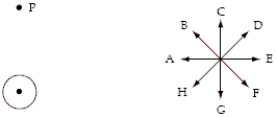
(Multiple Choice)
4.7/5 (70)
(70) A proton with a kinetic energy of 0.20 keV follows a circular path in a region where the magnetic field is uniform and has a magnitude of 60 mT. What is the radius of this path?
(Multiple Choice)
4.9/5 (77)
(77) A physicist claims that she has found a new particle with a mass 200 000 times the mass of the proton (1.67 × 10⁻²⁷ kg) and a charge of 3.20 × 10⁻¹⁹ C. If she is correct, such a particle traveling in a circle in a uniform 5.00 T magnetic field at a velocity of 2 500 m/s will have a radius of
(Multiple Choice)
4.9/5 (91)
(91) 
Filters
- Essay(0)
- Multiple Choice(0)
- Short Answer(0)
- True False(0)
- Matching(0)