



 Chat with AI
Exam 21: The Kinetic Theory of Gases

Exam 1: Physics and Measurement25 Questions
Exam 2: Motion in One Dimension66 Questions
Exam 3: Vectors47 Questions
Exam 4: Motion in Two Dimensions79 Questions
Exam 5: The Laws of Motion113 Questions
Exam 6: Circular Motion and Other Applications of Newtons Laws55 Questions
Exam 7: Energy of a System74 Questions
Exam 8: Conservation of Energy84 Questions
Exam 9: Linear Momentum and Collisions89 Questions
Exam 10: Rotation of a Rigid Object About a Fixed Axis82 Questions
Exam 11: Angular Momentum46 Questions
Exam 12: Static Equilibrium and Elasticity34 Questions
Exam 13: Universal Gravitation47 Questions
Exam 14: Fluid Mechanics53 Questions
Exam 15: Oscillatory Motion41 Questions
Exam 16: Wave Motion82 Questions
Exam 18: Superposition and Standing Waves72 Questions
Exam 19: Temperature47 Questions
Exam 20: The First Law of Thermodynamics61 Questions
Exam 21: The Kinetic Theory of Gases38 Questions
Exam 22: Heat Engines, Entropy, and the Second Law of Thermodynamics55 Questions
Exam 23: Electric Fields67 Questions
Exam 24: Gausss Law82 Questions
Exam 25: Electric Potential111 Questions
Exam 26: Capacitance and Dielectrics63 Questions
Exam 27: Current and Resistance34 Questions
Exam 28: Direct-Current Circuits84 Questions
Exam 29: Magnetic Fields80 Questions
Exam 30: Sources of the Magnetic Field95 Questions
Exam 31: Faradays Law62 Questions
Exam 32: Inductance23 Questions
Exam 33: Alternating-Current Circuits65 Questions
Exam 34: Electromagnetic Waves40 Questions
Exam 35: The Nature of Light and the Principles of Ray Optics37 Questions
Exam 36: Image Formation43 Questions
Exam 37: Wave Optics48 Questions
Exam 38: Diffraction Patterns and Polarization47 Questions
Exam 39: Relativity34 Questions
Exam 40: Introduction to Quantum Physics48 Questions
Exam 41: Quantum Mechanics33 Questions
Exam 42: Atomic Physics59 Questions
Exam 43: Molecules and Solids46 Questions
Exam 44: Nuclear Structure89 Questions
Exam 46: Particle Physics and Cosmology34 Questions
Select questions type


The temperature of a quantity of an ideal gas is

Free
(Multiple Choice)
4.9/5  (80)
(80) Correct Answer: Verified
D
According to kinetic theory, a typical gas molecule in thermal equilibrium at room temperature has a kinetic energy K = 6.00 × 10⁻²¹ J, regardless of mass. Estimate the speed at room temperature of a hydrogen molecule H2 (m = 3.34 × 10⁻²⁷ kg) and a xenon atom (m = 2.00 × 10⁻²⁵ kg). [kB = 1.38 × 10⁻²³ J/K]
Free
(Short Answer)
4.9/5 (82)
(82) Correct Answer:Verified
Verified1 895 m/s, 245 m/s
When we consider a thin horizontal layer of the atmosphere, of thickness dy, of area A, with pressure P on the bottom, with an average mass m per molecule, and nV molecules per unit volume, the magnitude of the difference of the pressure at the top and bottom of the layer is given by dP =
Free
(Multiple Choice)
4.9/5 (89)
(89) Correct Answer:Verified
VerifiedB
The relation PV = nRT holds for all ideal gases. The additional relation PVγ holds for an adiabatic process. The figure below shows two curves: one is an adiabat and one is an isotherm. Each starts at the same pressure and volume. Which statement is correct? (Note: "∝" means "is proportional to".) 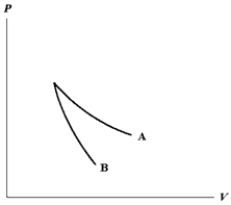
(Multiple Choice)
4.9/5 (73)
(73) During the volcanic eruption of Mt. Pelee in 1902, an incredibly hot "burning cloud" rolled down the mountain and incinerated the town of Saint-Pierre. From the damage done, the temperature in the cloud was estimated at 700°C. If the air temperature was 20°C and a mole of air is 29 grams, estimate the molecular weight of the gas in the "burning cloud" that made it heavier than the surrounding air. (As a follow-on, estimate the most probable composition of the cloud. Some typical volcanic gases are H2S, SO2, H2SO4, CO2, NO.)
(Essay)
4.9/5 (78)
(78) Nitrogen gas is heated by a pulsed laser to 50 000 K. If the diameter of the nitrogen atoms is assumed to be 1.0 × 10⁻¹⁰ m, and the pressure is 1.0 atm, what is the mean free path?
(Multiple Choice)
4.9/5 (67)
(67) Air expands adiabatically (no heat in, no heat out) from T = 300 K and P = 100 atm to a final pressure of 1 atm. Treat the gas as ideal with γ = 1.4, and determine the final temperature. Compare your result to the boiling points of nitrogen (77.4 K) and oxygen (90.2 K). Could this method result in the liquification of air?
(Short Answer)
4.7/5 (77)
(77) When we say that the speed of sound is measured under adiabatic conditions we assume that
(Multiple Choice)
4.9/5 (71)
(71) Find the specific heat (in cal/mole K) of a gas kept at constant volume when it takes 1.0 × 10⁴ J of heat to raise the temperature of 5.0 moles of the gas 200 K above the initial temperature.
(Multiple Choice)
4.9/5 (76)
(76) The molar specific heat at constant volume at 0°C of an ideal diatomic gas is
(Multiple Choice)
4.8/5 (84)
(84) One mole of hydrogen, one mole of nitrogen and one mole of oxygen are held in a 22.4 × 103 cm3 enclosed vessel at 20°C. The pressure in the vessel, in N/m2, is
(Multiple Choice)
4.8/5 (88)
(88) The molar specific heat at constant volume at 0°C of an ideal monatomic gas is
(Multiple Choice)
4.8/5 (84)
(84) A 50-gram sample of dry ice (solid CO2) is placed in a 4-liter container. The system is sealed and allowed to reach room temperature (20°C). By approximately how much does the pressure inside the container increase when the dry ice turns to gas? (Ignore the initial volume of the sample.)
(Short Answer)
4.8/5 (73)
(73) The root mean square speed of a gas molecule is greater than the average speed, because the former gives a greater weight to
(Multiple Choice)
4.8/5 (71)
(71) Assume 3.0 moles of a diatomic gas has an internal kinetic energy of 10 kJ. Determine the temperature of the gas after it has reached equilibrium.
(Multiple Choice)
4.9/5 (83)
(83) The specific heat of an ideal gas at constant pressure is greater than the specific heat of an ideal gas at constant volume because
(Multiple Choice)
4.9/5 (82)
(82) If CP for an ideal gas is 35.4 J/mol⋅K, which of the following is CV for this gas?
(Multiple Choice)
4.9/5 (88)
(88) The air in an automobile engine at 20°C is compressed from an initial pressure of 1.0 atm and a volume of 200 cm3 to a volume of 20 cm3. Find the temperature if the air behaves like an ideal gas (γ = 1.4) and the compression is adiabatic.
(Multiple Choice)
4.7/5 (93)
(93) Suppose a box contains about 5.0 × 10²¹ hydrogen atoms at room temperature (21°C). Determine the thermal energy of these atoms.
(Multiple Choice)
4.7/5 (63)
(63) Two tanks of gas, one of hydrogen, H2, and one of helium, He, contain equal numbers of moles of gas. The gram-molecular mass of He is twice that of H2. Both tanks of gas are at the same temperature, 293 K. Which statement(s) below is(are) correct when we ignore vibrational motion?
(Multiple Choice)
4.9/5 (83)
(83) 
Filters
- Essay(0)
- Multiple Choice(0)
- Short Answer(0)
- True False(0)
- Matching(0)