



 Chat with AI
Exam 29: Magnetic Fields

Exam 1: Physics and Measurement25 Questions
Exam 2: Motion in One Dimension66 Questions
Exam 3: Vectors47 Questions
Exam 4: Motion in Two Dimensions79 Questions
Exam 5: The Laws of Motion113 Questions
Exam 6: Circular Motion and Other Applications of Newtons Laws55 Questions
Exam 7: Energy of a System74 Questions
Exam 8: Conservation of Energy84 Questions
Exam 9: Linear Momentum and Collisions89 Questions
Exam 10: Rotation of a Rigid Object About a Fixed Axis82 Questions
Exam 11: Angular Momentum46 Questions
Exam 12: Static Equilibrium and Elasticity34 Questions
Exam 13: Universal Gravitation47 Questions
Exam 14: Fluid Mechanics53 Questions
Exam 15: Oscillatory Motion41 Questions
Exam 16: Wave Motion82 Questions
Exam 18: Superposition and Standing Waves72 Questions
Exam 19: Temperature47 Questions
Exam 20: The First Law of Thermodynamics61 Questions
Exam 21: The Kinetic Theory of Gases38 Questions
Exam 22: Heat Engines, Entropy, and the Second Law of Thermodynamics55 Questions
Exam 23: Electric Fields67 Questions
Exam 24: Gausss Law82 Questions
Exam 25: Electric Potential111 Questions
Exam 26: Capacitance and Dielectrics63 Questions
Exam 27: Current and Resistance34 Questions
Exam 28: Direct-Current Circuits84 Questions
Exam 29: Magnetic Fields80 Questions
Exam 30: Sources of the Magnetic Field95 Questions
Exam 31: Faradays Law62 Questions
Exam 32: Inductance23 Questions
Exam 33: Alternating-Current Circuits65 Questions
Exam 34: Electromagnetic Waves40 Questions
Exam 35: The Nature of Light and the Principles of Ray Optics37 Questions
Exam 36: Image Formation43 Questions
Exam 37: Wave Optics48 Questions
Exam 38: Diffraction Patterns and Polarization47 Questions
Exam 39: Relativity34 Questions
Exam 40: Introduction to Quantum Physics48 Questions
Exam 41: Quantum Mechanics33 Questions
Exam 42: Atomic Physics59 Questions
Exam 43: Molecules and Solids46 Questions
Exam 44: Nuclear Structure89 Questions
Exam 46: Particle Physics and Cosmology34 Questions
Select questions type


An explorer walks into a lab in a science building. She has a compass in her hand and finds that the south pole of her compass points toward the room's East wall when she is nearer that wall and toward the west wall when she is nearer that wall. You could explain this if magnetized metal had been installed in the East and West walls with North poles pointing into the room. If no magnetic material was installed in the North or South walls of the room, she would expect that
(Multiple Choice)
4.8/5  (75)
(75) The point P lies along the perpendicular bisector of the line connecting two long straight wires S and T perpendicular to the page. A set of directions A through H is shown next to the diagram. When the two equal currents in the wires are directed into the page, the direction of the magnetic field at P is closest to the direction of 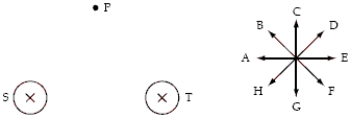
(Multiple Choice)
4.9/5 (88)
(88) A straight wire of length L carries a current I in the positive z direction in a region where the magnetic field is uniform and specified by Bx = 3B, By = −2B, and Bz = B, where B is a constant. What is the magnitude of the magnetic force on the wire?
(Multiple Choice)
4.7/5 (85)
(85) A straight wire is bent into the shape shown. Determine the net magnetic force on the wire when the current I travels in the direction shown in the magnetic field  .
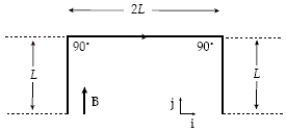
. (Multiple Choice)
4.9/5 (89)
(89) A charged particle (m = 5.0 g, q = −70 μC) moves horizontally at a constant speed of 30 km/s in a region where the free fall gravitational acceleration is 9.8 m/s2 downward, the electric field is 700 N/C upward, and the magnetic field is perpendicular to the velocity of the particle. What is the magnitude of the magnetic field in this region?
(Multiple Choice)
4.9/5 (89)
(89) The point P lies along the perpendicular bisector of the line connecting two long straight wires S and T that are perpendicular to the page. A set of directions A through H is shown next to the diagram. When the two equal currents in the wires are directed up out of the page, the direction of the magnetic field at P is closest to the direction of 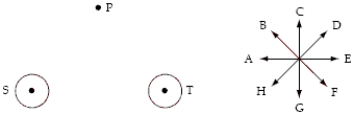
(Multiple Choice)
4.9/5 (83)
(83) An unusual lightning strike has a vertical portion with a positive current of +400 A upwards. The Earth's magnetic field at that location is parallel to the ground and has a magnitude of 30 μT. In N, the force exerted by the Earth's magnetic field on the 25 m-long current is
(Multiple Choice)
4.9/5 (68)
(68) A stream of electrons passes through a velocity filter where the crossed magnetic and electric fields are 0.020 T and 5.00 × 10⁴ V/m, respectively. Find the kinetic energy (in electron volts) of the electrons passing through the filter. [1 eV = 1.60 × 10⁻¹⁹ J]
(Short Answer)
4.7/5 (87)
(87) What value of B should be used in a velocity selector to separate out 2.0-keV protons if E is fixed at 80 kV/m?
(Multiple Choice)
4.7/5 (85)
(85) A circular coil (radius = 0.40 m) has 160 turns and is in a uniform magnetic field. When the orientation of the coil is varied through all possible positions, the maximum torque on the coil by magnetic forces is 0.16 N ⋅ m when the current in the coil is 4.0 mA. What is the magnitude of the magnetic field?
(Multiple Choice)
4.7/5 (79)
(79) An electron moves in a region where the magnetic field is uniform, has a magnitude of 60 μT, and points in the positive x direction. At t = 0 the electron has a velocity that has an x component of 30 km/s, a y component of 40 km/s, and a z component of zero. What is the radius of the resulting helical path?
(Multiple Choice)
5.0/5 (80)
(80) A magnetic field is directed out of the page. Two charged particles enter from the top and take the paths shown in the figure. Which statement is correct? 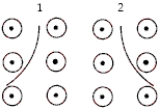
(Multiple Choice)
5.0/5 (87)
(87) What is the radius of curvature of the path of a 3.0-keV proton in a perpendicular magnetic field of magnitude 0.80 T?
(Multiple Choice)
4.8/5 (78)
(78) A square loop (L = 0.20 m) consists of 50 closely wrapped turns, each carrying a current of 0.50 A. The loop is oriented as shown in a uniform magnetic field of 0.40 T directed in the positive y direction. What is the magnitude of the torque on the loop? 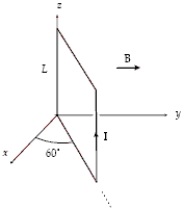
(Multiple Choice)
4.8/5 (76)
(76) A particle (m = 3.0 μg, q = 5.0 μC) moves in a uniform magnetic field given by (  ) mT. At t = 0 the velocity of the particle is equal to (
 ) m/s. The subsequent path of the particle is
) mT. At t = 0 the velocity of the particle is equal to ( ) m/s. The subsequent path of the particle is (Multiple Choice)
4.9/5 (75)
(75) A rectangular coil (0.20 m × 0.80 m) has 200 turns and is in a uniform magnetic field of 0.30 T. When the orientation of the coil is varied through all possible positions, the maximum torque on the coil by magnetic forces is 0.080 N ⋅ m. What is the current in the coil?
(Multiple Choice)
4.7/5 (84)
(84) A 2.0-m wire carries a current of 15 A directed along the positive x axis in a region where the magnetic field is uniform and given by B = (30  − 40
 ) mT. What is the resulting magnetic force on the wire?
− 40 ) mT. What is the resulting magnetic force on the wire? (Multiple Choice)
4.8/5 (88)
(88) A uniform magnetic field of 0.50 T is directed along the positive x axis. A proton moving with a speed of 60 km/s enters this field. The helical path followed by the proton shown has a pitch of 5.0 mm. Determine the angle between the magnetic field and the velocity of the proton. 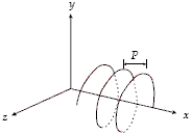
(Multiple Choice)
4.9/5 (62)
(62) An electron follows a circular path (radius = 15 cm) in a uniform magnetic field (magnitude = 3.0 G). What is the period of this motion?
(Multiple Choice)
5.0/5 (70)
(70) A straight wire carries a current of 40 A in a uniform magnetic field (magnitude = 80 mT). If the force per unit length on this wire is 2.0 N/m, determine the angle between the wire and the magnetic field.
(Multiple Choice)
5.0/5 (77)
(77) 
Filters
- Essay(0)
- Multiple Choice(0)
- Short Answer(0)
- True False(0)
- Matching(0)