



 Chat with AI
Exam 29: Magnetic Fields

Exam 1: Physics and Measurement25 Questions
Exam 2: Motion in One Dimension66 Questions
Exam 3: Vectors47 Questions
Exam 4: Motion in Two Dimensions79 Questions
Exam 5: The Laws of Motion113 Questions
Exam 6: Circular Motion and Other Applications of Newtons Laws55 Questions
Exam 7: Energy of a System74 Questions
Exam 8: Conservation of Energy84 Questions
Exam 9: Linear Momentum and Collisions89 Questions
Exam 10: Rotation of a Rigid Object About a Fixed Axis82 Questions
Exam 11: Angular Momentum46 Questions
Exam 12: Static Equilibrium and Elasticity34 Questions
Exam 13: Universal Gravitation47 Questions
Exam 14: Fluid Mechanics53 Questions
Exam 15: Oscillatory Motion41 Questions
Exam 16: Wave Motion82 Questions
Exam 18: Superposition and Standing Waves72 Questions
Exam 19: Temperature47 Questions
Exam 20: The First Law of Thermodynamics61 Questions
Exam 21: The Kinetic Theory of Gases38 Questions
Exam 22: Heat Engines, Entropy, and the Second Law of Thermodynamics55 Questions
Exam 23: Electric Fields67 Questions
Exam 24: Gausss Law82 Questions
Exam 25: Electric Potential111 Questions
Exam 26: Capacitance and Dielectrics63 Questions
Exam 27: Current and Resistance34 Questions
Exam 28: Direct-Current Circuits84 Questions
Exam 29: Magnetic Fields80 Questions
Exam 30: Sources of the Magnetic Field95 Questions
Exam 31: Faradays Law62 Questions
Exam 32: Inductance23 Questions
Exam 33: Alternating-Current Circuits65 Questions
Exam 34: Electromagnetic Waves40 Questions
Exam 35: The Nature of Light and the Principles of Ray Optics37 Questions
Exam 36: Image Formation43 Questions
Exam 37: Wave Optics48 Questions
Exam 38: Diffraction Patterns and Polarization47 Questions
Exam 39: Relativity34 Questions
Exam 40: Introduction to Quantum Physics48 Questions
Exam 41: Quantum Mechanics33 Questions
Exam 42: Atomic Physics59 Questions
Exam 43: Molecules and Solids46 Questions
Exam 44: Nuclear Structure89 Questions
Exam 46: Particle Physics and Cosmology34 Questions
Select questions type


A proton is accelerated from rest through a potential difference of 150 V. It then enters a region of uniform magnetic field and moves in a circular path (radius = 12 cm). What is the magnitude of the magnetic field in this region?
(Multiple Choice)
4.9/5  (74)
(74) The point P lies along the perpendicular bisector of the line connecting two long straight wires S and T perpendicular to the page. A set of directions A through H is shown next to the diagram. When the two equal currents in the wires are directed into the page, the direction of the magnetic field at P is closest to the direction of 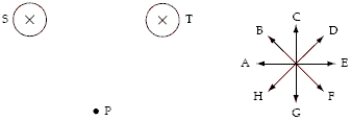
(Multiple Choice)
4.9/5 (72)
(72) A charged particle moves in a region of uniform magnetic field along a helical path (radius = 4.0 cm, pitch = 20 cm, period = 2.0 ms). What is the speed of the particle as it moves along this path?
(Multiple Choice)
4.9/5 (90)
(90) The magnetic field in a region of space is parallel to the surface of a long flat table. Imagine that this page is lying flat on the table. When current is present in the coil, which is lying on the table, the coil tends to rotate so that the left side moves up and the right side moves down. The magnetic field is 
(Multiple Choice)
4.7/5 (77)
(77) Equal charges, one at rest, the other having a velocity of 104 m/s, are released in a uniform magnetic field. Which charge has the largest force exerted on it by the magnetic field?
(Multiple Choice)
5.0/5 (86)
(86) A wire (mass = 50 g, length = 40 cm) is suspended horizontally by two vertical wires which conduct a current I = 8.0 A, as shown in the figure. The magnetic field in the region is into the paper and has a magnitude of 60 mT. What is the tension in either wire? 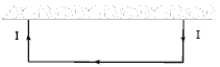
(Multiple Choice)
4.9/5 (88)
(88) The figure shows the orientation of a rectangular loop consisting of 80 closely wrapped turns each carrying a current I. The magnetic field in the region is (  ) mT. The loop can turn about the y axis. If θ = 30°, a = 0.40 m, b = 0.30 m, and I = 8.0 A, what is the magnitude of the torque exerted on the loop?
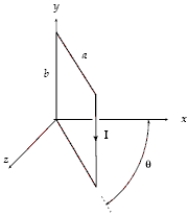
) mT. The loop can turn about the y axis. If θ = 30°, a = 0.40 m, b = 0.30 m, and I = 8.0 A, what is the magnitude of the torque exerted on the loop? (Multiple Choice)
4.8/5 (73)
(73) A charged particle (m = 2.0 g, q = −50 μC) moves in a region of uniform field along a helical path (radius = 4.0 cm, pitch = 8.0 cm) as shown. What is the angle between the velocity of the particle and the magnetic field? 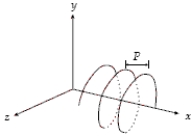
(Multiple Choice)
4.8/5 (81)
(81) A current loop is oriented in three different positions relative to a uniform magnetic field. In position 1 the plane of the loop is perpendicular to the field lines. In position 2 and 3 the plane of the loop is parallel to the field as shown. The torque on the loop is maximum in 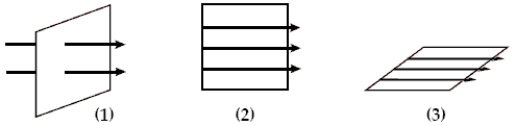
(Multiple Choice)
4.8/5 (72)
(72) A straight wire of length 70 cm carries a current of 50 A and makes an angle of 60° with a uniform magnetic field. If the force on the wire is 1.0 N what is the magnitude of B?
(Multiple Choice)
4.8/5 (83)
(83) The diagram below shows the position of a long straight wire perpendicular to the page and a set of directions labeled A through H. When the current in the wire is directed up out of the page, the direction of the magnetic field at point P is 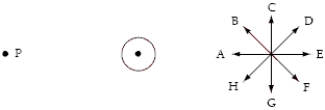
(Multiple Choice)
4.8/5 (83)
(83) A thin ribbon of a silver alloy 2.00-cm wide and 0.015 0-mm thick carries a current of 6.98 A perpendicular to a magnetic field. The Hall voltage is found to be 1.24 × 10⁻⁴ V when the magnetic field is 2.50 T. Calculate n, the number of charge carriers per cubic meter.
(Short Answer)
4.7/5 (70)
(70) A charged particle moves in a region of uniform magnetic field along a helical path (radius = 5.0 cm, pitch = 12 cm, period = 5.0 ms). What is the speed of this particle as it moves along this path?
(Multiple Choice)
4.8/5 (86)
(86) You stand near the earth's equator. A positively charged particle that starts moving parallel to the surface of the earth in a straight line directed east is initially deflected upwards. If you know there are no electric fields in the vicinity, a possible reason why the particle does not initially acquire a downward component of velocity is because near the equator the magnetic field lines of the earth are directed
(Multiple Choice)
4.8/5 (85)
(85) A segment of wire carries a current of 25 A along the x axis from x = −2.0 m to x = 0 and then along the y axis from y = 0 to y = 3.0 m. In this region of space, the magnetic field is equal to 40 mT in the positive z direction. What is the magnitude of the force on this segment of wire?
(Multiple Choice)
4.7/5 (91)
(91) The diagram below shows the position of a long straight wire perpendicular to the page and a set of directions labeled A through H. 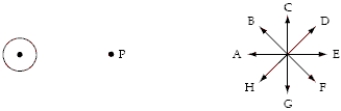 When the current in the wire is directed up out of the page, the direction of the magnetic field at point P is
 (Multiple Choice)
4.8/5 (84)
(84) A circular loop (radius = 0.50 m) carries a current of 3.0 A and has unit normal vector of (  )/3. What is the x component of the torque on this loop when it is placed in a uniform magnetic field of (
 )T?
)/3. What is the x component of the torque on this loop when it is placed in a uniform magnetic field of ( )T? (Multiple Choice)
4.8/5 (74)
(74) A straight wire is bent into the shape shown. Determine the net magnetic force on the wire. 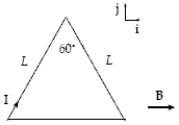
(Multiple Choice)
4.9/5 (84)
(84) A deuteron is accelerated from rest through a 10-kV potential difference and then moves perpendicularly to a uniform magnetic field with B = 1.6 T. What is the radius of the resulting circular path? (deuteron: m = 3.3 × 10⁻²⁷ kg, q = 1.6 × 10⁻¹⁹ C)
(Multiple Choice)
5.0/5 (77)
(77) The reason the north pole of a bar magnet free to rotate points north is because
(Multiple Choice)
4.8/5 (73)
(73) 
Filters
- Essay(0)
- Multiple Choice(0)
- Short Answer(0)
- True False(0)
- Matching(0)