



 Chat with AI
Exam 30: Sources of the Magnetic Field

Exam 1: Physics and Measurement25 Questions
Exam 2: Motion in One Dimension66 Questions
Exam 3: Vectors47 Questions
Exam 4: Motion in Two Dimensions79 Questions
Exam 5: The Laws of Motion113 Questions
Exam 6: Circular Motion and Other Applications of Newtons Laws55 Questions
Exam 7: Energy of a System74 Questions
Exam 8: Conservation of Energy84 Questions
Exam 9: Linear Momentum and Collisions89 Questions
Exam 10: Rotation of a Rigid Object About a Fixed Axis82 Questions
Exam 11: Angular Momentum46 Questions
Exam 12: Static Equilibrium and Elasticity34 Questions
Exam 13: Universal Gravitation47 Questions
Exam 14: Fluid Mechanics53 Questions
Exam 15: Oscillatory Motion41 Questions
Exam 16: Wave Motion82 Questions
Exam 18: Superposition and Standing Waves72 Questions
Exam 19: Temperature47 Questions
Exam 20: The First Law of Thermodynamics61 Questions
Exam 21: The Kinetic Theory of Gases38 Questions
Exam 22: Heat Engines, Entropy, and the Second Law of Thermodynamics55 Questions
Exam 23: Electric Fields67 Questions
Exam 24: Gausss Law82 Questions
Exam 25: Electric Potential111 Questions
Exam 26: Capacitance and Dielectrics63 Questions
Exam 27: Current and Resistance34 Questions
Exam 28: Direct-Current Circuits84 Questions
Exam 29: Magnetic Fields80 Questions
Exam 30: Sources of the Magnetic Field95 Questions
Exam 31: Faradays Law62 Questions
Exam 32: Inductance23 Questions
Exam 33: Alternating-Current Circuits65 Questions
Exam 34: Electromagnetic Waves40 Questions
Exam 35: The Nature of Light and the Principles of Ray Optics37 Questions
Exam 36: Image Formation43 Questions
Exam 37: Wave Optics48 Questions
Exam 38: Diffraction Patterns and Polarization47 Questions
Exam 39: Relativity34 Questions
Exam 40: Introduction to Quantum Physics48 Questions
Exam 41: Quantum Mechanics33 Questions
Exam 42: Atomic Physics59 Questions
Exam 43: Molecules and Solids46 Questions
Exam 44: Nuclear Structure89 Questions
Exam 46: Particle Physics and Cosmology34 Questions
Select questions type


A long hollow cylindrical conductor (inner radius = 2.0 mm, outer radius = 4.0 mm) carries a current of 24 A distributed uniformly across its cross section. A long wire which is coaxial with the cylinder carries an equal current in the opposite direction. What is the magnitude of the magnetic field 3.0 mm from the axis?
(Multiple Choice)
4.7/5  (80)
(80) If a = 2.0 cm, b = 5.0 cm, and I = 20 A, what is the magnitude of the magnetic field at the point P? 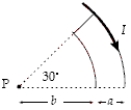
(Multiple Choice)
4.8/5 (77)
(77) Two long parallel wires separated by 4.0 mm each carry a current of 24 A. These two currents are in the same direction. What is the magnitude of the magnetic field at a point that is between the two wires and 1.0 mm from one of the two wires?
(Multiple Choice)
4.8/5 (90)
(90) A long straight wire carries a current of 40 A in a region where a uniform external magnetic field has a 30-μT magnitude and is parallel to the current. What is the magnitude of the resultant magnetic field at a point that is 20 cm from the wire?
(Multiple Choice)
4.8/5 (91)
(91) In the figure, if a = 2.0 cm, b = 4.0 cm, and I = 2.0 A, what is the magnitude of the magnetic field at point P? 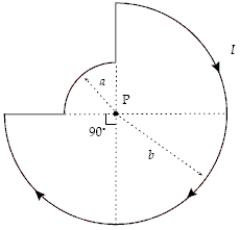
(Multiple Choice)
4.9/5 (70)
(70) When a ferromagnetic material that has been magnetized is brought to a temperature greater than the Curie temperature, what happens to its residual magnetism.
(Multiple Choice)
4.8/5 (61)
(61) Two very long parallel wires carry currents in the positive x direction. One wire (current = 15 A) is coincident with the x axis. The other wire (current = 50 A) passes through the point (0, 4.0 mm, 0). What is the magnitude of the magnetic field at the point (0, 0, 3.0 mm)?
(Multiple Choice)
4.9/5 (103)
(103) The segment of wire (total length = 6R, including the incoming and outgoing portions of the wire) is formed into the shape shown and carries a current I. What is the magnitude of the resulting magnetic field at the point P? 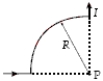
(Multiple Choice)
4.8/5 (75)
(75) Two current loops are coaxial and coplanar. One has radius a and the other has radius 2a. Current 2I in the outer loop is parallel to current I in the inner loop. The magnitude of the magnetic field at the center of the two loops is
(Multiple Choice)
4.8/5 (78)
(78) What is the magnitude of the magnetic field at point P if a = R and b = 2R? 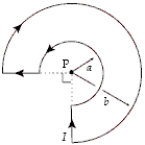
(Multiple Choice)
4.9/5 (78)
(78) A long solenoid (n = 1200 turns/m, radius = 2.0 cm) has a current of a 0.30 A in its winding. A long wire carrying a current of 20 A is parallel to and 1.0 cm from the axis of the solenoid. What is the magnitude of the resulting magnetic field at a point on the axis of the solenoid?
(Multiple Choice)
4.8/5 (82)
(82) Equal currents of magnitude I travel into the page in wires M and N. Eight directions are indicated by letters A through H. 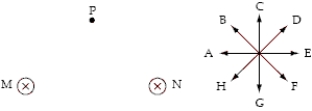 The direction of the magnetic field at point P is
 (Multiple Choice)
4.9/5 (71)
(71) We find that N current loops are coplanar and coaxial. The first has radius a and current I. The second has radius 2a and current 2I, and the pattern is repeated up to the Nth, which has radius Na and current NI. The current in each loop is counterclockwise as seen from above. The magnitude of the magnetic field at the center of the loops is
(Multiple Choice)
4.8/5 (79)
(79) Three long, straight, parallel wires each carry a current of 10 A in the positive x direction. If the distance between each wire and the other two is 10 cm, what is the magnitude of the magnetic force on a 20-cm length of either of the wires?
(Multiple Choice)
5.0/5 (81)
(81) A solenoid 4.0 cm in radius and 4.0 m in length has 8 000 uniformly spaced turns and carries a current of 5.0 A. Consider a plane circular surface (radius = 2.0 cm) located at the center of the solenoid with its axis coincident with the axis of the solenoid. What is the magnetic flux through this surface? (1 Wb = 1 T ⋅ m2)
(Multiple Choice)
5.0/5 (77)
(77) 
Filters
- Essay(0)
- Multiple Choice(0)
- Short Answer(0)
- True False(0)
- Matching(0)