



 Chat with AI
Exam 30: Sources of the Magnetic Field

Exam 1: Physics and Measurement25 Questions
Exam 2: Motion in One Dimension66 Questions
Exam 3: Vectors47 Questions
Exam 4: Motion in Two Dimensions79 Questions
Exam 5: The Laws of Motion113 Questions
Exam 6: Circular Motion and Other Applications of Newtons Laws55 Questions
Exam 7: Energy of a System74 Questions
Exam 8: Conservation of Energy84 Questions
Exam 9: Linear Momentum and Collisions89 Questions
Exam 10: Rotation of a Rigid Object About a Fixed Axis82 Questions
Exam 11: Angular Momentum46 Questions
Exam 12: Static Equilibrium and Elasticity34 Questions
Exam 13: Universal Gravitation47 Questions
Exam 14: Fluid Mechanics53 Questions
Exam 15: Oscillatory Motion41 Questions
Exam 16: Wave Motion82 Questions
Exam 18: Superposition and Standing Waves72 Questions
Exam 19: Temperature47 Questions
Exam 20: The First Law of Thermodynamics61 Questions
Exam 21: The Kinetic Theory of Gases38 Questions
Exam 22: Heat Engines, Entropy, and the Second Law of Thermodynamics55 Questions
Exam 23: Electric Fields67 Questions
Exam 24: Gausss Law82 Questions
Exam 25: Electric Potential111 Questions
Exam 26: Capacitance and Dielectrics63 Questions
Exam 27: Current and Resistance34 Questions
Exam 28: Direct-Current Circuits84 Questions
Exam 29: Magnetic Fields80 Questions
Exam 30: Sources of the Magnetic Field95 Questions
Exam 31: Faradays Law62 Questions
Exam 32: Inductance23 Questions
Exam 33: Alternating-Current Circuits65 Questions
Exam 34: Electromagnetic Waves40 Questions
Exam 35: The Nature of Light and the Principles of Ray Optics37 Questions
Exam 36: Image Formation43 Questions
Exam 37: Wave Optics48 Questions
Exam 38: Diffraction Patterns and Polarization47 Questions
Exam 39: Relativity34 Questions
Exam 40: Introduction to Quantum Physics48 Questions
Exam 41: Quantum Mechanics33 Questions
Exam 42: Atomic Physics59 Questions
Exam 43: Molecules and Solids46 Questions
Exam 44: Nuclear Structure89 Questions
Exam 46: Particle Physics and Cosmology34 Questions
Select questions type


Two wires, each having a weight per unit length of 1.0 × 10⁻⁴ N/m, are strung parallel, one 0.10 m above the other. If the wires carry the same current, though in opposite directions, how great must the current in each wire be for the magnetic field of the lower conductor to balance the weight of the upper conductor?
(Short Answer)
4.8/5  (69)
(69) By using a compass to measure the magnetic field direction at various points adjacent to a long straight wire, you can show that the wire's magnetic field lines are
(Multiple Choice)
4.9/5 (69)
(69) The figure shows a cross section of three parallel wires each carrying a current of 15 A. The currents in wires A and C are out of the paper, while that in wire B is into the paper. If the distance R = 5.0 mm, what is the magnitude of the force on a 4.0-m length of wire C? 
(Multiple Choice)
4.9/5 (79)
(79) Two long parallel wires are separated by 2.0 cm. The current in one of the wires is three times the other current. If the magnitude of the force on a 2.0-m length of one of the wires is equal to 60 μN, what is the greater of the two currents?
(Multiple Choice)
4.8/5 (79)
(79) The planetary model of the hydrogen atom consists of an electron in a circular orbit about a proton. The motion of the electron of charge 1.60 × 10⁻¹⁹ C creates an electric current. The radius of the electron orbit is 5.30 × 10⁻¹¹ m and the electron's velocity is 2.20 × 10⁶ m/s. What is the magnetic field strength at the location of the proton?
(Short Answer)
4.9/5 (81)
(81) A segment of wire of total length 2.0 m is formed into a circular loop having 5.0 turns. If the wire carries a 1.2-A current, determine the magnitude of the magnetic field at the center of the loop.
(Multiple Choice)
4.9/5 (71)
(71) A long cylindrical wire (radius = 2.0 cm) carries a current of 40 A that is uniformly distributed over a cross section of the wire. What is the magnitude of the magnetic field at a point which is 1.5 cm from the axis of the wire?
(Multiple Choice)
4.8/5 (75)
(75) A hollow cylindrical (inner radius = 1.0 mm, outer radius = 3.0 mm) conductor carries a current of 80 A parallel to its axis. This current is uniformly distributed over a cross section of the conductor. Determine the magnitude of the magnetic field at a point that is 2.0 mm from the axis of the conductor.
(Multiple Choice)
4.8/5 (74)
(74) Two solenoids of equal length are each made of 2000 turns of copper wire per meter. Solenoid I has a 5.00 cm radius; solenoid II a 10.0 cm radius. When equal currents are present in the two solenoids, the ratio of the magnitude of the magnetic field BI along the axis of solenoid I to the magnitude of the magnetic field BII along the axis of solenoid II, BI/BII, is
(Multiple Choice)
4.9/5 (68)
(68) Two long parallel wires separated by 5.0 mm each carry a current of 60 A. These two currents are oppositely directed. What is the magnitude of the magnetic field at a point that is between the two wires and 2.0 mm from one of the two wires?
(Multiple Choice)
4.8/5 (79)
(79) A long wire is known to have a radius greater than 4.0 mm and to carry a current uniformly distributed over its cross section. If the magnitude of the magnetic field is 0.285 mT at a point 4.0 mm from the axis of the wire and 0.200 mT at a point 10 mm from the axis, what is the radius of the wire?
(Multiple Choice)
4.7/5 (78)
(78) A straight wire (length = 8.0 m) is bent to form a square. If the wire carries a current of 20 A, what is the magnitude of the magnetic field at the center of the square?
(Multiple Choice)
4.8/5 (84)
(84) A long, straight wire (radius = 2.0 mm) carries a current of 2.0 A distributed uniformly over a cross section perpendicular to the axis of the wire. What is the magnitude of the magnetic field at a distance of 1.0 mm from the axis of the wire?
(Multiple Choice)
4.8/5 (82)
(82) Two parallel and coaxial current loops of radius a are placed a distance 2L apart. When you look along the axis at the loops, the current in one is clockwise, and counterclockwise in the other. At a point on the axis half way between the loops the magnetic field in T has magnitude
(Multiple Choice)
4.8/5 (68)
(68) Three coplanar parallel straight wires carry equal currents I to the right as shown below. Each pair of wires is a distance a apart. The direction of the magnetic force on the middle wire 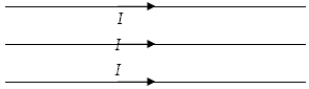
(Multiple Choice)
4.9/5 (80)
(80) The magnetic moment of an electron (charge = −e; mass = me) moving in a circular orbit of radius r with speed v about a nucleus of mass mN is proportional to
(Multiple Choice)
4.8/5 (81)
(81) On the average, in a ferromagnetic domain permanent atomic magnetic moments are aligned ____ to one another.
(Multiple Choice)
4.9/5 (83)
(83) A current-carrying 2.0-cm long segment of wire is inside a long solenoid (radius = 4.0 cm, n = 800 turns/m, current = 50 mA). The wire segment is oriented perpendicularly to the axis of the solenoid. If the current in the wire segment is 12 A, what is the magnitude of the magnetic force on this segment?
(Multiple Choice)
4.9/5 (82)
(82) A long wire carries a current of 3.0 A along the axis of a long solenoid (radius = 3.0 cm, n = 900 turns/m, current = 30 mA). What is the magnitude of the magnetic field at a point 2.0 cm from the axis of the solenoid? Neglect any end effects.
(Multiple Choice)
4.8/5 (76)
(76) What is the magnitude of the magnetic field at point P if a = R and b = 2R? 
(Multiple Choice)
4.8/5 (76)
(76) 
Filters
- Essay(0)
- Multiple Choice(0)
- Short Answer(0)
- True False(0)
- Matching(0)