



 Chat with AI
Exam 30: Sources of the Magnetic Field

Exam 1: Physics and Measurement25 Questions
Exam 2: Motion in One Dimension66 Questions
Exam 3: Vectors47 Questions
Exam 4: Motion in Two Dimensions79 Questions
Exam 5: The Laws of Motion113 Questions
Exam 6: Circular Motion and Other Applications of Newtons Laws55 Questions
Exam 7: Energy of a System74 Questions
Exam 8: Conservation of Energy84 Questions
Exam 9: Linear Momentum and Collisions89 Questions
Exam 10: Rotation of a Rigid Object About a Fixed Axis82 Questions
Exam 11: Angular Momentum46 Questions
Exam 12: Static Equilibrium and Elasticity34 Questions
Exam 13: Universal Gravitation47 Questions
Exam 14: Fluid Mechanics53 Questions
Exam 15: Oscillatory Motion41 Questions
Exam 16: Wave Motion82 Questions
Exam 18: Superposition and Standing Waves72 Questions
Exam 19: Temperature47 Questions
Exam 20: The First Law of Thermodynamics61 Questions
Exam 21: The Kinetic Theory of Gases38 Questions
Exam 22: Heat Engines, Entropy, and the Second Law of Thermodynamics55 Questions
Exam 23: Electric Fields67 Questions
Exam 24: Gausss Law82 Questions
Exam 25: Electric Potential111 Questions
Exam 26: Capacitance and Dielectrics63 Questions
Exam 27: Current and Resistance34 Questions
Exam 28: Direct-Current Circuits84 Questions
Exam 29: Magnetic Fields80 Questions
Exam 30: Sources of the Magnetic Field95 Questions
Exam 31: Faradays Law62 Questions
Exam 32: Inductance23 Questions
Exam 33: Alternating-Current Circuits65 Questions
Exam 34: Electromagnetic Waves40 Questions
Exam 35: The Nature of Light and the Principles of Ray Optics37 Questions
Exam 36: Image Formation43 Questions
Exam 37: Wave Optics48 Questions
Exam 38: Diffraction Patterns and Polarization47 Questions
Exam 39: Relativity34 Questions
Exam 40: Introduction to Quantum Physics48 Questions
Exam 41: Quantum Mechanics33 Questions
Exam 42: Atomic Physics59 Questions
Exam 43: Molecules and Solids46 Questions
Exam 44: Nuclear Structure89 Questions
Exam 46: Particle Physics and Cosmology34 Questions
Select questions type


Two solenoids are each made of 2 000 turns of copper wire per meter. Solenoid I is 2 m long, while solenoid II is 1 m long. When equal currents are present in the two solenoids, the ratio of the magnetic field BI along the axis of solenoid I to the magnetic field BII along the axis of solenoid II, BI/BII, is
(Multiple Choice)
4.7/5  (86)
(86) A toroid is made of 2 000 turns of wire of radius 2.00 cm formed into a donut shape of inner radius 10.0 cm and outer radius 14.0 cm. When a 30.0-A current is present in the toroid, the magnetic field at a distance of 11.0 cm from the center of the toroid is
(Multiple Choice)
4.8/5 (76)
(76) Each of two parallel wires separated by 8.0 mm carries a 20-A current. These two currents are oppositely directed. Determine the magnitude of the magnetic field at a point that is 5.0 mm from each of the wires.
(Multiple Choice)
4.9/5 (74)
(74) A long straight wire (diameter = 2.0 mm) carries a current of 25 A. What is the magnitude of the magnetic field 0.50 mm from the axis of the wire?
(Multiple Choice)
4.8/5 (94)
(94) What current in a solenoid 15.0-cm long wound with 100 turns would produce a magnetic field equal to that of the Earth, 5.00 × 10⁻⁵ T?
(Short Answer)
4.8/5 (88)
(88) When a microwave filter consisting of vertical parallel metal rods is in the absorbing position, oscillating currents are set up in the rods. At any one instant, the current in each rod has the same magnitude and direction. At that instant
(Multiple Choice)
4.8/5 (77)
(77) One long wire carries a current of 30 A along the entire x axis. A second long wire carries a current of 40 A perpendicular to the xy plane and passes through the point (0, 4, 0) m. What is the magnitude of the resulting magnetic field at the point y = 2.0 m on the y axis?
(Multiple Choice)
4.7/5 (74)
(74) Two long straight wires carry currents perpendicular to the xy plane. One carries a current of 50 A and passes through the point x = 5.0 cm on the x axis. The second wire has a current of 80 A and passes through the point y = 4.0 cm on the y axis. What is the magnitude of the resulting magnetic field at the origin?
(Multiple Choice)
4.9/5 (95)
(95) Two long parallel wires each carry a current of 5.0 A directed to the east. The two wires are separated by 8.0 cm. What is the magnitude of the magnetic field at a point that is 5.0 cm from each of the wires?
(Multiple Choice)
5.0/5 (86)
(86) A superconducting wire carries a current of 1.0 × 10⁴ A. Find the magnetic field at a distance of 1.0 m from the wire.
(Short Answer)
4.8/5 (96)
(96) Two long parallel wires carry unequal currents in opposite directions. The ratio of the currents is 3 to 1. The magnitude of the magnetic field at a point in the plane of the wires and 10 cm from each wire is 4.0 μT. What is the larger of the two currents?
(Multiple Choice)
4.7/5 (73)
(73) A hollow cylindrical (inner radius = 2.0 mm, outer radius = 4.0 mm) conductor carries a current of 24 A parallel to its axis. This current is uniformly distributed over a cross section of the conductor. Determine the magnitude of the magnetic field at a point that is 5.0 mm from the axis of the conductor.
(Multiple Choice)
4.7/5 (94)
(94) If a = 1.0 cm, b = 3.0 cm, and I = 30 A, what is the magnitude of the magnetic field at point P? 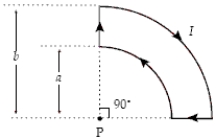
(Multiple Choice)
4.9/5 (71)
(71) If you were to travel parallel to an infinitely long straight wire with current I at the same velocity as the electrons in the wire at a distance a from the wire, the magnitude of the magnetic field (according to your measuring instruments) would be
(Multiple Choice)
4.8/5 (92)
(92) Two long parallel wires are separated by 4.0 cm. One of the wires carries a current of 20 A and the other carries a 30-A current. Determine the magnitude of the magnetic force on a 2.0-m length of the wire carrying the greater current.
(Multiple Choice)
4.8/5 (87)
(87) A long wire lies in a tangle on the surface of a table, as shown below. When a current is run through the wire as shown, the largest component of the magnetic field at X points 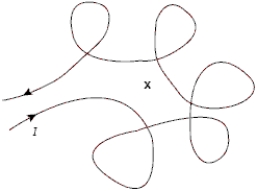
(Multiple Choice)
5.0/5 (72)
(72) Three long wires parallel to the x axis carry currents as shown. If I = 20 A, what is the magnitude of the magnetic field at the origin? 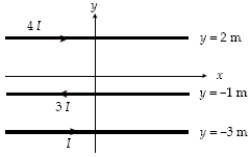
(Multiple Choice)
4.9/5 (66)
(66) A conducting rod with a square cross section (3.0 cm × 3.0 cm) carries a current of 60 A that is uniformly distributed across the cross section. What is the magnitude of the (line) integral  around a square path (1.5 cm × 1.5 cm) if the path is centered on the center of the rod and lies in a plane perpendicular to the axis of the rod?
 (Multiple Choice)
5.0/5 (78)
(78) Which of the following type(s) of materials is(are) repelled when a magnet is brought near by?
(Multiple Choice)
4.9/5 (87)
(87) Equal currents of magnitude I travel into the page in wire M and out of the page in wire N. Eight directions are indicated by letters A through H. 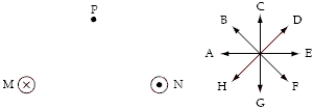 The direction of the magnetic field at point P is
 (Multiple Choice)
4.7/5 (90)
(90) 
Filters
- Essay(0)
- Multiple Choice(0)
- Short Answer(0)
- True False(0)
- Matching(0)