



 Chat with AI
Exam 2: Motion in One Dimension

Exam 1: Physics and Measurement25 Questions
Exam 2: Motion in One Dimension66 Questions
Exam 3: Vectors47 Questions
Exam 4: Motion in Two Dimensions79 Questions
Exam 5: The Laws of Motion113 Questions
Exam 6: Circular Motion and Other Applications of Newtons Laws55 Questions
Exam 7: Energy of a System74 Questions
Exam 8: Conservation of Energy84 Questions
Exam 9: Linear Momentum and Collisions89 Questions
Exam 10: Rotation of a Rigid Object About a Fixed Axis82 Questions
Exam 11: Angular Momentum46 Questions
Exam 12: Static Equilibrium and Elasticity34 Questions
Exam 13: Universal Gravitation47 Questions
Exam 14: Fluid Mechanics53 Questions
Exam 15: Oscillatory Motion41 Questions
Exam 16: Wave Motion82 Questions
Exam 18: Superposition and Standing Waves72 Questions
Exam 19: Temperature47 Questions
Exam 20: The First Law of Thermodynamics61 Questions
Exam 21: The Kinetic Theory of Gases38 Questions
Exam 22: Heat Engines, Entropy, and the Second Law of Thermodynamics55 Questions
Exam 23: Electric Fields67 Questions
Exam 24: Gausss Law82 Questions
Exam 25: Electric Potential111 Questions
Exam 26: Capacitance and Dielectrics63 Questions
Exam 27: Current and Resistance34 Questions
Exam 28: Direct-Current Circuits84 Questions
Exam 29: Magnetic Fields80 Questions
Exam 30: Sources of the Magnetic Field95 Questions
Exam 31: Faradays Law62 Questions
Exam 32: Inductance23 Questions
Exam 33: Alternating-Current Circuits65 Questions
Exam 34: Electromagnetic Waves40 Questions
Exam 35: The Nature of Light and the Principles of Ray Optics37 Questions
Exam 36: Image Formation43 Questions
Exam 37: Wave Optics48 Questions
Exam 38: Diffraction Patterns and Polarization47 Questions
Exam 39: Relativity34 Questions
Exam 40: Introduction to Quantum Physics48 Questions
Exam 41: Quantum Mechanics33 Questions
Exam 42: Atomic Physics59 Questions
Exam 43: Molecules and Solids46 Questions
Exam 44: Nuclear Structure89 Questions
Exam 46: Particle Physics and Cosmology34 Questions
Select questions type


A peregrine falcon dives at a pigeon. The falcon starts with zero downward velocity and falls with the acceleration of gravity. If the pigeon is 76.0 m below the initial height of the falcon, how long does it take the falcon to intercept the pigeon?
(Short Answer)
4.9/5  (81)
(81) The position of an object at equal time intervals is shown below:  Which graph below correctly represents position versus time for this object?
 (Multiple Choice)
4.8/5 (81)
(81) The position of a particle moving along the x axis is given by x = (21 + 22t − 6.0t2)m, where t is in s. What is the average velocity during the time interval t = 1.0 s to t = 3.0 s?
(Multiple Choice)
4.7/5 (92)
(92) The position of a particle moving along the y axis has a position given by 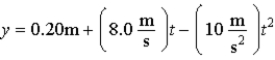 Is there any time interval during which the particle is not moving?
 (Multiple Choice)
4.7/5 (78)
(78) The position of a particle as it moves along the x axis is given by x = 15e−2t m, where t is in s. What is the acceleration of the particle at t = 1.0 s?
(Multiple Choice)
4.9/5 (77)
(77) The velocity at the midway point of a ball able to reach a height y when thrown with velocity vi at the origin is:
(Multiple Choice)
4.9/5 (75)
(75) 
Filters
- Essay(0)
- Multiple Choice(0)
- Short Answer(0)
- True False(0)
- Matching(0)