



 Chat with AI
Exam 2: Motion in One Dimension

Exam 1: Physics and Measurement25 Questions
Exam 2: Motion in One Dimension66 Questions
Exam 3: Vectors47 Questions
Exam 4: Motion in Two Dimensions79 Questions
Exam 5: The Laws of Motion113 Questions
Exam 6: Circular Motion and Other Applications of Newtons Laws55 Questions
Exam 7: Energy of a System74 Questions
Exam 8: Conservation of Energy84 Questions
Exam 9: Linear Momentum and Collisions89 Questions
Exam 10: Rotation of a Rigid Object About a Fixed Axis82 Questions
Exam 11: Angular Momentum46 Questions
Exam 12: Static Equilibrium and Elasticity34 Questions
Exam 13: Universal Gravitation47 Questions
Exam 14: Fluid Mechanics53 Questions
Exam 15: Oscillatory Motion41 Questions
Exam 16: Wave Motion82 Questions
Exam 18: Superposition and Standing Waves72 Questions
Exam 19: Temperature47 Questions
Exam 20: The First Law of Thermodynamics61 Questions
Exam 21: The Kinetic Theory of Gases38 Questions
Exam 22: Heat Engines, Entropy, and the Second Law of Thermodynamics55 Questions
Exam 23: Electric Fields67 Questions
Exam 24: Gausss Law82 Questions
Exam 25: Electric Potential111 Questions
Exam 26: Capacitance and Dielectrics63 Questions
Exam 27: Current and Resistance34 Questions
Exam 28: Direct-Current Circuits84 Questions
Exam 29: Magnetic Fields80 Questions
Exam 30: Sources of the Magnetic Field95 Questions
Exam 31: Faradays Law62 Questions
Exam 32: Inductance23 Questions
Exam 33: Alternating-Current Circuits65 Questions
Exam 34: Electromagnetic Waves40 Questions
Exam 35: The Nature of Light and the Principles of Ray Optics37 Questions
Exam 36: Image Formation43 Questions
Exam 37: Wave Optics48 Questions
Exam 38: Diffraction Patterns and Polarization47 Questions
Exam 39: Relativity34 Questions
Exam 40: Introduction to Quantum Physics48 Questions
Exam 41: Quantum Mechanics33 Questions
Exam 42: Atomic Physics59 Questions
Exam 43: Molecules and Solids46 Questions
Exam 44: Nuclear Structure89 Questions
Exam 46: Particle Physics and Cosmology34 Questions
Select questions type


A rocket, initially at rest, is fired vertically with an upward acceleration of 10 m/s2. At an altitude of 0.50 km, the engine of the rocket cuts off. What is the maximum altitude it achieves?
(Multiple Choice)
4.9/5  (87)
(87) A toy rocket, launched from the ground, rises vertically with an acceleration of 20 m/s2 for 6.0 s until its motor stops. Disregarding any air resistance, what maximum height above the ground will the rocket achieve?
(Multiple Choice)
4.8/5 (83)
(83) In 2.0 s, a particle moving with constant acceleration along the x axis goes from x = 10 m to x = 50 m. The velocity at the end of this time interval is 10 m/s. What is the acceleration of the particle?
(Multiple Choice)
4.9/5 (87)
(87) An object is thrown downward with an initial (t = 0) speed of 10 m/s from a height of 60 m above the ground. At the same instant (t = 0), a second object is propelled vertically upward from ground level with a speed of 40 m/s. At what height above the ground will the two objects pass each other?
(Multiple Choice)
4.8/5 (81)
(81) Vx is the velocity of a particle moving along the x axis as shown. If x = 2.0 m at t = 1.0 s, what is the position of the particle at t = 6.0 s? 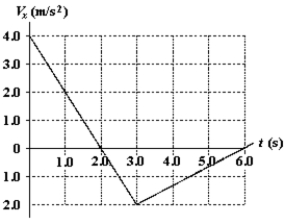
(Multiple Choice)
4.7/5 (82)
(82) In 20 minutes, Kara ran 2.40 km on a treadmill facing due east. Relative to the gym, what were her displacement and average velocity during this time interval?
(Multiple Choice)
4.8/5 (69)
(69) A particle starts from rest at xi = 0 and moves for 10 s with an acceleration of +2.0 cm/s2. For the next 20 s, the acceleration of the particle is −1.0 cm/s2. What is the position of the particle at the end of this motion?
(Multiple Choice)
4.9/5 (71)
(71) An automobile traveling along a straight road increases its speed from 30.0 m/s to 50.0 m/s in a distance of 180 m. If the acceleration is constant, how much time elapses while the auto moves this distance?
(Multiple Choice)
4.8/5 (81)
(81) The graph below shows the velocity versus time graph for a ball. Which explanation best fits the motion of the ball as shown by the graph? 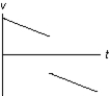
(Multiple Choice)
4.8/5 (84)
(84) At t = 0, a particle is located at x = 25 m and has a velocity of 15 m/s in the positive x direction. The acceleration of the particle varies with time as shown in the diagram. What is the position of the particle at t = 5.0 s? 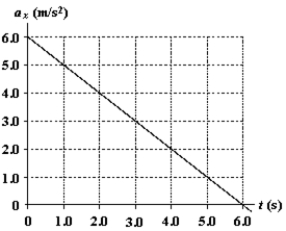
(Multiple Choice)
4.9/5 (79)
(79) A speedy tortoise can run with a velocity of 10.0 cm/s and a hare can run 20.0 times as fast. In a race, they both start at the same time, but the hare stops to rest for 2.00 minutes. The tortoise wins by a shell (20.0 cm). What was the length of the race?
(Short Answer)
4.9/5 (76)
(76) A problem may be solved more easily when alternative representations are used. The best strategy is to formulate representations in an order that assists in understanding the physical principles involved. Of the orders given below, the one that will work best most often is
(Multiple Choice)
5.0/5 (79)
(79) A 50-gram superball traveling at 25.0 m/s is bounced off a brick wall and rebounds at 22.0 m/s. A high-speed camera records this event. If the ball is in contact with the wall for 3.50 ms, what is the average acceleration of the ball during this time interval?
(Short Answer)
4.9/5 (90)
(90) Two identical balls are at rest and side by side at the top of a hill. You let one ball, A, start rolling down the hill. A little later you start the second ball, B, down the hill by giving it a shove. The second ball rolls down the hill along a line parallel to the path of the first ball and passes it. At the instant ball B passes ball A:
(Multiple Choice)
4.8/5 (70)
(70) A skier leaves a ski jump with a horizontal velocity of 29.4 m/s. The instant before she lands three seconds later, the magnitudes of the horizontal and vertical components of her velocity are:
(Multiple Choice)
4.9/5 (76)
(76) Two identical balls are at rest side by side at the bottom of a hill. Some time after ball A is kicked up the hill, ball B is given a kick up the hill. Ball A is headed downhill when it passes ball B headed up the hill. At the instant when ball A passes ball B,
(Multiple Choice)
4.7/5 (90)
(90) A boy on a skate board skates off a horizontal bench at a velocity of 10 m/s. One tenth of a second after he leaves the bench, to two significant figures, the magnitudes of his velocity and acceleration are:
(Multiple Choice)
4.8/5 (76)
(76) A stone is thrown from the top of a building with an initial velocity of 20 m/s downward. The top of the building is 60 m above the ground. How much time elapses between the instant of release and the instant of impact with the ground?
(Multiple Choice)
4.8/5 (77)
(77) A proton moving along the x axis has an initial velocity of 4.0 × 10⁶ m/s and a constant acceleration of 6.0 × 10¹² m/s2. What is the velocity of the proton after it has traveled a distance of 80 cm?
(Multiple Choice)
5.0/5 (77)
(77)  . The problem is:

Filters
- Essay(0)
- Multiple Choice(0)
- Short Answer(0)
- True False(0)
- Matching(0)