



 Chat with AI
Exam 2: Motion in One Dimension

Exam 1: Physics and Measurement25 Questions
Exam 2: Motion in One Dimension66 Questions
Exam 3: Vectors47 Questions
Exam 4: Motion in Two Dimensions79 Questions
Exam 5: The Laws of Motion113 Questions
Exam 6: Circular Motion and Other Applications of Newtons Laws55 Questions
Exam 7: Energy of a System74 Questions
Exam 8: Conservation of Energy84 Questions
Exam 9: Linear Momentum and Collisions89 Questions
Exam 10: Rotation of a Rigid Object About a Fixed Axis82 Questions
Exam 11: Angular Momentum46 Questions
Exam 12: Static Equilibrium and Elasticity34 Questions
Exam 13: Universal Gravitation47 Questions
Exam 14: Fluid Mechanics53 Questions
Exam 15: Oscillatory Motion41 Questions
Exam 16: Wave Motion82 Questions
Exam 18: Superposition and Standing Waves72 Questions
Exam 19: Temperature47 Questions
Exam 20: The First Law of Thermodynamics61 Questions
Exam 21: The Kinetic Theory of Gases38 Questions
Exam 22: Heat Engines, Entropy, and the Second Law of Thermodynamics55 Questions
Exam 23: Electric Fields67 Questions
Exam 24: Gausss Law82 Questions
Exam 25: Electric Potential111 Questions
Exam 26: Capacitance and Dielectrics63 Questions
Exam 27: Current and Resistance34 Questions
Exam 28: Direct-Current Circuits84 Questions
Exam 29: Magnetic Fields80 Questions
Exam 30: Sources of the Magnetic Field95 Questions
Exam 31: Faradays Law62 Questions
Exam 32: Inductance23 Questions
Exam 33: Alternating-Current Circuits65 Questions
Exam 34: Electromagnetic Waves40 Questions
Exam 35: The Nature of Light and the Principles of Ray Optics37 Questions
Exam 36: Image Formation43 Questions
Exam 37: Wave Optics48 Questions
Exam 38: Diffraction Patterns and Polarization47 Questions
Exam 39: Relativity34 Questions
Exam 40: Introduction to Quantum Physics48 Questions
Exam 41: Quantum Mechanics33 Questions
Exam 42: Atomic Physics59 Questions
Exam 43: Molecules and Solids46 Questions
Exam 44: Nuclear Structure89 Questions
Exam 46: Particle Physics and Cosmology34 Questions
Select questions type


The area under a graph of ax vs. t from t = ti to t = tf represents
(Multiple Choice)
4.9/5  (76)
(76) An object is thrown vertically and has an upward velocity of 18 m/s when it reaches one fourth of its maximum height above its launch point. What is the initial (launch) speed of the object?
(Multiple Choice)
4.9/5 (95)
(95) A juggler throws two balls to the same height so that one is at the halfway point going up when the other is at the halfway point coming down. At that point:
(Multiple Choice)
4.9/5 (86)
(86) A rock is thrown downward from an unknown height above the ground with an initial speed of 10 m/s. It strikes the ground 3.0 s later. Determine the initial height of the rock above the ground.
(Multiple Choice)
4.8/5 (75)
(75) To help Kim practice for the Special Olympics, Sally runs beside him for half the required distance. She runs the remaining distance at her regular speed and arrives 90 seconds ahead of Kim. What is the ratio of Sally's regular speed to Kim's speed? Use tKim for Kim's total time.
(Multiple Choice)
4.8/5 (83)
(83) An object is thrown vertically upward such that it has a speed of 25 m/s when it reaches two thirds of its maximum height above the launch point. Determine this maximum height.
(Multiple Choice)
4.9/5 (86)
(86) A particle moving with a constant acceleration has a velocity of 20 cm/s when its position is x = 10 cm. Its position 7.0 s later is x = −30 cm. What is the acceleration of the particle?
(Multiple Choice)
4.9/5 (78)
(78) A particle confined to motion along the x axis moves with constant acceleration from x = 2.0 m to x = 8.0 m during a 2.5-s time interval. The velocity of the particle at x = 8.0 m is 2.8 m/s. What is the acceleration during this time interval?
(Multiple Choice)
4.7/5 (62)
(62) A ball thrown vertically from ground level is caught 3.0 s later when it is at its highest point by a person on a balcony which is 14 m above the ground. Determine the initial speed of the ball.
(Multiple Choice)
5.0/5 (78)
(78) The speed of an object is given by  where v is in m/s and t is in s.What is the acceleration of the object at t = 2.00 s?
 (Multiple Choice)
4.9/5 (99)
(99) Dallas says that any change in velocity is directly proportional to the time interval over which the change took place. Dana says that is true only when the acceleration is constant. Which one, if either, is correct?
(Multiple Choice)
4.8/5 (85)
(85) The area under a graph of vx vs. t from t = ti to t = tf represents
(Multiple Choice)
4.9/5 (84)
(84) A particle is moving with a constant acceleration of 4.0 m/s2. Its speed at t = 1.0 s is 4.0 m/s and at t = 3.0 s it is 12.0 m/s. What is the area under the position-time graph for the interval from t = 1.0 s to t = 3.0 s?
(Multiple Choice)
4.8/5 (68)
(68) The position of a particle moving along the x axis is given by x = 6.0t2 − 1.0t3, where x is in meters and t in seconds. What is the position of the particle when it achieves its maximum speed in the positive x direction?
(Multiple Choice)
4.9/5 (70)
(70) A car originally traveling at 30 m/s manages to brake for 5.0 seconds while traveling 125 m downhill. At that point the brakes fail. After an additional 5.0 seconds it travels an additional 150 m down the hill. What was the acceleration of the car after the brakes failed?
(Short Answer)
4.7/5 (76)
(76) The position of a particle as it moves along the x axis is given for t > 0 by x = (t3 − 3t2 + 6t) m, where t is in s. Where is the particle when it achieves its minimum speed (after t = 0)?
(Multiple Choice)
4.8/5 (83)
(83) At t = 0, a particle is located at x = 25 m and has a velocity of 15 m/s in the positive x direction. The acceleration of the particle varies with time as shown in the diagram. What is the velocity of the particle at t = 5.0 s? 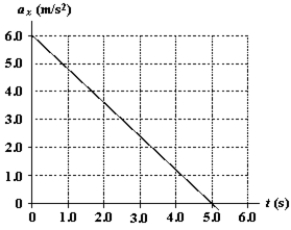
(Multiple Choice)
4.9/5 (77)
(77) A particle is moving at constant velocity. Its position at t = 1.0 s is 3.0 m and its position at t = 4.0 s is 15.0 m. What is the slope of the position-time graph for this particle?
(Multiple Choice)
4.9/5 (90)
(90) Two children start at one end of a street, the origin, run to the other end, then head back. On the way back Joan is ahead of Mike. Which statement is correct about the distances run and the displacements from the origin?
(Multiple Choice)
4.9/5 (95)
(95) When starting from rest at the bottom of a straight road with constant upward slope, Joan bicycles to the top 50.0 s ahead of Sally, whose travel time is 5.00 minutes. What is the ratio of Joan's acceleration to Sally's acceleration?
(Multiple Choice)
4.8/5 (84)
(84) 
Filters
- Essay(0)
- Multiple Choice(0)
- Short Answer(0)
- True False(0)
- Matching(0)