



 Chat with AI
Exam 34: The Origin and Evolution of Vertebrates

Exam 1: Introduction: Themes in the Study of Life64 Questions
Exam 2: The Chemical Context of Life83 Questions
Exam 3: Water and Life70 Questions
Exam 4: Carbon and the Molecular Diversity of Life71 Questions
Exam 5: The Structure and Function of Large Biological Molecules109 Questions
Exam 6: A Tour of the Cell80 Questions
Exam 7: Membrane Structure and Function80 Questions
Exam 8: An Introduction to Metabolism80 Questions
Exam 9: Cellular Respiration and Fermentation107 Questions
Exam 10: Photosynthesis81 Questions
Exam 11: Cell Communication69 Questions
Exam 12: The Cell Cycle79 Questions
Exam 13: Meiosis and Sexual Life Cycles70 Questions
Exam 14: Mendel and the Gene Idea73 Questions
Exam 15: The Chromosomal Basis of Inheritance61 Questions
Exam 16: The Molecular Basis of Inheritance57 Questions
Exam 17: From Gene to Protein83 Questions
Exam 18: Regulation of Gene Expression99 Questions
Exam 19: Viruses47 Questions
Exam 20: Biotechnology72 Questions
Exam 21: Genomes and Their Evolution42 Questions
Exam 22: Descent with Modification: A Darwinian View of Life55 Questions
Exam 23: The Evolution of Populations78 Questions
Exam 24: The Origin of Species63 Questions
Exam 25: The History of Life on Earth75 Questions
Exam 26: Phylogeny and the Tree of Life73 Questions
Exam 27: Bacteria and Archaea78 Questions
Exam 28: Protists76 Questions
Exam 29: Plant Diversity I: How Plants Colonized Land74 Questions
Exam 30: Plant Diversity II: The Evolution of Seed Plants102 Questions
Exam 31: Fungi89 Questions
Exam 32: An Overview of Animal Diversity74 Questions
Exam 33: An Introduction to Invertebrates93 Questions
Exam 34: The Origin and Evolution of Vertebrates109 Questions
Exam 35: Plant Structure, Growth, and Development67 Questions
Exam 36: Resource Acquisition and Transport in Vascular Plants82 Questions
Exam 37: Soil and Plant Nutrition83 Questions
Exam 38: Angiosperm Reproduction and Biotechnology86 Questions
Exam 39: Plant Responses to Internal and External Signals108 Questions
Exam 40: Basic Principles of Animal Form and Function77 Questions
Exam 41: Animal Nutrition64 Questions
Exam 42: Circulation and Gas Exchange90 Questions
Exam 43: The Immune System100 Questions
Exam 44: Osmoregulation and Excretion69 Questions
Exam 45: Hormones and the Endocrine System72 Questions
Exam 46: Animal Reproduction94 Questions
Exam 47: Animal Development92 Questions
Exam 48: Neurons, Synapses, and Signaling73 Questions
Exam 49: Nervous Systems65 Questions
Exam 50: Sensory and Motor Mechanisms82 Questions
Exam 51: Animal Behavior69 Questions
Exam 52: An Introduction to Ecology and the Biosphere73 Questions
Exam 53: Population Ecology79 Questions
Exam 54: Community Ecology77 Questions
Exam 55: Ecosystems and Restoration Ecology81 Questions
Exam 56: Conservation Biology and Global Change67 Questions
Select questions type


In the United States and Canada, bats use one of two strategies to survive winter: They either migrate south, or they hibernate. Recently, those that hibernate seem to have come under attack by a fungus, Geomyces destructans (Gd), an attack that is occurring from Missouri to southern Canada. Many infected bats have a delicate, white filamentous mat on their muzzles, which is referred to as white-nose syndrome (WNS). The fungus invades the bat tissues, causes discomfort, and awakens the bat from its hibernation. The bat fidgets and wastes calories, using up its stored fat. The bat then behaves abnormally, leaving its cave during daytime in winter to search for food. Their food, primarily insects, is scarce during the winter, and the bats ultimately starve to death. Since 2007, it is estimated that up to 1 million bats have perished from WNS.
-Gd is a cold-loving fungus. Thus, which characteristics of normal bat behavior can be most expected to favor the growth of this fungus?
(Multiple Choice)
4.9/5  (77)
(77) At least one of these has been found in all species of eumetazoan animals studied thus far.
(Multiple Choice)
4.9/5 (86)
(86) Which of the following is the most inclusive (most general)group, all of whose members have foramina magna centrally positioned in the base of the cranium?
(Multiple Choice)
4.8/5 (86)
(86) Regarding its position in the water column, the same thing that happens to a shark when it stops swimming also happens to a
(Multiple Choice)
4.8/5 (93)
(93) Which of these species was apparently the first to craft stone tools?
(Multiple Choice)
4.9/5 (81)
(81) If a physoclistus fish removes gas from its swim bladder, this fish's density cannot actually change until that gas arrives at the
(Multiple Choice)
4.8/5 (75)
(75) Which of the following are the only extant animals that descended directly from dinosaurs?
(Multiple Choice)
4.8/5 (78)
(78) The following questions refer to the description below.
Terry catches a ray-finned fish from the ocean and notices that attached to its flank is an equally long, snakelike organism. The attached organism has no external segmentation, no scales, a round mouth surrounded by a sucker, and two small eyes. Terry thinks it might be a marine leech, a hagfish, or a lamprey.
-Terry takes the body of the snakelike organism and slices it open along its dorsal side. If it is a hagfish, what should Terry see?
(Multiple Choice)
4.9/5 (75)
(75) Which of the following are the most abundant and diverse of the extant vertebrates?
(Multiple Choice)
4.9/5 (78)
(78) The oldest fossil remains of Homo sapiens found so far date from about
(Multiple Choice)
4.8/5 (63)
(63) In order for the four-chambered hearts of birds and mammals to be homologous, which other organisms would have to have had four-chambered hearts?
(Multiple Choice)
4.8/5 (83)
(83) 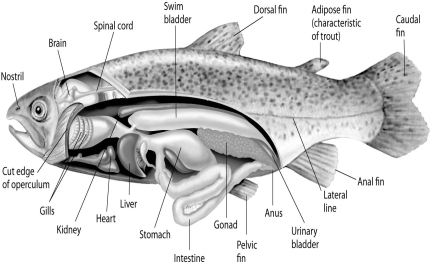 Figure 34.1
Fishes that have swim bladders can regulate their density and, thus, their buoyancy. There are two types of swim bladder: physostomus and physoclistus. The ancestral version is the physostomus version, in which the swim bladder is connected to the esophagus via a short tube (Figure 34.1). The fish fills this version by swimming to the surface, taking gulps of air, and directing them into the swim bladder. Air is removed from this version by "belching." The physoclistus version is more derived, and has lost its connection to the esophagus. Instead, gas enters and leaves the swim bladder via special circulatory mechanisms within the wall of the swim bladder.
-The presence of a swim bladder allows the typical ray-finned fish to stop swimming and still
Figure 34.1
Fishes that have swim bladders can regulate their density and, thus, their buoyancy. There are two types of swim bladder: physostomus and physoclistus. The ancestral version is the physostomus version, in which the swim bladder is connected to the esophagus via a short tube (Figure 34.1). The fish fills this version by swimming to the surface, taking gulps of air, and directing them into the swim bladder. Air is removed from this version by "belching." The physoclistus version is more derived, and has lost its connection to the esophagus. Instead, gas enters and leaves the swim bladder via special circulatory mechanisms within the wall of the swim bladder.
-The presence of a swim bladder allows the typical ray-finned fish to stop swimming and still (Multiple Choice)
4.8/5 (75)
(75) Arrange the following taxonomic terms from most inclusive (most general)to least inclusive (most specific).
1)apes
2)hominins
3)Homo
4 anthropoids
5)primates
(Multiple Choice)
4.9/5 (70)
(70) A new species of aquatic chordate is discovered that closely resembles an ancient form. It has the following characteristics: external armor of bony plates, no paired lateral fins, and a suspension-feeding mode of nutrition. In addition to these, it will probably have which of the following characteristics?
(Multiple Choice)
4.8/5 (78)
(78) Some bird bones are hollow rather than honeycombed. The hollow bones mostly contain air sacs. The replacement of bone marrow with air sacs is properly understood as an adaptation to
(Multiple Choice)
4.8/5 (75)
(75) Which graph properly depicts the relationship between the amount of gas in the swim bladder and the density of the fish?
(Multiple Choice)
4.9/5 (65)
(65) With which of the following statements would a biologist be most inclined to agree?
(Multiple Choice)
4.8/5 (72)
(72) 
Filters
- Essay(0)
- Multiple Choice(0)
- Short Answer(0)
- True False(0)
- Matching(0)