



 Chat with AI
Exam 34: The Origin and Evolution of Vertebrates

Exam 1: Introduction: Themes in the Study of Life64 Questions
Exam 2: The Chemical Context of Life83 Questions
Exam 3: Water and Life70 Questions
Exam 4: Carbon and the Molecular Diversity of Life71 Questions
Exam 5: The Structure and Function of Large Biological Molecules109 Questions
Exam 6: A Tour of the Cell80 Questions
Exam 7: Membrane Structure and Function80 Questions
Exam 8: An Introduction to Metabolism80 Questions
Exam 9: Cellular Respiration and Fermentation107 Questions
Exam 10: Photosynthesis81 Questions
Exam 11: Cell Communication69 Questions
Exam 12: The Cell Cycle79 Questions
Exam 13: Meiosis and Sexual Life Cycles70 Questions
Exam 14: Mendel and the Gene Idea73 Questions
Exam 15: The Chromosomal Basis of Inheritance61 Questions
Exam 16: The Molecular Basis of Inheritance57 Questions
Exam 17: From Gene to Protein83 Questions
Exam 18: Regulation of Gene Expression99 Questions
Exam 19: Viruses47 Questions
Exam 20: Biotechnology72 Questions
Exam 21: Genomes and Their Evolution42 Questions
Exam 22: Descent with Modification: A Darwinian View of Life55 Questions
Exam 23: The Evolution of Populations78 Questions
Exam 24: The Origin of Species63 Questions
Exam 25: The History of Life on Earth75 Questions
Exam 26: Phylogeny and the Tree of Life73 Questions
Exam 27: Bacteria and Archaea78 Questions
Exam 28: Protists76 Questions
Exam 29: Plant Diversity I: How Plants Colonized Land74 Questions
Exam 30: Plant Diversity II: The Evolution of Seed Plants102 Questions
Exam 31: Fungi89 Questions
Exam 32: An Overview of Animal Diversity74 Questions
Exam 33: An Introduction to Invertebrates93 Questions
Exam 34: The Origin and Evolution of Vertebrates109 Questions
Exam 35: Plant Structure, Growth, and Development67 Questions
Exam 36: Resource Acquisition and Transport in Vascular Plants82 Questions
Exam 37: Soil and Plant Nutrition83 Questions
Exam 38: Angiosperm Reproduction and Biotechnology86 Questions
Exam 39: Plant Responses to Internal and External Signals108 Questions
Exam 40: Basic Principles of Animal Form and Function77 Questions
Exam 41: Animal Nutrition64 Questions
Exam 42: Circulation and Gas Exchange90 Questions
Exam 43: The Immune System100 Questions
Exam 44: Osmoregulation and Excretion69 Questions
Exam 45: Hormones and the Endocrine System72 Questions
Exam 46: Animal Reproduction94 Questions
Exam 47: Animal Development92 Questions
Exam 48: Neurons, Synapses, and Signaling73 Questions
Exam 49: Nervous Systems65 Questions
Exam 50: Sensory and Motor Mechanisms82 Questions
Exam 51: Animal Behavior69 Questions
Exam 52: An Introduction to Ecology and the Biosphere73 Questions
Exam 53: Population Ecology79 Questions
Exam 54: Community Ecology77 Questions
Exam 55: Ecosystems and Restoration Ecology81 Questions
Exam 56: Conservation Biology and Global Change67 Questions
Select questions type


The following questions refer to the description below.
Terry catches a ray-finned fish from the ocean and notices that attached to its flank is an equally long, snakelike organism. The attached organism has no external segmentation, no scales, a round mouth surrounded by a sucker, and two small eyes. Terry thinks it might be a marine leech, a hagfish, or a lamprey.
-Terry saved some of the tooth-like objects within the hagfish's round mouth to analyze their composition in his mentor's biochemistry research lab. Terry will find that they are composed of the same protein found in tetrapod
(Multiple Choice)
4.8/5  (75)
(75) The following questions refer to the description below.
While on an intersession course in tropical ecology, Kris pulls a large, snakelike organism from a burrow (the class was granted a collecting permit). The 1-m-long organism has smooth skin, which appears to be segmented. It has two tiny eyes that are hard to see because they seem to be covered by skin. Kris brings it back to the lab at the field station, where it is a source of puzzlement to the class. Kris says that it is a giant oligochaete worm; Shaun suggests it is a legless amphibian; Kelly proposes it belongs to a snake species that is purely fossorial (lives in a burrow).
-Which one of these, if found, should clear up any remaining doubt as to the identity of the organism?
(Multiple Choice)
4.9/5 (81)
(81) The following questions refer to the description below.
Terry catches a ray-finned fish from the ocean and notices that attached to its flank is an equally long, snakelike organism. The attached organism has no external segmentation, no scales, a round mouth surrounded by a sucker, and two small eyes. Terry thinks it might be a marine leech, a hagfish, or a lamprey.
-Having caught and handled a hagfish, what will Terry's shipmates most likely require Terry to do before returning to further fishing?
(Multiple Choice)
4.8/5 (75)
(75) To which of the following are the scales of chondrichthyans most closely related in a structural sense?
(Multiple Choice)
4.9/5 (88)
(88) In the United States and Canada, bats use one of two strategies to survive winter: They either migrate south, or they hibernate. Recently, those that hibernate seem to have come under attack by a fungus, Geomyces destructans (Gd), an attack that is occurring from Missouri to southern Canada. Many infected bats have a delicate, white filamentous mat on their muzzles, which is referred to as white-nose syndrome (WNS). The fungus invades the bat tissues, causes discomfort, and awakens the bat from its hibernation. The bat fidgets and wastes calories, using up its stored fat. The bat then behaves abnormally, leaving its cave during daytime in winter to search for food. Their food, primarily insects, is scarce during the winter, and the bats ultimately starve to death. Since 2007, it is estimated that up to 1 million bats have perished from WNS.
-Gd is a cold-loving fungus. Thus, which characteristics of normal bat behavior can be most expected to favor the spread of this fungus to uninfected bats?
(Multiple Choice)
4.9/5 (82)
(82) At 5, 10, and 15 hours in the graph below, which of the following statements should be true?
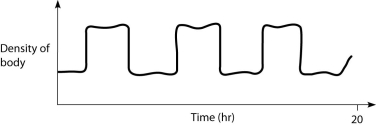
(Multiple Choice)
4.8/5 (78)
(78) Which of these statements about human evolution is correct?
(Multiple Choice)
4.9/5 (90)
(90) What is the single unique characteristic that distinguishes extant birds from other extant vertebrates?
(Multiple Choice)
4.8/5 (85)
(85) Which of the following represents the strongest evidence that two of the three middle ear bones of mammals are homologous to certain reptilian jawbones?
(Multiple Choice)
4.8/5 (79)
(79) Which of these species is currently thought to have coexisted (at the same time and places)with H. neanderthalensis?
(Multiple Choice)
4.7/5 (85)
(85) Which of the following statements about human evolution is correct?
(Multiple Choice)
4.8/5 (88)
(88) Which of these species had members who moved out of Africa?
(Multiple Choice)
4.9/5 (95)
(95) The lamprey species whose larvae live in freshwater streams, but whose adults live most of their lives in seawater, are similar in this respect to certain species of
(Multiple Choice)
4.9/5 (88)
(88) Which of the following is the most inclusive (most general)group, all of whose members have fully opposable thumbs?
(Multiple Choice)
4.8/5 (82)
(82) Which of the following could be considered the most recent common ancestor of living tetrapods?
(Multiple Choice)
4.9/5 (80)
(80) Among extant vertebrates, a sheet of muscle called the diaphragm is found in
(Multiple Choice)
4.9/5 (76)
(76) For the following items, match the extant vertebrate groups with the descriptions.
-Internal fertilization, leathery amniotic egg, and skin that resists drying are characteristics of
(Multiple Choice)
4.8/5 (88)
(88) 
Filters
- Essay(0)
- Multiple Choice(0)
- Short Answer(0)
- True False(0)
- Matching(0)