



 Chat with AI
Exam 34: The Origin and Evolution of Vertebrates

Exam 1: Introduction: Themes in the Study of Life64 Questions
Exam 2: The Chemical Context of Life83 Questions
Exam 3: Water and Life70 Questions
Exam 4: Carbon and the Molecular Diversity of Life71 Questions
Exam 5: The Structure and Function of Large Biological Molecules109 Questions
Exam 6: A Tour of the Cell80 Questions
Exam 7: Membrane Structure and Function80 Questions
Exam 8: An Introduction to Metabolism80 Questions
Exam 9: Cellular Respiration and Fermentation107 Questions
Exam 10: Photosynthesis81 Questions
Exam 11: Cell Communication69 Questions
Exam 12: The Cell Cycle79 Questions
Exam 13: Meiosis and Sexual Life Cycles70 Questions
Exam 14: Mendel and the Gene Idea73 Questions
Exam 15: The Chromosomal Basis of Inheritance61 Questions
Exam 16: The Molecular Basis of Inheritance57 Questions
Exam 17: From Gene to Protein83 Questions
Exam 18: Regulation of Gene Expression99 Questions
Exam 19: Viruses47 Questions
Exam 20: Biotechnology72 Questions
Exam 21: Genomes and Their Evolution42 Questions
Exam 22: Descent with Modification: A Darwinian View of Life55 Questions
Exam 23: The Evolution of Populations78 Questions
Exam 24: The Origin of Species63 Questions
Exam 25: The History of Life on Earth75 Questions
Exam 26: Phylogeny and the Tree of Life73 Questions
Exam 27: Bacteria and Archaea78 Questions
Exam 28: Protists76 Questions
Exam 29: Plant Diversity I: How Plants Colonized Land74 Questions
Exam 30: Plant Diversity II: The Evolution of Seed Plants102 Questions
Exam 31: Fungi89 Questions
Exam 32: An Overview of Animal Diversity74 Questions
Exam 33: An Introduction to Invertebrates93 Questions
Exam 34: The Origin and Evolution of Vertebrates109 Questions
Exam 35: Plant Structure, Growth, and Development67 Questions
Exam 36: Resource Acquisition and Transport in Vascular Plants82 Questions
Exam 37: Soil and Plant Nutrition83 Questions
Exam 38: Angiosperm Reproduction and Biotechnology86 Questions
Exam 39: Plant Responses to Internal and External Signals108 Questions
Exam 40: Basic Principles of Animal Form and Function77 Questions
Exam 41: Animal Nutrition64 Questions
Exam 42: Circulation and Gas Exchange90 Questions
Exam 43: The Immune System100 Questions
Exam 44: Osmoregulation and Excretion69 Questions
Exam 45: Hormones and the Endocrine System72 Questions
Exam 46: Animal Reproduction94 Questions
Exam 47: Animal Development92 Questions
Exam 48: Neurons, Synapses, and Signaling73 Questions
Exam 49: Nervous Systems65 Questions
Exam 50: Sensory and Motor Mechanisms82 Questions
Exam 51: Animal Behavior69 Questions
Exam 52: An Introduction to Ecology and the Biosphere73 Questions
Exam 53: Population Ecology79 Questions
Exam 54: Community Ecology77 Questions
Exam 55: Ecosystems and Restoration Ecology81 Questions
Exam 56: Conservation Biology and Global Change67 Questions
Select questions type


The following questions refer to the phylogenetic tree shown in Figure 34.2.
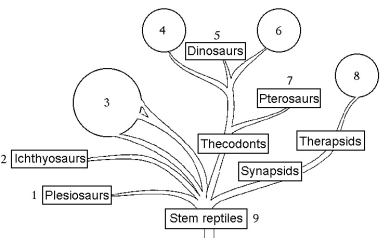 Figure 34.2
-Whose DNA would have had the most sequence homologies with amphibian DNA?
Figure 34.2
-Whose DNA would have had the most sequence homologies with amphibian DNA? (Multiple Choice)
4.8/5  (73)
(73) Which of the following is characteristic of most extant reptiles and most extant mammals?
(Multiple Choice)
5.0/5 (85)
(85) In which vertebrates is fertilization exclusively internal?
(Multiple Choice)
4.9/5 (93)
(93) As hominins diverged from other primates, which of the following appeared first?
(Multiple Choice)
4.9/5 (78)
(78) Why is the discovery of the fossil Archaeopteryx significant? It supports the
(Multiple Choice)
4.9/5 (85)
(85) Chordate pharyngeal slits appear to have functioned first as
(Multiple Choice)
4.9/5 (84)
(84) The earliest known mineralized structures in vertebrates are associated with which function?
(Multiple Choice)
4.7/5 (78)
(78) If a ray-finned fish is to both hover (remain stationary)in the water column and ventilate its gills effectively, then what other structure besides its swim bladder will it use?
(Multiple Choice)
4.9/5 (79)
(79) The following questions refer to the description below.
While on an intersession course in tropical ecology, Kris pulls a large, snakelike organism from a burrow (the class was granted a collecting permit). The 1-m-long organism has smooth skin, which appears to be segmented. It has two tiny eyes that are hard to see because they seem to be covered by skin. Kris brings it back to the lab at the field station, where it is a source of puzzlement to the class. Kris says that it is a giant oligochaete worm; Shaun suggests it is a legless amphibian; Kelly proposes it belongs to a snake species that is purely fossorial (lives in a burrow).
-The adaptation of the body shape of snakes has resulted in one of their lungs becoming vestigial. Another adaptation (to a fossorial lifestyle)is snakes' absence of limbs. If the "mystery organism" has also become adapted to a fossorial lifestyle, though its ancestors moved about on the surface, then which structures should one expect to find upon dissecting the organism?
1)reduced or absent pelvic and/or pectoral girdles
2)metanephridia
3)hydrostatic skeleton
(Multiple Choice)
4.9/5 (73)
(73) A trend first observed in the evolution of the earliest tetrapods was
(Multiple Choice)
4.8/5 (82)
(82) Which of the following statements is correct in regard to Homo erectus?
(Multiple Choice)
4.9/5 (75)
(75) Which of these would a paleontologist be most likely to do in order to determine whether a fossil represents a reptile or a mammal?
(Multiple Choice)
4.8/5 (91)
(91) Which feature of some carinates has the same effect on weight as the presence of air sacs?
(Multiple Choice)
4.9/5 (75)
(75) Which of these characteristics added most to vertebrate success in relatively dry environments?
(Multiple Choice)
5.0/5 (71)
(71) During chordate evolution, what is the sequence (from earliest to most recent)in which the following structures arose?
1)amniotic egg
2)paired fins
3)jaws
4)swim bladder
5)four-chambered heart
(Multiple Choice)
4.9/5 (84)
(84) 
Filters
- Essay(0)
- Multiple Choice(0)
- Short Answer(0)
- True False(0)
- Matching(0)