



 Chat with AI
Exam 15: Organic Compounds and the Atomic Properties of Carbon

Exam 1: Keys to the Study of Chemistry: Definitions, Units, and Problem Solving71 Questions
Exam 2: The Components of Matter101 Questions
Exam 3: Stoichiometry of Formulas and Equations72 Questions
Exam 4: Three Major Classes of Chemical Reactions111 Questions
Exam 5: Gases and the Kinetic-Molecular Theory98 Questions
Exam 6: Thermochemistry: Energy Flow and Chemical Change71 Questions
Exam 7: Quantum Theory and Atomic Structure69 Questions
Exam 8: Electron Configuration and Chemical Periodicity77 Questions
Exam 9: Models of Chemical Bonding61 Questions
Exam 10: The Shapes of Molecules98 Questions
Exam 11: Theories of Covalent Bonding48 Questions
Exam 12: Intermolecular Forces: Liquids, Solids, and Phase Changes95 Questions
Exam 13: The Properties of Mixtures: Solutions and Colloids96 Questions
Exam 14: Periodic Patterns in the Main-Group Elements103 Questions
Exam 15: Organic Compounds and the Atomic Properties of Carbon107 Questions
Exam 16: Kinetics: Rates and Mechanisms of Chemical Reactions78 Questions
Exam 17: Equilibrium: the Extent of Chemical Reactions98 Questions
Exam 18: Acid-Base Equilibria100 Questions
Exam 19: Ionic Equilibria in Aqueous Systems114 Questions
Exam 20: Thermodynamics: Entropy, Free Energy, and Reaction Direction85 Questions
Exam 21: Electrochemistry: Chemical Change and Electrical Work101 Questions
Exam 22: The Elements in Nature and Industry45 Questions
Exam 23: Transition Elements and Their Coordination Compounds81 Questions
Exam 24: Nuclear Reactions and Their Applications82 Questions
Select questions type


Identify the products of the reaction of 3-octene with chlorine. 
(Multiple Choice)
4.7/5  (96)
(96) Which of the following is likely to be an aromatic compound?
(Multiple Choice)
5.0/5 (77)
(77) The millipede ejects the compound shown below to protect itself from its enemies. Identify the functional group circled. 
(Multiple Choice)
4.9/5 (81)
(81) Which of the following is not a constitutional isomer of CH3CH2COOH?
(Multiple Choice)
4.9/5 (70)
(70) One characteristic of the monomers that form condensation polymers that is not common in monomers which form addition polymers is
(Multiple Choice)
5.0/5 (94)
(94) Identify the organic product when cyclopentanol reacts with sulfuric acid. 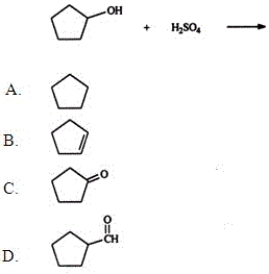
(Multiple Choice)
4.8/5 (78)
(78) Amygdalin (Laetrile) was once touted for its potential anticancer activity. However, the claims were never scientifically verified. Identify the functional group circled. 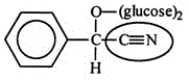
(Multiple Choice)
4.8/5 (76)
(76) The reaction of bromine with an alkene such as cyclopentene is a good laboratory test for the presence of a double bond in a compound. What type of reaction is it? 
(Multiple Choice)
4.7/5 (77)
(77) 
Because organic compounds are associated with living organisms, their properties are governed by fundamentally different chemical principles from those of inorganic compounds.
(True/False)
4.8/5 (82)
(82) Including cyclic compounds, how many possible isomers exist for C4H8?
(Multiple Choice)
4.8/5 (76)
(76) Identify the two principal products of the reaction between ammonia and ethyl propionate. 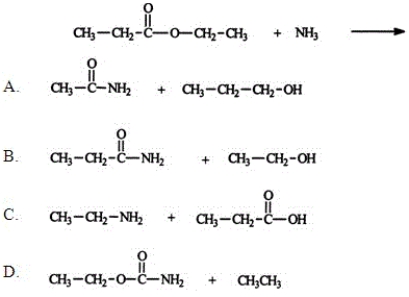
(Multiple Choice)
4.8/5 (81)
(81) Tartaric acid, shown below, is a dihydroxycarboxylic acid. How many chiral centers does it possess? 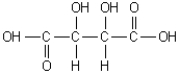
(Multiple Choice)
4.9/5 (73)
(73) Vanillin is a flavoring agent which occurs naturally in the vanilla bean, the seed of an orchid. Identify the functional group circled. 
(Multiple Choice)
4.8/5 (91)
(91) Esters can be formed by the dehydration-condensation of a carboxylic acid and an alcohol.
(True/False)
4.7/5 (89)
(89) 
Filters
- Essay(0)
- Multiple Choice(0)
- Short Answer(0)
- True False(0)
- Matching(0)