



 Chat with AI
Exam 12: Earthquakes and Earths Interior

Exam 1: The Nature of Geology110 Questions
Exam 2: Investigating Geologic Questions106 Questions
Exam 3: Plate Tectonics152 Questions
Exam 4: Earth Materials131 Questions
Exam 5: Igneous Environments147 Questions
Exam 6: Volcanoes and Volcanic Hazards186 Questions
Exam 7: Sedimentary Environments155 Questions
Exam 8: Deformation and Metamorphism144 Questions
Exam 9: Geologic Time126 Questions
Exam 10: Seafloor and Continental Margins105 Questions
Exam 11: Mountains, Basins, and Continents124 Questions
Exam 12: Earthquakes and Earths Interior119 Questions
Exam 13: Climate and Weathering109 Questions
Exam 14: Glaciers, Shorelines, and Changing Sea Levels109 Questions
Exam 15: Weathering, Soil, and Unstable Slopes92 Questions
Exam 16: Streams and Flooding137 Questions
Exam 17: Water Resources142 Questions
Exam 18: Energy and Mineral Resources95 Questions
Exam 19: Geology of the Solar System77 Questions
Select questions type


In order to provide an early warning system, which of the following is LEAST helpful in trying to predict a tsunami?
(Multiple Choice)
4.8/5  (82)
(82) Most large earthquakes on subduction zones occur because of: 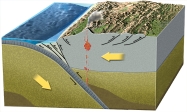
(Multiple Choice)
4.9/5 (89)
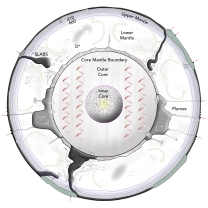
(89) 
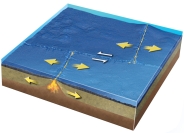
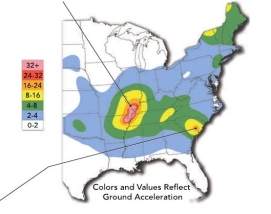
Why does the United States have such varying risks of seismic activity?
(Multiple Choice)
4.9/5 (76)
(76) Which of the following is NOT true about some segments of the San Andreas fault?
(Multiple Choice)
4.8/5 (69)
(69) Which of the following types of faults does NOT generate earthquakes?
(Multiple Choice)
4.8/5 (76)
(76) Using this nomogram, what is the magnitude of an earthquake that is 500 km from a seismic station and has an amplitude of 0.2 mm? 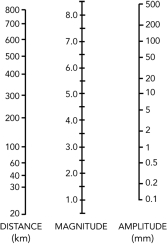
(Multiple Choice)
4.8/5 (85)
(85) What is true about the earthquakes on this figure at points A and B)? 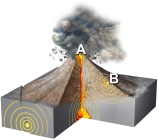
(Multiple Choice)
4.7/5 (60)
(60) In the trench pictured to the right, the information most important to a geologist studying a prehistoric earthquake is: 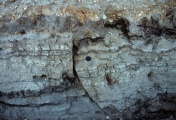
(Multiple Choice)
4.9/5 (71)
(71) 
If an earthquake occurred near the oceanic trench in this figure, which one of the following hazards is likely to threaten the town of Ashton. 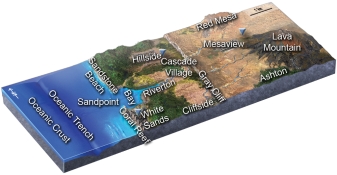
(Multiple Choice)
5.0/5 (78)
(78) The image is a similar cross-section to the one developed by a USGS geologist after the large 1964 Alaska earthquake, showing how uplift from the earthquake was explained by thrusting of the continent over the oceanic crust. How did this support the development of the theory of plate tectonics? 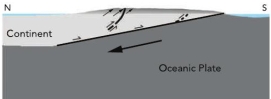
(Multiple Choice)
4.9/5 (95)
(95) If an earthquake occurred near the oceanic trench in this figure, which one of the following hazards is likely to threaten the town of White Sands? 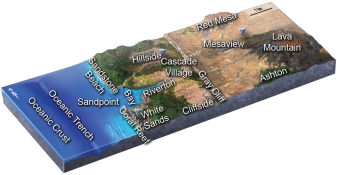
(Multiple Choice)
4.7/5 (85)
(85) 
Filters
- Essay(0)
- Multiple Choice(0)
- Short Answer(0)
- True False(0)
- Matching(0)