



 Chat with AI
Exam 12: Earthquakes and Earths Interior

Exam 1: The Nature of Geology110 Questions
Exam 2: Investigating Geologic Questions106 Questions
Exam 3: Plate Tectonics152 Questions
Exam 4: Earth Materials131 Questions
Exam 5: Igneous Environments147 Questions
Exam 6: Volcanoes and Volcanic Hazards186 Questions
Exam 7: Sedimentary Environments155 Questions
Exam 8: Deformation and Metamorphism144 Questions
Exam 9: Geologic Time126 Questions
Exam 10: Seafloor and Continental Margins105 Questions
Exam 11: Mountains, Basins, and Continents124 Questions
Exam 12: Earthquakes and Earths Interior119 Questions
Exam 13: Climate and Weathering109 Questions
Exam 14: Glaciers, Shorelines, and Changing Sea Levels109 Questions
Exam 15: Weathering, Soil, and Unstable Slopes92 Questions
Exam 16: Streams and Flooding137 Questions
Exam 17: Water Resources142 Questions
Exam 18: Energy and Mineral Resources95 Questions
Exam 19: Geology of the Solar System77 Questions
Select questions type


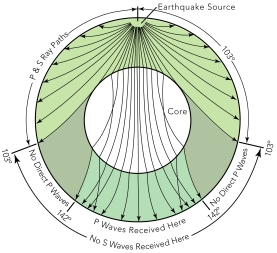

Geologists look at rocks that were once at great depth, create high temperature and pressure conditions for rocks in the laboratory, and develop computer models in order to:
(Multiple Choice)
4.8/5  (86)
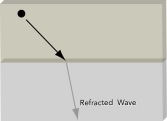
(86) 
In which of the following ways may earthquakes be generated within a continental plate?
(Multiple Choice)
4.9/5 (78)
(78) Which of the following does NOT help explain why refraction causes some seismic waves to return toward Earth's surface? 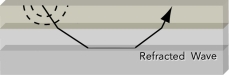
(Multiple Choice)
4.7/5 (85)
(85) Which of the following is a major source of earthquakes associated with continental collisions?
(Multiple Choice)
5.0/5 (88)
(88) On this map of earthquakes near Japan, why do shallow earthquakes occur to the east and deeper earthquakes occur to the west? 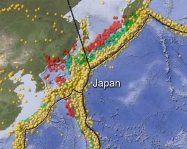
(Multiple Choice)
4.9/5 (80)
(80) Which of the following features was most likely the cause of the earthquake in the Investigation?
(Multiple Choice)
4.8/5 (78)
(78) What likely caused much of the damage shown in this photograph in the 1906 San Francisco earthquake? 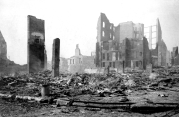
(Multiple Choice)
4.8/5 (75)
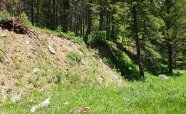
(75) 
In the map to the right, areas of significant earthquake risk are shaded. Most high risk areas will be located: 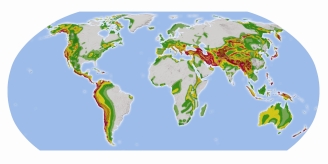
(Multiple Choice)
4.8/5 (73)
(73) Which area did NOT have casualties caused by the Indonesian earthquake of 2004?
(Multiple Choice)
4.8/5 (73)
(73) Six large historical earthquakes occurred on the Parkfield segment of the San Andreas fault prior to 2004, with the last one of these occurring in 1966. The graph to the right plots the actual versus predicted dates of all the earthquakes on the Parkfield segment and shows: 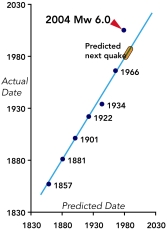
(Multiple Choice)
4.8/5 (56)
(56) 
Filters
- Essay(0)
- Multiple Choice(0)
- Short Answer(0)
- True False(0)
- Matching(0)