



 Chat with AI
Exam 12: Earthquakes and Earths Interior

Exam 1: The Nature of Geology110 Questions
Exam 2: Investigating Geologic Questions106 Questions
Exam 3: Plate Tectonics152 Questions
Exam 4: Earth Materials131 Questions
Exam 5: Igneous Environments147 Questions
Exam 6: Volcanoes and Volcanic Hazards186 Questions
Exam 7: Sedimentary Environments155 Questions
Exam 8: Deformation and Metamorphism144 Questions
Exam 9: Geologic Time126 Questions
Exam 10: Seafloor and Continental Margins105 Questions
Exam 11: Mountains, Basins, and Continents124 Questions
Exam 12: Earthquakes and Earths Interior119 Questions
Exam 13: Climate and Weathering109 Questions
Exam 14: Glaciers, Shorelines, and Changing Sea Levels109 Questions
Exam 15: Weathering, Soil, and Unstable Slopes92 Questions
Exam 16: Streams and Flooding137 Questions
Exam 17: Water Resources142 Questions
Exam 18: Energy and Mineral Resources95 Questions
Exam 19: Geology of the Solar System77 Questions
Select questions type


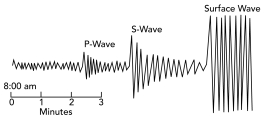

What is the tectonic setting of the large 2011Tohuku earthquake in Japan?
(Multiple Choice)
4.9/5  (69)
(69) Which of the following places did NOT experience a major earthquake?
(Multiple Choice)
4.8/5 (80)
(80) Based on the three seismograms, which seismic station was closest to the epicenter of the earthquake? 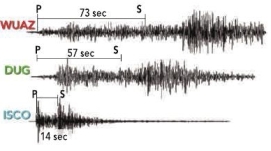
(Multiple Choice)
5.0/5 (79)
(79) If an earthquake occurred near the oceanic trench in this figure, which one of the following hazards is likely to threaten the town of Mesaview? 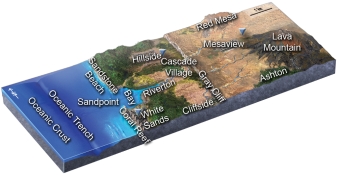
(Multiple Choice)
4.8/5 (79)
(79) The image shows a surface expression of slip along a normal fault caused by an earthquake. What is the indicated feature? 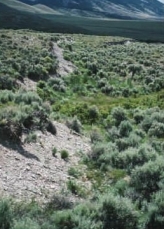
(Multiple Choice)
4.7/5 (76)
(76) Which of the following is true about where earthquakes occur?
(Multiple Choice)
4.9/5 (84)
(84) The southern San Andreas fault near Los Angeles is considered a candidate for a major earthquake because:
(Multiple Choice)
4.9/5 (72)
(72) Which of the following would NOT be a good idea in an area that has a high risk for earthquakes?
(Multiple Choice)
4.8/5 (87)
(87) What features may be common along active faults, like the San Andreas?
(Multiple Choice)
4.7/5 (99)
(99) The top cross section below shows earthquakes along the San Andreas fault before October 17, 1989 and the one on the bottom shows earthquakes along the same fault after that date. These two cross sections illustrate that: 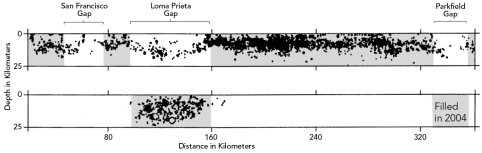
(Multiple Choice)
4.7/5 (81)
(81) What types of information can be gained from trenches dug across a fault?
(Multiple Choice)
5.0/5 (76)
(76) Which of the following may indicate the presence of a fault scarp?
(Multiple Choice)
4.7/5 (91)
(91) If three seismic stations have the following P-S intervals: DUG = 57 sec, WUAZ = 73 sec, ISCO = 14 sec, what is the order from closest station to the earthquake to the one farthest away?
(Multiple Choice)
4.9/5 (75)
(75) The refracted wave shown in the diagram has passed into a material that caused it to: 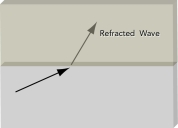
(Multiple Choice)
4.8/5 (75)
(75) On this map of South America and adjacent areas, which site would most likely generate a tsunami? 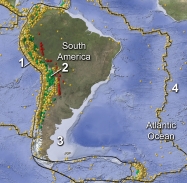
(Multiple Choice)
4.7/5 (72)
(72) Overall, a P-wave increases in velocity with depth. This implies that:
(Multiple Choice)
4.9/5 (64)
(64) 
Filters
- Essay(0)
- Multiple Choice(0)
- Short Answer(0)
- True False(0)
- Matching(0)