



 Chat with AI
Exam 17: Process Cost Systems

Exam 1: Introduction to Accounting and Business243 Questions
Exam 2: Analyzing Transactions234 Questions
Exam 3: The Adjusting Process225 Questions
Exam 4: The Accounting Cycle211 Questions
Exam 5: Accounting for Retail Businesses273 Questions
Exam 6: Inventories236 Questions
Exam 7: Internal Control and Cash197 Questions
Exam 8: Receivables210 Questions
Exam 9: Long-Term Assets: Fixed and Intangible243 Questions
Exam 10: Liabilities: Current, Installment Notes, and Contingencies199 Questions
Exam 11: Liabilities: Bonds Payable172 Questions
Exam 12: Corporations: Organization, Stock Transactions, and Dividends221 Questions
Exam 13: Statement of Cash Flows193 Questions
Exam 14: Financial Statement Analysis206 Questions
Exam 15: Introduction to Managerial Accounting244 Questions
Exam 16: Job Order Costing212 Questions
Exam 17: Process Cost Systems196 Questions
Exam 18: Activity-Based Costing109 Questions
Exam 19: Support Department and Joint Cost Allocation172 Questions
Exam 20: Cost-Volume-Profit Analysis247 Questions
Exam 21: Variable Costing for Management Analysis136 Questions
Exam 22: Budgeting197 Questions
Exam 23: Evaluating Variances From Standard Costs172 Questions
Exam 24: Evaluating Decentralized Operations210 Questions
Exam 25: Differential Analysis and Product Pricing157 Questions
Exam 26: Capital Investment Analysis191 Questions
Exam 27: Lean Manufacturing and Activity Analysis134 Questions
Exam 28: The Balanced Scorecard and Corporate Social Responsibility170 Questions
Exam 29: Investments137 Questions
Select questions type


Match each business that follows to the type of costing system (a or b) it would typically use.
-Movie studio
A)Job order costing
B)Process costing
(Short Answer)
5.0/5  (72)
(72) If the products of a manufacturing process are produced to customer specifications, a process cost system is more appropriate than a job order cost system.
(True/False)
4.8/5 (68)
(68) Match each phrase that follows with the term (a-e) it describes.
-Measures the quantity of output of production relative to the inputs
A)Cost of production report
B)Equivalent units of production
C)First-in, first-out (FIFO) method
D)Last-in, first-out (LIFO) method
E)Whole units
F)Yield
(Short Answer)
4.8/5 (76)
(76) If the principal products of a manufacturing process are identical, a process cost system is more appropriate than a job order cost system.
(True/False)
4.8/5 (81)
(81) The cost of direct materials transferred into the Bottling Department of Mountain Springs Water Company is $27,225. The conversion cost for the period in the Bottling Department is $7,596. The total equivalent units for direct materials and conversion are 60,500 liters and 63,300 liters, respectively. Determine the direct materials and conversion cost per equivalent unit. Round answers to nearest cent.
(Essay)
4.9/5 (73)
(73) Department G had 3,600 units, 40% completed at the beginning of the period, 12,000 units were completed during the period, 2,000 units were 20% completed at the end of the period, and the following manufacturing costs were debited to the departmental work in process account during the period: 
-Assuming that all direct materials are placed in process at the beginning of production and that the first-in, first-out method of inventory costing is used, the materials and conversion cost per unit (rounded to the nearest cent), respectively, are
-Assuming that all direct materials are placed in process at the beginning of production and that the first-in, first-out method of inventory costing is used, the materials and conversion cost per unit (rounded to the nearest cent), respectively, are (Multiple Choice)
4.7/5 (95)
(95) Conversion costs are usually incurred evenly throughout a process.
(True/False)
4.7/5 (92)
(92) The cost per equivalent unit of direct materials and conversion in the Bottling Department of Mountain Springs Water Company is $0.45 and $0.12, respectively. The equivalent units to be assigned costs are as follows: 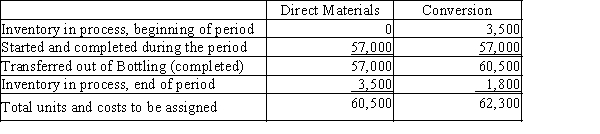 The beginning work in process inventory had a cost of $2,200. Determine the cost of completed and transferred-out production, and the ending work in process inventory.
 (Essay)
4.9/5 (84)
(84) Department G had 3,600 units 25% completed at the beginning of the period, 11,000 units were completed during the period; 3,000 units were 20% completed at the end of the period, and the following manufacturing costs debited to the departmental work in process account during the period:
Work in process, beginning of period
$40,000
Costs added during period:
Direct materials (10,400 units at $8)83,200
Direct labor
63,000
Factory overhead
25,000
-Department R had 5,000 units in work in process that were 75% completed as to labor and overhead at the beginning of the period; 30,000 units of direct materials were added during the period; 32,000 units were completed during the period; and 3,000 units were 40% completed as to labor and overhead at the end of the period. All materials are added at the beginning of the process. The first-in, first-out method is used to cost inventories. The number of equivalent units of production for conversion costs for the period was
(Multiple Choice)
4.8/5 (77)
(77) Mountain Springs Water Company has two departments, Purifying and Bottling. The Bottling Department had 3,000 liters in beginning work in process inventory (30% complete). During the period 71,000 liters were completed. The ending work in process was 5,000 liters (70% completed). What is the total equivalent units for direct materials (using the FIFO method) if materials were added at the beginning of the process?
(Essay)
4.9/5 (89)
(89) Conversion costs include materials, direct labor, and factory overhead.
(True/False)
4.8/5 (64)
(64) Alexandra Company's Molding Department opened on July 1. During July, 70,000 units were completed and transferred out to the next department. On July 31, the 10,000 units that remained in inventory were 40% complete with respect to conversion costs and 100% complete with respect to materials.
How many equivalent units of work did the Molding Department complete during July for materials and conversion costs?
(Essay)
4.7/5 (70)
(70) The cost of direct materials transferred into the Bottling Department of Mountain Springs Water Company is $28,072. The conversion cost for the period in the Bottling Department is $10,275. The total equivalent units for direct materials and conversion are 63,800 and 68,500, respectively. Determine the direct materials and conversion cost per equivalent unit. Round answers to nearest cent.
(Essay)
4.9/5 (81)
(81) The FIFO method of process costing is simpler than the weighted average method.
(True/False)
4.8/5 (83)
(83) Match each phrase that follows with the term (a-h) it describes.
-Prime costs
A)Direct labor and factory overhead
B)Direct labor and direct materials
C)Transferred-in costs
D)Equivalent units
E)Process costing
F)Job order costing
G)First-in, first-out method
H)Cost of production report
(Short Answer)
4.9/5 (80)
(80) Custom-made goods would be accounted for using a process costing system.
(True/False)
4.9/5 (73)
(73) Department A had 5,000 units in work in process that were 60% completed as to labor and overhead at the beginning of the period, 34,000 units of direct materials were added during the period, 31,000 units were completed during the period, and 2,000 units were 80% completed as to labor and overhead at the end of the period. All materials are added at the beginning of the process. The first-in, first-out method is used to cost inventories.
-The number of equivalent units of production for conversion costs for the period was
(Multiple Choice)
4.9/5 (70)
(70) The following unit data were assembled for the assembly process of Super Co. for the month of April. Direct materials are added at the beginning of the process. Conversion costs are added uniformly over the production process. The company uses the FIFO method. 
-The number of equivalent units produced with respect to direct materials costs is
-The number of equivalent units produced with respect to direct materials costs is (Multiple Choice)
4.8/5 (81)
(81) In a process costing system, costs flow into finished goods inventory only from the work in process inventory of the last manufacturing process.
(True/False)
4.8/5 (78)
(78) If the costs for direct materials, direct labor, and factory overhead were $277,300, $52,600, and $61,000, respectively, for 14,000 equivalent units of production, the total conversion cost was $390,900.
(True/False)
4.8/5 (86)
(86) 
Filters
- Essay(0)
- Multiple Choice(0)
- Short Answer(0)
- True False(0)
- Matching(0)