



 Chat with AI
Exam 17: Process Cost Systems

Exam 1: Introduction to Accounting and Business243 Questions
Exam 2: Analyzing Transactions234 Questions
Exam 3: The Adjusting Process225 Questions
Exam 4: The Accounting Cycle211 Questions
Exam 5: Accounting for Retail Businesses273 Questions
Exam 6: Inventories236 Questions
Exam 7: Internal Control and Cash197 Questions
Exam 8: Receivables210 Questions
Exam 9: Long-Term Assets: Fixed and Intangible243 Questions
Exam 10: Liabilities: Current, Installment Notes, and Contingencies199 Questions
Exam 11: Liabilities: Bonds Payable172 Questions
Exam 12: Corporations: Organization, Stock Transactions, and Dividends221 Questions
Exam 13: Statement of Cash Flows193 Questions
Exam 14: Financial Statement Analysis206 Questions
Exam 15: Introduction to Managerial Accounting244 Questions
Exam 16: Job Order Costing212 Questions
Exam 17: Process Cost Systems196 Questions
Exam 18: Activity-Based Costing109 Questions
Exam 19: Support Department and Joint Cost Allocation172 Questions
Exam 20: Cost-Volume-Profit Analysis247 Questions
Exam 21: Variable Costing for Management Analysis136 Questions
Exam 22: Budgeting197 Questions
Exam 23: Evaluating Variances From Standard Costs172 Questions
Exam 24: Evaluating Decentralized Operations210 Questions
Exam 25: Differential Analysis and Product Pricing157 Questions
Exam 26: Capital Investment Analysis191 Questions
Exam 27: Lean Manufacturing and Activity Analysis134 Questions
Exam 28: The Balanced Scorecard and Corporate Social Responsibility170 Questions
Exam 29: Investments137 Questions
Select questions type


If the costs for direct materials, direct labor, and factory overhead were $60,000, $35,000, and $25,000, respectively, for 20,000 equivalent units of production, the conversion cost per equivalent unit was $6.
(True/False)
4.8/5  (69)
(69) Stevens Company's inventory on March 1 and the costs charged to Work in Process-Department B during March are as follows:  During March, all direct materials were transferred from Department A, the units in process at March 1 were completed, and of the 55,000 units entering the department, all were completed except 6,000 units that were 70% completed. Inventories are costed by the first-in, first-out method.
Prepare a cost of production report for March. Round unit cost data to four decimal places and total cost to nearest cent.
During March, all direct materials were transferred from Department A, the units in process at March 1 were completed, and of the 55,000 units entering the department, all were completed except 6,000 units that were 70% completed. Inventories are costed by the first-in, first-out method.
Prepare a cost of production report for March. Round unit cost data to four decimal places and total cost to nearest cent. (Essay)
5.0/5 (95)
(95) Department W had 2,400 units, one-third completed at the beginning of the period; 16,000 units were transferred to Department X from Department W during the period; and 1,800 units were one-half completed at the end of the period. Assume the completion ratios apply to direct materials and conversion costs.
-Blue Lake Water Company has two departments, Purifying and Bottling. The Bottling Department received 76,000 liters from the Purifying Department. During the period, the Bottling Department completed 74,000 liters, including 3,000 liters of work in process at the beginning of the period. The ending work in process was 5,000 liters. The number of liters started and completed during the period is
(Multiple Choice)
4.8/5 (67)
(67) Mocha Company manufactures a single product by a continuous process, involving three production departments. The records indicate that direct materials, direct labor, and applied factory overhead for Department 1 were $100,000, $125,000, and $150,000, respectively. The records further indicate that direct materials, direct labor, and applied factory overhead for Department 2 were $55,000, $65,000, and $80,000, respectively. In addition, work in process at the beginning of the period for Department 1 totaled $75,000, and work in process at the end of the period totaled $60,000.
-The journal entry to record the flow of costs into Department 2 during the period for direct materials is 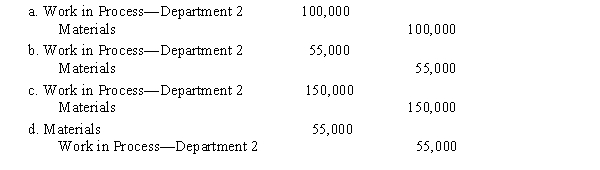
(Short Answer)
4.7/5 (78)
(78) Both process and job order cost systems maintain perpetual inventory accounts with subsidiary ledgers.
(True/False)
4.7/5 (73)
(73) Department A had 1,000 units in Work in Process that were 60% completed at the beginning of the period at a cost of $7,000. During the period, 4,000 units of direct materials were added at a cost of $8,200, and 4,500 units were completed. At the end of the period, 500 units were 40% completed. All materials are added at the beginning of the process. Direct labor was $28,700 and factory overhead was $4,510. The cost of the 500 units in process at the end of the period if the first-in, first-out method is used to cost inventories was
(Multiple Choice)
4.8/5 (72)
(72) Department B had 3,000 units in Work in Process that were 25% completed at the beginning of the period at a cost of $12,500, 13,700 units of direct materials were added during the period at a cost of $28,700, 15,000 units were completed during the period, and 1,700 units were 95% completed at the end of the period. All materials are added at the beginning of the process. Direct labor was $32,450 and factory overhead was $18,710.
-The number of equivalent units of production for the period for materials, if the first-in, first-out method is used to cost inventories, was
(Multiple Choice)
4.9/5 (94)
(94) Industries that typically use process cost systems include chemicals, oil, metals, food, paper, and pharmaceuticals.
(True/False)
5.0/5 (77)
(77) The cost of materials transferred into the Bottling Department of Mountain Springs Water Company is $32,400, with $26,000 from the Purifying Department, plus an additional $6,400 from the materials storeroom. The conversion cost for the period in the Bottling Department is $8,750 ($3,750 factory applied and $5,000 direct labor). The total cost transferred to finished goods for the period was $31,980. The Bottling Department had a beginning inventory of $1,860.
a.Journalize the entries to record the cost of transferred-in materials, conversion costs, and the cost transferred out to finished goods.
b.Determine the balance of Work in Process-Bottling at the end of the period.
(Essay)
4.7/5 (66)
(66) Which of the following would most likely use a process cost system?
(Multiple Choice)
4.8/5 (87)
(87) The following unit data were assembled for the assembly process of Super Co. for the month of April. Direct materials are added at the beginning of the process. Conversion costs are added uniformly over the production process. The company uses the FIFO method. 
-The number of equivalent units produced with respect to conversion costs is
-The number of equivalent units produced with respect to conversion costs is (Multiple Choice)
4.8/5 (95)
(95) In a process costing system, the cost per equivalent unit is computed before computing equivalent units.
(True/False)
4.9/5 (90)
(90) Carmelita Inc. has the following information available: 
-The portion of whole units that were completed with respect to either materials or conversion costs within a given accounting period is the definition of
-The portion of whole units that were completed with respect to either materials or conversion costs within a given accounting period is the definition of (Multiple Choice)
4.9/5 (74)
(74) Companies that use the weighted average method for process costing have unit costs that include costs from more than one accounting period.
(True/False)
4.8/5 (95)
(95) In a process costing system, a separate work in process inventory account is maintained for each customer's job.
(True/False)
4.9/5 (75)
(75) The three categories of manufacturing costs comprising the total cost of work in process are direct labor, direct materials, and
(Multiple Choice)
4.9/5 (70)
(70) Department E had 4,000 units in Work in Process that were 40% completed at the beginning of the period at a cost of $12,500, 14,000 units of direct materials were added during the period at a cost of $28,700, 15,000 units were completed during the period, and 3,000 units were 75% completed at the end of the period. All materials are added at the beginning of the process. Direct labor was $32,450 and factory overhead was $18,710.
-The number of equivalent units of production for the period for conversion if the weighted average method is used to cost inventories was
(Multiple Choice)
4.8/5 (79)
(79) Mocha Company manufactures a single product by a continuous process, involving three production departments. The records indicate that direct materials, direct labor, and applied factory overhead for Department 1 were $100,000, $125,000, and $150,000, respectively. The records further indicate that direct materials, direct labor, and applied factory overhead for Department 2 were $55,000, $65,000, and $80,000, respectively. In addition, work in process at the beginning of the period for Department 1 totaled $75,000, and work in process at the end of the period totaled $60,000.
-The journal entry to record the flow of costs into Department 2 for applied overhead is 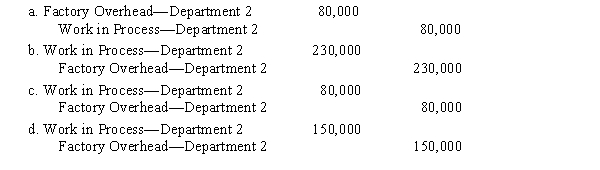
(Short Answer)
4.8/5 (90)
(90) When a process cost accounting system records the purchase of materials, the materials account is credited.
(True/False)
4.8/5 (90)
(90) Match each phrase that follows with the term (a-e) it describes.
-Job order manufacturing and process manufacturing are two major costing systems used in manufacturing. Briefly contrast the characteristics of these two systems.
A)Cost of production report
B)Equivalent units of production
C)First-in, first-out (FIFO) method
D)Last-in, first-out (LIFO) method
E)Whole units
F)Yield
(Essay)
4.8/5 (87)
(87) 
Filters
- Essay(0)
- Multiple Choice(0)
- Short Answer(0)
- True False(0)
- Matching(0)