



 Chat with AI
Exam 17: Process Cost Systems

Exam 1: Introduction to Accounting and Business243 Questions
Exam 2: Analyzing Transactions234 Questions
Exam 3: The Adjusting Process225 Questions
Exam 4: The Accounting Cycle211 Questions
Exam 5: Accounting for Retail Businesses273 Questions
Exam 6: Inventories236 Questions
Exam 7: Internal Control and Cash197 Questions
Exam 8: Receivables210 Questions
Exam 9: Long-Term Assets: Fixed and Intangible243 Questions
Exam 10: Liabilities: Current, Installment Notes, and Contingencies199 Questions
Exam 11: Liabilities: Bonds Payable172 Questions
Exam 12: Corporations: Organization, Stock Transactions, and Dividends221 Questions
Exam 13: Statement of Cash Flows193 Questions
Exam 14: Financial Statement Analysis206 Questions
Exam 15: Introduction to Managerial Accounting244 Questions
Exam 16: Job Order Costing212 Questions
Exam 17: Process Cost Systems196 Questions
Exam 18: Activity-Based Costing109 Questions
Exam 19: Support Department and Joint Cost Allocation172 Questions
Exam 20: Cost-Volume-Profit Analysis247 Questions
Exam 21: Variable Costing for Management Analysis136 Questions
Exam 22: Budgeting197 Questions
Exam 23: Evaluating Variances From Standard Costs172 Questions
Exam 24: Evaluating Decentralized Operations210 Questions
Exam 25: Differential Analysis and Product Pricing157 Questions
Exam 26: Capital Investment Analysis191 Questions
Exam 27: Lean Manufacturing and Activity Analysis134 Questions
Exam 28: The Balanced Scorecard and Corporate Social Responsibility170 Questions
Exam 29: Investments137 Questions
Select questions type


Which of the following is not a characteristic of a process cost system?
(Multiple Choice)
4.8/5  (72)
(72) Department K had 3,000 units 45% completed in process at the beginning of the period, 17,000 units completed during the period, and 1,200 units 40% completed at the end of the period. What was the number of equivalent units of production for the period for conversion if the first-in, first-out method is used to cost inventories? Assume the completion percentage applies to both direct materials and conversion cost.
(Multiple Choice)
4.9/5 (94)
(94) Both job order and process cost accounting use equivalent units of production to determine costs.
(True/False)
4.9/5 (92)
(92) The cost per equivalent unit of direct materials and conversion in the Bottling Department of Beverages on Jolt Company is $0.47 and $0.15, respectively. The equivalent units to be assigned costs are as follows: 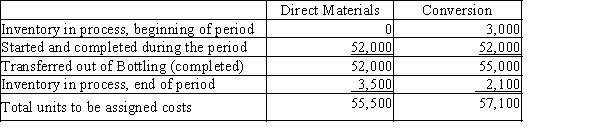 The beginning work in process inventory had a cost of $3,500. Determine the cost of completed and transferred-out production, and the ending work in process inventory.
 (Essay)
4.9/5 (68)
(68) The following production data were taken from the records of the Finishing Department for June: 
-The debits to Work in Process-Assembly Department for April, together with data concerning production, are as follows:
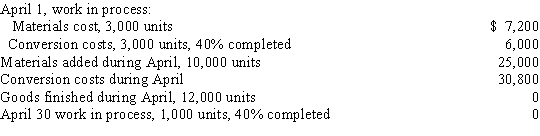 All direct materials are added at the beginning of the process, and the first-in, first-out method is used to cost inventories. The conversion cost per equivalent unit for April is
-The debits to Work in Process-Assembly Department for April, together with data concerning production, are as follows: All direct materials are added at the beginning of the process, and the first-in, first-out method is used to cost inventories. The conversion cost per equivalent unit for April is (Multiple Choice)
4.8/5 (70)
(70) Conversion costs are seldom added evenly throughout the process.
(True/False)
4.8/5 (79)
(79) The cost of production report for August shows conversion costs for 5,000 gallons, 70% complete, to be $2,450. The conversion cost per equivalent unit in July was $0.75. Which of the following best describes the change in the conversion costs between the two months?
(Multiple Choice)
4.7/5 (83)
(83) Match each business that follows to the type of costing system (a or b) it would typically use.
-Gasoline refinery
A)Job order costing
B)Process costing
(Short Answer)
4.8/5 (77)
(77) Match each phrase that follows with the term (a-h) it describes.
-Conversion costs
A)Direct labor and factory overhead
B)Direct labor and direct materials
C)Transferred-in costs
D)Equivalent units
E)Process costing
F)Job order costing
G)First-in, first-out method
H)Cost of production report
(Short Answer)
4.8/5 (84)
(84) The last step in the preparation of a cost of production report is the computation of equivalent units of production.
(True/False)
4.9/5 (93)
(93) Erin Company's inventory at December 1 and the costs charged to Work in Process-Department B during December are as follows:  During December, all direct materials are transferred from Department A, the units in process at December 1 were completed, and of the 26,000 units entering the department, all were completed except 1,000 units that were 70% completed as to conversion costs. Inventories are costed by the first-in, first-out method.Prepare a cost of production report for December.
 (Essay)
4.9/5 (70)
(70) Match each business that follows to the type of costing system (a or b) it would typically use.
-Paper manufacturer
A)Job order costing
B)Process costing
(Short Answer)
4.9/5 (98)
(98) In the manufacture of 10,000 units of a product, direct materials cost incurred was $165,000, direct labor cost incurred was $105,000, and applied factory overhead was $53,000. The total conversion cost is
(Multiple Choice)
4.8/5 (93)
(93) Mocha Company manufactures a single product by a continuous process, involving three production departments. The records indicate that direct materials, direct labor, and applied factory overhead for Department 1 were $100,000, $125,000, and $150,000, respectively. The records further indicate that direct materials, direct labor, and applied factory overhead for Department 2 were $55,000, $65,000, and $80,000, respectively. In addition, work in process at the beginning of the period for Department 1 totaled $75,000, and work in process at the end of the period totaled $60,000.
-The journal entry to record the flow of costs into Department 1 for direct labor is 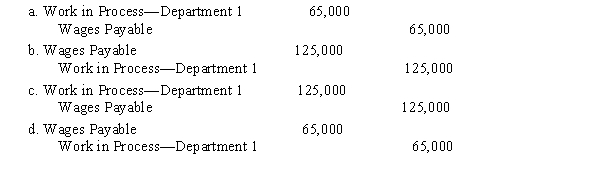
(Short Answer)
4.9/5 (77)
(77) Carmelita Inc. has the following information available: 
-At the beginning of the period, there were 500 units in process that were 60% complete as to conversion costs and 100% complete as to direct materials costs. During the period, 4,500 units were started and completed. Ending inventory contained 340 units that were 30% complete as to conversion costs and 100% complete as to materials costs. The company uses the FIFO process cost method. The cost of completing a unit during the current period was
-At the beginning of the period, there were 500 units in process that were 60% complete as to conversion costs and 100% complete as to direct materials costs. During the period, 4,500 units were started and completed. Ending inventory contained 340 units that were 30% complete as to conversion costs and 100% complete as to materials costs. The company uses the FIFO process cost method. The cost of completing a unit during the current period was (Multiple Choice)
4.7/5 (83)
(83) 
Filters
- Essay(0)
- Multiple Choice(0)
- Short Answer(0)
- True False(0)
- Matching(0)