



 Chat with AI
Exam 17: Process Cost Systems

Exam 1: Introduction to Accounting and Business243 Questions
Exam 2: Analyzing Transactions234 Questions
Exam 3: The Adjusting Process225 Questions
Exam 4: The Accounting Cycle211 Questions
Exam 5: Accounting for Retail Businesses273 Questions
Exam 6: Inventories236 Questions
Exam 7: Internal Control and Cash197 Questions
Exam 8: Receivables210 Questions
Exam 9: Long-Term Assets: Fixed and Intangible243 Questions
Exam 10: Liabilities: Current, Installment Notes, and Contingencies199 Questions
Exam 11: Liabilities: Bonds Payable172 Questions
Exam 12: Corporations: Organization, Stock Transactions, and Dividends221 Questions
Exam 13: Statement of Cash Flows193 Questions
Exam 14: Financial Statement Analysis206 Questions
Exam 15: Introduction to Managerial Accounting244 Questions
Exam 16: Job Order Costing212 Questions
Exam 17: Process Cost Systems196 Questions
Exam 18: Activity-Based Costing109 Questions
Exam 19: Support Department and Joint Cost Allocation172 Questions
Exam 20: Cost-Volume-Profit Analysis247 Questions
Exam 21: Variable Costing for Management Analysis136 Questions
Exam 22: Budgeting197 Questions
Exam 23: Evaluating Variances From Standard Costs172 Questions
Exam 24: Evaluating Decentralized Operations210 Questions
Exam 25: Differential Analysis and Product Pricing157 Questions
Exam 26: Capital Investment Analysis191 Questions
Exam 27: Lean Manufacturing and Activity Analysis134 Questions
Exam 28: The Balanced Scorecard and Corporate Social Responsibility170 Questions
Exam 29: Investments137 Questions
Select questions type


Penny, Inc. employs a process costing system. Direct materials are added at the beginning of the process. Information about July's activities is as follows: 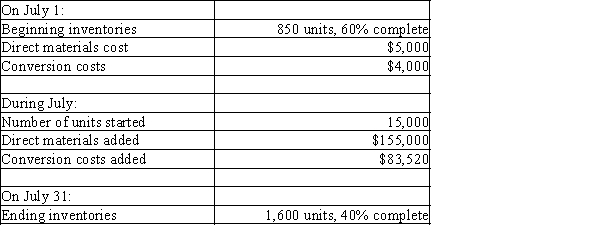
-Using the FIFO method, the cost per equivalent unit for materials used during July was
-Using the FIFO method, the cost per equivalent unit for materials used during July was
Free
(Multiple Choice)
4.9/5  (89)
(89) Correct Answer: Verified
B
Department S had 500 units 60% completed in process at the beginning of the period, 9,000 units completed during the period, and 600 units 30% completed at the end of the period. What was the number of equivalent units of production for the period for conversion if the first-in, first-out method is used to cost inventories? Assume the completion percentage applies to both direct materials and conversion cost.
Free
(Multiple Choice)
4.9/5 (78)
(78) Correct Answer:Verified
VerifiedA
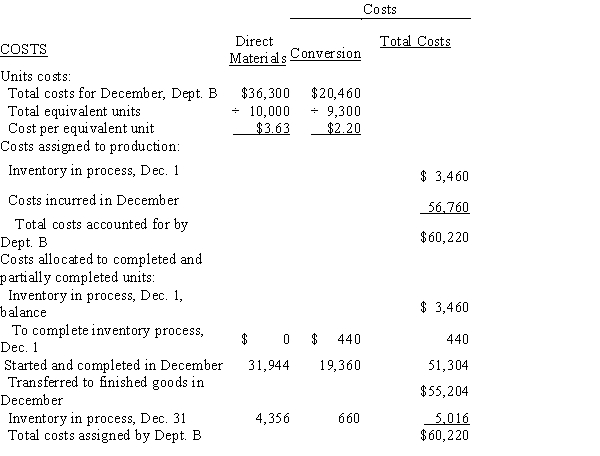
Everett Company's inventory at December 31 and the costs charged to Work in Process-Department B during December are as follows:  During December, all direct materials are transferred from Department A, and the units in process at December 1 were completed. Of the 10,000 units entering the department, all were completed except 1,200 units that were 25% completed as to conversion costs. Inventories are costed by the first-in, first-out method.Prepare a cost of production report for December.
Free
(Essay)
4.8/5 (81)
(81) Correct Answer:Verified
Verified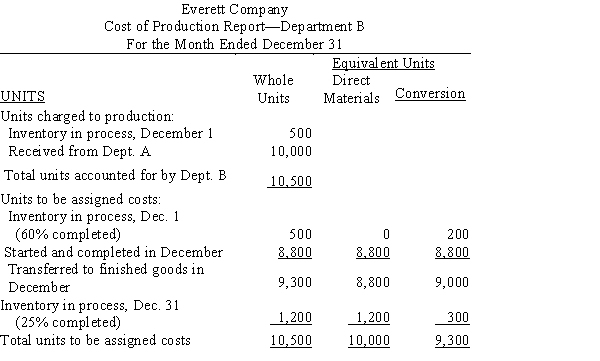
Department W had 2,400 units, one-third completed at the beginning of the period; 16,000 units were transferred to Department X from Department W during the period; and 1,800 units were one-half completed at the end of the period. Assume the completion ratios apply to direct materials and conversion costs.
-Carolwood Company manufactures widgets and uses process costing. The status of the beginning and ending inventory is:  Direct materials are added to the manufacturing process in stages. None are added when production begins. Approximately half of the materials are added when the product is 25% complete. The other half are added when the product is 50% complete. The percentages complete of beginning inventory and ending inventory with respect to direct materials (DM) and conversion costs (CC), respectively, are
 (Multiple Choice)
4.8/5 (76)
(76) If 16,000 units of materials enter production during the first year of operations, 12,000 of the units are finished, and 4,000 are 75% completed, the number of equivalent units of production would be 15,000.
(True/False)
4.9/5 (72)
(72) The Bottling Department of Mountain Springs Water Company had 5,000 liters in beginning work in process inventory (20% complete). During the period, 58,000 liters were completed. The ending work in process inventory was 3,000 liters (90% complete). What are the equivalent units for conversion costs under the FIFO method?
(Essay)
4.9/5 (75)
(75) Gallons of output for October and November were 45,000 and 56,000, respectively. Gallons of input for October and November were 46,000 and 64,000, respectively. Which of the following statements is true?
(Multiple Choice)
5.0/5 (81)
(81) Carmelita Inc. has the following information available: 
-A report prepared periodically by a processing department, summarizing (1) the units for which the department is accountable and the disposition of those units and (2) the costs incurred by the department and the allocation of those costs between completed and incomplete production, is termed a
-A report prepared periodically by a processing department, summarizing (1) the units for which the department is accountable and the disposition of those units and (2) the costs incurred by the department and the allocation of those costs between completed and incomplete production, is termed a (Multiple Choice)
4.7/5 (70)
(70) The cost system best suited to industries that manufacture a large number of identical units of commodities on a continuous basis is
(Multiple Choice)
5.0/5 (81)
(81) Match each business that follows with the job cost system (a or b) it would most likely utilize.
-Website designer
A)Job order cost system
B)Process cost system
(Short Answer)
4.7/5 (88)
(88) The amount journalized showing the cost added to finished goods is taken from the cost of production report.
(True/False)
4.9/5 (96)
(96) Which of the following measures would not help managers to control and improve operations?
(Multiple Choice)
4.7/5 (77)
(77) Discuss how equivalent units are computed under the weighted average method.
(Essay)
4.8/5 (76)
(76) One of the differences in accounting for a process costing system compared to a job order system is that the amounts used to transfer goods from one department to the next comes from the cost of production report instead of job cost cards.
(True/False)
4.7/5 (74)
(74) Process and job order cost systems are similar in all of the following ways except
(Multiple Choice)
4.9/5 (77)
(77) Mocha Company manufactures a single product by a continuous process, involving three production departments. The records indicate that direct materials, direct labor, and applied factory overhead for Department 1 were $100,000, $125,000, and $150,000, respectively. The records further indicate that direct materials, direct labor, and applied factory overhead for Department 2 were $55,000, $65,000, and $80,000, respectively. In addition, work in process at the beginning of the period for Department 1 totaled $75,000, and work in process at the end of the period totaled $60,000.
-Mocha Company manufactures a single product by a continuous process, involving three production departments. The records indicate that direct materials, direct labor, and applied factory overhead for Department 1 were $100,000, $125,000, and $150,000, respectively. Work in process at the beginning of the period for Department 1 was $75,000, and work in process at the end of the period totaled $60,000. The records indicate that direct materials, direct labor, and applied factory overhead for Department 2 were $50,000, $60,000, and $70,000, respectively. In addition, work in process at the beginning of the period for Department 2 totaled $75,000, and work in process at the end of the period totaled $60,000. The journal entry to record the flow of costs into Department 3 during the period is 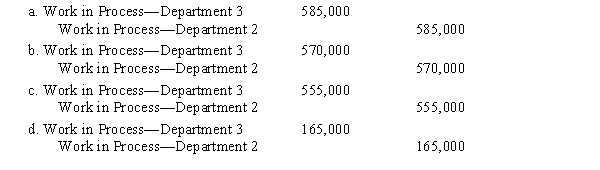
(Short Answer)
4.8/5 (78)
(78) Department E had 4,000 units in Work in Process that were 40% completed at the beginning of the period at a cost of $12,500. During the period, 14,000 units of direct materials were added at a cost of $28,700, and 15,000 units were completed. At the end of the period, 3,000 units were 75% completed. All materials are added at the beginning of the process. Direct labor was $32,450 and factory overhead was $18,710. The number of equivalent units of production for the period for conversion if the first-in, first-out method is used to cost inventories was
(Multiple Choice)
4.8/5 (70)
(70) Department S had no work in process at the beginning of the period. It added 12,000 units of direct materials during the period at a cost of $84,000; 9,000 units were completed during the period; and 3,000 units were 30% completed as to labor and overhead at the end of the period. All materials are added at the beginning of the process. Direct labor was $49,500 and factory overhead was $9,900.
-The total conversion costs for the period were
(Multiple Choice)
4.8/5 (90)
(90) The estimated total factory overhead cost and total machine hours for Department 40 for the current year are $250,000 and 56,250, respectively. During January, the first month of the current year, actual machine hours used totaled 5,100 and factory overhead cost incurred totaled $22,000.
a.Determine the factory overhead rate based on machine hours.
b.Journalize the entry to apply factory overhead to production in Department 40 for January.
c.What is the balance of Factory Overhead-Department 40 at January 31?
d.Does the balance of Factory Overhead-Department 40 at January 31 represent over- or underapplied factory overhead?
Round total cost to the nearest dollar.
(Essay)
4.9/5 (77)
(77) Match each phrase that follows with the term (a-e) it describes.
-The portion of whole units that are complete with respect to materials or conversion costs
A)Cost of production report
B)Equivalent units of production
C)First-in, first-out (FIFO) method
D)Last-in, first-out (LIFO) method
E)Whole units
F)Yield
(Short Answer)
4.8/5 (78)
(78) 
Filters
- Essay(0)
- Multiple Choice(0)
- Short Answer(0)
- True False(0)
- Matching(0)