



 Chat with AI
Exam 17: Process Cost Systems

Exam 1: Introduction to Accounting and Business243 Questions
Exam 2: Analyzing Transactions234 Questions
Exam 3: The Adjusting Process225 Questions
Exam 4: The Accounting Cycle211 Questions
Exam 5: Accounting for Retail Businesses273 Questions
Exam 6: Inventories236 Questions
Exam 7: Internal Control and Cash197 Questions
Exam 8: Receivables210 Questions
Exam 9: Long-Term Assets: Fixed and Intangible243 Questions
Exam 10: Liabilities: Current, Installment Notes, and Contingencies199 Questions
Exam 11: Liabilities: Bonds Payable172 Questions
Exam 12: Corporations: Organization, Stock Transactions, and Dividends221 Questions
Exam 13: Statement of Cash Flows193 Questions
Exam 14: Financial Statement Analysis206 Questions
Exam 15: Introduction to Managerial Accounting244 Questions
Exam 16: Job Order Costing212 Questions
Exam 17: Process Cost Systems196 Questions
Exam 18: Activity-Based Costing109 Questions
Exam 19: Support Department and Joint Cost Allocation172 Questions
Exam 20: Cost-Volume-Profit Analysis247 Questions
Exam 21: Variable Costing for Management Analysis136 Questions
Exam 22: Budgeting197 Questions
Exam 23: Evaluating Variances From Standard Costs172 Questions
Exam 24: Evaluating Decentralized Operations210 Questions
Exam 25: Differential Analysis and Product Pricing157 Questions
Exam 26: Capital Investment Analysis191 Questions
Exam 27: Lean Manufacturing and Activity Analysis134 Questions
Exam 28: The Balanced Scorecard and Corporate Social Responsibility170 Questions
Exam 29: Investments137 Questions
Select questions type


Equivalent units are the sum of direct materials used and direct labor incurred.
(True/False)
5.0/5  (78)
(78) Match each phrase that follows with the term (a-h) it describes.
-Costs incurred in a previous process that are carried forward as part of the product's cost when it moves to the next department
A)Direct labor and factory overhead
B)Direct labor and direct materials
C)Transferred-in costs
D)Equivalent units
E)Process costing
F)Job order costing
G)First-in, first-out method
H)Cost of production report
(Short Answer)
4.8/5 (75)
(75) Kamin Company's Mixing Department had a beginning inventory of 4,000 units that had accumulated conversion costs of $55,000. During the period, the Mixing Department accumulated conversion costs of $92,000 and started 8,000 new units. Ending inventory was 2,500 units that were 40% complete with respect to conversion costs. Kamin uses the weighted average method to cost inventories.
Compute the cost per equivalent unit for conversion costs in the Mixing Department.
(Essay)
4.7/5 (60)
(60) Match each phrase that follows with the term (a-h) it describes.
-Costing system used by a company producing custom window treatments
A)Direct labor and factory overhead
B)Direct labor and direct materials
C)Transferred-in costs
D)Equivalent units
E)Process costing
F)Job order costing
G)First-in, first-out method
H)Cost of production report
(Short Answer)
4.9/5 (74)
(74) Once equivalent units are computed for materials, this number will also be used for direct labor and factory overhead.
(True/False)
4.8/5 (75)
(75) Department S had no work in process at the beginning of the period. It added 12,000 units of direct materials during the period at a cost of $84,000; 9,000 units were completed during the period; and 3,000 units were 30% completed as to labor and overhead at the end of the period. All materials are added at the beginning of the process. Direct labor was $49,500 and factory overhead was $9,900.
-The total cost of units completed during the period was
(Multiple Choice)
4.9/5 (78)
(78) Match each phrase that follows with the term (a-h) it describes.
-A process costing method that costs each period's equivalent units of work with that period's costs per equivalent unit
A)Direct labor and factory overhead
B)Direct labor and direct materials
C)Transferred-in costs
D)Equivalent units
E)Process costing
F)Job order costing
G)First-in, first-out method
H)Cost of production report
(Short Answer)
4.8/5 (68)
(68) The two categories of cost comprising conversion costs are
(Multiple Choice)
4.8/5 (89)
(89) Mocha Company manufactures a single product by a continuous process, involving three production departments. The records indicate that direct materials, direct labor, and applied factory overhead for Department 1 were $100,000, $125,000, and $150,000, respectively. The records further indicate that direct materials, direct labor, and applied factory overhead for Department 2 were $55,000, $65,000, and $80,000, respectively. In addition, work in process at the beginning of the period for Department 1 totaled $75,000, and work in process at the end of the period totaled $60,000.
-Which of the following is not a use of the cost of production report?
(Multiple Choice)
4.9/5 (79)
(79) Match each phrase that follows with the term (a-h) it describes.
-Measure of the work done during a production period, expressed in terms of fully complete units of output
A)Direct labor and factory overhead
B)Direct labor and direct materials
C)Transferred-in costs
D)Equivalent units
E)Process costing
F)Job order costing
G)First-in, first-out method
H)Cost of production report
(Short Answer)
4.8/5 (72)
(72) The four steps necessary to complete a cost of production report in a process cost system are
1)allocate costs to units transferred out and partially completed units
2)determine the units to be assigned costs
3)determine the cost per equivalent unit
4)compute equivalent units of production
The correct ordering of the steps is
(Multiple Choice)
4.8/5 (75)
(75) The inventory at June 1 and costs charged to Work in Process-Department 60 during June are as follows:  During June, 32,000 units were placed into production and 31,200 units were completed, including those in inventory on June 1. On June 30, the inventory of work in process consisted of 4,600 units that were 40% completed. Inventories are costed by the weighted average method and all materials are added at the beginning of the process.Determine the following, presenting your computations:
a.Equivalent units of production for conversion cost
b.Conversion cost per equivalent unit and material cost per equivalent unit
c.Total and unit cost of finished goods completed in the current period
d.Total cost of work in process inventory at June 30
During June, 32,000 units were placed into production and 31,200 units were completed, including those in inventory on June 1. On June 30, the inventory of work in process consisted of 4,600 units that were 40% completed. Inventories are costed by the weighted average method and all materials are added at the beginning of the process.Determine the following, presenting your computations:
a.Equivalent units of production for conversion cost
b.Conversion cost per equivalent unit and material cost per equivalent unit
c.Total and unit cost of finished goods completed in the current period
d.Total cost of work in process inventory at June 30 (Essay)
4.8/5 (82)
(82) Process cost systems use job order cost cards to accumulate cost data.
(True/False)
4.9/5 (84)
(84) Costs of ending work in process inventory are included in the cost per equivalent unit computation.
(True/False)
4.8/5 (83)
(83) Mocha Company manufactures a single product by a continuous process, involving three production departments. The records indicate that direct materials, direct labor, and applied factory overhead for Department 1 were $100,000, $125,000, and $150,000, respectively. The records further indicate that direct materials, direct labor, and applied factory overhead for Department 2 were $55,000, $65,000, and $80,000, respectively. In addition, work in process at the beginning of the period for Department 1 totaled $75,000, and work in process at the end of the period totaled $60,000.
-Mocha Company manufactures a single product by a continuous process, involving three production departments. The records indicate that direct materials, direct labor, and applied factory overhead for Department 1 were $100,000, $125,000, and $150,000, respectively. The records further indicate that direct materials, direct labor, and applied factory overhead for Department 2 were $50,000, $60,000, and $70,000, respectively. Department 2 has transferred-in costs of $390,000 for the current period. In addition, work in process at the beginning of the period for Department 2 totaled $75,000, and work in process at the end of the period totaled $90,000. The journal entry to record the flow of costs into Department 3 during the period is 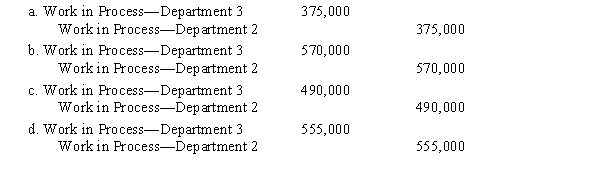
(Short Answer)
4.7/5 (86)
(86) Match each business that follows to the type of costing system (a or b) it would typically use.
-Flour mill
A)Job order costing
B)Process costing
(Short Answer)
4.8/5 (76)
(76) If a department that applies FIFO process costing starts the reporting period with 50,000 physical units that were 25% complete with respect to direct materials and 40% complete with respect to conversion, it must add 12,500 equivalent units of direct materials and 20,000 equivalent units to direct labor to complete them.
(True/False)
4.8/5 (81)
(81) Match each business that follows with the job cost system (a or b) it would most likely utilize.
-Paint manufacturer
A)Job order cost system
B)Process cost system
(Short Answer)
4.9/5 (76)
(76) Penny, Inc. employs a process costing system. Direct materials are added at the beginning of the process. Information about July's activities is as follows: 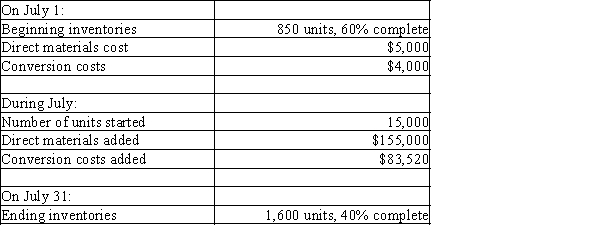
-Using the FIFO method, the number of units started and completed in July was
-Using the FIFO method, the number of units started and completed in July was (Multiple Choice)
4.7/5 (74)
(74) Department F had 4,000 units in Work in Process that were 40% completed at the beginning of the period at a cost of $12,500. Of the $12,500, $8,000 was for material and $4,500 was for conversion costs, 14,000 units of direct materials were added during the period at a cost of $28,700, 15,000 units were completed during the period, and 3,000 units were 75% completed at the end of the period. All materials are added at the beginning of the process. Direct labor was $32,450 and factory overhead was $18,710.
-If the weighted average method is used, the materials cost per unit (rounded to the nearest cent) would be
(Multiple Choice)
4.8/5 (76)
(76) 
Filters
- Essay(0)
- Multiple Choice(0)
- Short Answer(0)
- True False(0)
- Matching(0)