



 Chat with AI
Exam 9: Application: International Trade

Exam 1: Ten Principles of Economics220 Questions
Exam 2: Thinking Like an Economist284 Questions
Exam 3: Interdependence and the Gains From Trade192 Questions
Exam 4: The Market Forces of Supply and Demand277 Questions
Exam 5: Elasticity and Its Application222 Questions
Exam 6: Supply, Demand, and Government Policies321 Questions
Exam 7: Consumers, Producers, and the Efficiency of Markets218 Questions
Exam 8: Applications: The Costs of Taxation203 Questions
Exam 9: Application: International Trade214 Questions
Exam 10: Externalities204 Questions
Exam 11: Public Goods and Common Resources182 Questions
Exam 12: The Design of the Tax System225 Questions
Exam 13: The Costs of Production261 Questions
Exam 14: Firms in Competitive Markets243 Questions
Exam 15: Monopoly231 Questions
Exam 16: Monopolistic Competition246 Questions
Exam 17: Oligopoly204 Questions
Exam 18: The Markets for the Factors of Production232 Questions
Exam 19: Earnings and Discrimination230 Questions
Exam 20: Income Inequality and Poverty194 Questions
Exam 21: The Theory of Consumer Choice209 Questions
Exam 22: Frontiers in Microeconomics185 Questions
Exam 23: Measuring a Nations Income231 Questions
Exam 24: Measuring the Cost of Living214 Questions
Exam 25: Production and Growth187 Questions
Exam 26: Saving, Investment, and the Financial System225 Questions
Exam 27: Tools of Finance198 Questions
Exam 28: Unemployment and Its Natural Rate361 Questions
Exam 29: The Monetary System210 Questions
Exam 30: Money Growth and Inflation201 Questions
Exam 31: Open-Economy Macroeconomics: Basic Concepts194 Questions
Exam 32: A Macroeconomic Theory of the Open Economy188 Questions
Exam 33: Aggregate Demand and Aggregate Supply189 Questions
Exam 34: The Influence of Monetary and Fiscal Policy on Aggregate Demand207 Questions
Exam 35: The Short-Run Tradeoff Between Inflation and Unemployment223 Questions
Exam 36: Six Debates Over Macroeconomic Policy154 Questions
Select questions type


Scenario 9-1
For a small country called Boxland, the equation of the domestic demand curve for cardboard is QD = 210 − 2P, where QD represents the domestic quantity of cardboard demanded, in tons, and P represents the price of a ton of cardboard. For Boxland, the equation of the domestic supply curve for cardboard is QS = -90 + 3P, where QS represents the domestic quantity of cardboard supplied, in tons, and P again represents the price of a ton of cardboard.
-Refer to Scenario 9-1. Suppose the world price of cardboard is $82.5 and international trade is allowed. Then Boxland's consumers demand
(Multiple Choice)
4.8/5  (77)
(77) Assume, for China, that the domestic price of apples without international trade is higher than the world price of apples. This suggests that, in the production of apples,
(Multiple Choice)
4.9/5 (85)
(85) For Country A, the world price of soybeans exceeds the domestic equilibrium price of soybeans. As a result, international trade allows buyers of soybeans in Country A to experience greater consumer surplus than they otherwise would experience.
(True/False)
4.9/5 (81)
(81) Figure 9-8
The following diagram shows the domestic demand and supply curves in a market. Assume that the world price in this market is $20 per unit. 
-Refer to Figure 9-8. If the country allows free trade, will the country import or export this good, and how many units will be imported/exported?
-Refer to Figure 9-8. If the country allows free trade, will the country import or export this good, and how many units will be imported/exported? (Essay)
4.9/5 (74)
(74) The problem with the protection-as-a-bargaining-chip argument for trade restrictions is
(Multiple Choice)
4.8/5 (76)
(76) If a tariff is placed on watches, the price of both domestic and imported watches will rise by the amount of the tariff.
(True/False)
4.8/5 (75)
(75) Suppose in the country of Nash that the price of corn is $4 per bushel with no trade allowed. If the world price of corn is $3 per bushel and if Nash allows free trade, will Nash be an importer or an exporter of corn?
(Short Answer)
4.9/5 (93)
(93) Figure 9-8
The following diagram shows the domestic demand and supply curves in a market. Assume that the world price in this market is $20 per unit.
-Refer to Figure 9-8. Suppose the country imposes a $5 per unit tariff. If the country allows trade with a tariff, how much is the deadweight loss caused by the tariff?
-Refer to Figure 9-8. Suppose the country imposes a $5 per unit tariff. If the country allows trade with a tariff, how much is the deadweight loss caused by the tariff? (Essay)
4.8/5 (81)
(81) Figure 9-4 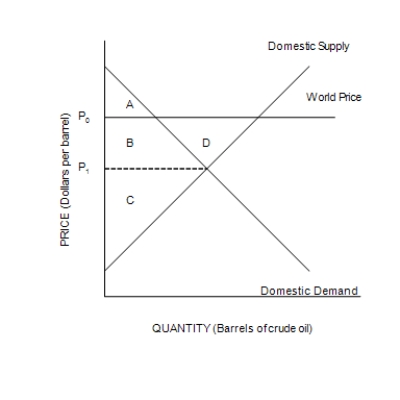 -Refer to Figure 9-4. The change in total surplus in this market because of trade is
 (Multiple Choice)
4.9/5 (79)
(79) Deadweight loss measures the decrease in total surplus that results from a tariff or quota.
(True/False)
4.9/5 (80)
(80) Figure 9-2 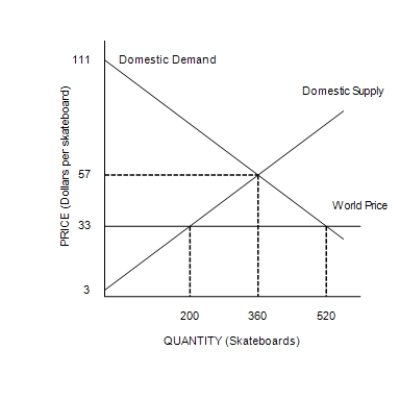
-Refer to Figure 9-2. Without trade, consumer surplus amounts to
-Refer to Figure 9-2. Without trade, consumer surplus amounts to (Multiple Choice)
4.7/5 (79)
(79) Figure 9-8
The following diagram shows the domestic demand and supply curves in a market. Assume that the world price in this market is $20 per unit.
-Refer to Figure 9-8. With no trade allowed, how much are consumer surplus, producer surplus, and total surplus?
-Refer to Figure 9-8. With no trade allowed, how much are consumer surplus, producer surplus, and total surplus? (Essay)
4.9/5 (78)
(78) Figure 9-2
-Refer to Figure 9-2. With trade, this country
-Refer to Figure 9-2. With trade, this country (Multiple Choice)
4.9/5 (89)
(89) Figure 9-5  -Refer to Figure 9-5. Consumer surplus in this market before trade is
 (Multiple Choice)
4.9/5 (80)
(80) The nation of Cranolia used to prohibit international trade, but now trade is allowed, and Cranolia is exporting furniture. Relative to the previous no-trade situation, buyers of furniture in Cranolia are now better off.
(True/False)
4.7/5 (77)
(77) The nation of Aviana soon will abandon its no-trade policy and adopt a free-trade policy. If the world price of goose meat is $3 per pound and the domestic price of goose meat without trade is $2 per pound, then Aviana should export goose meat.
(True/False)
4.8/5 (76)
(76) Figure 9-6  -Import quotas and tariffs produce some common results. Which of the following is not one of those common results?
 (Multiple Choice)
4.9/5 (77)
(77) Domestic consumers gain and domestic producers lose when the government imposes a tariff on imports.
(True/False)
4.8/5 (82)
(82) Figure 9-7
The following diagram shows the domestic demand and domestic supply curves in a market. 
-Refer to Figure 9-7. Suppose the world price in this market is $7. If the country allows free trade, how many units will domestic consumers demand, and how many units will domestic producers produce?
-Refer to Figure 9-7. Suppose the world price in this market is $7. If the country allows free trade, how many units will domestic consumers demand, and how many units will domestic producers produce? (Essay)
4.9/5 (75)
(75) 
Filters
- Essay(0)
- Multiple Choice(0)
- Short Answer(0)
- True False(0)
- Matching(0)