



 Chat with AI
Exam 9: Application: International Trade

Exam 1: Ten Principles of Economics220 Questions
Exam 2: Thinking Like an Economist284 Questions
Exam 3: Interdependence and the Gains From Trade192 Questions
Exam 4: The Market Forces of Supply and Demand277 Questions
Exam 5: Elasticity and Its Application222 Questions
Exam 6: Supply, Demand, and Government Policies321 Questions
Exam 7: Consumers, Producers, and the Efficiency of Markets218 Questions
Exam 8: Applications: The Costs of Taxation203 Questions
Exam 9: Application: International Trade214 Questions
Exam 10: Externalities204 Questions
Exam 11: Public Goods and Common Resources182 Questions
Exam 12: The Design of the Tax System225 Questions
Exam 13: The Costs of Production261 Questions
Exam 14: Firms in Competitive Markets243 Questions
Exam 15: Monopoly231 Questions
Exam 16: Monopolistic Competition246 Questions
Exam 17: Oligopoly204 Questions
Exam 18: The Markets for the Factors of Production232 Questions
Exam 19: Earnings and Discrimination230 Questions
Exam 20: Income Inequality and Poverty194 Questions
Exam 21: The Theory of Consumer Choice209 Questions
Exam 22: Frontiers in Microeconomics185 Questions
Exam 23: Measuring a Nations Income231 Questions
Exam 24: Measuring the Cost of Living214 Questions
Exam 25: Production and Growth187 Questions
Exam 26: Saving, Investment, and the Financial System225 Questions
Exam 27: Tools of Finance198 Questions
Exam 28: Unemployment and Its Natural Rate361 Questions
Exam 29: The Monetary System210 Questions
Exam 30: Money Growth and Inflation201 Questions
Exam 31: Open-Economy Macroeconomics: Basic Concepts194 Questions
Exam 32: A Macroeconomic Theory of the Open Economy188 Questions
Exam 33: Aggregate Demand and Aggregate Supply189 Questions
Exam 34: The Influence of Monetary and Fiscal Policy on Aggregate Demand207 Questions
Exam 35: The Short-Run Tradeoff Between Inflation and Unemployment223 Questions
Exam 36: Six Debates Over Macroeconomic Policy154 Questions
Select questions type


In principle, trade can make a nation better off, because the gains to the winners exceed the losses to the losers.
(True/False)
4.9/5  (66)
(66) If the world price of a good is greater than the domestic price in a country that can engage in international trade, then that country becomes an importer of that good.
(True/False)
4.8/5 (73)
(73) Scenario 9-2
Suppose domestic demand and domestic supply in a market are given by the following equations: =20-P =P
-Refer to Scenario 9-2. Suppose the world price in this market is $8 per unit. If the country allows free trade, will the country import or export this good, and how many units will be imported/exported?
(Short Answer)
4.9/5 (84)
(84) Figure 9-1
Uganda
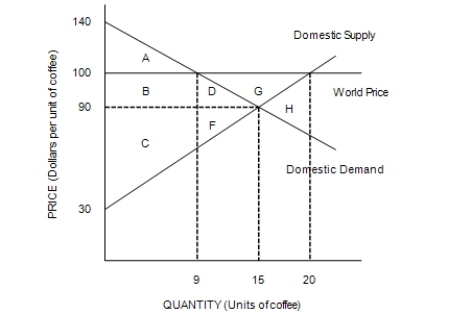 -Refer to Figure 9-1. From the figure it is apparent that
 (Multiple Choice)
4.9/5 (85)
(85) If the United Kingdom imports tea cups from other countries, then U.K. producers of tea cups are better off, and U.K. consumers of tea cups are worse off, as a result of trade.
(True/False)
4.8/5 (81)
(81) Suppose the world price of coffee is $3 per pound and Brazil's domestic price of coffee without trade is $2 per pound. If Brazil allows free trade, will Brazil be an importer or an exporter of coffee?
(Short Answer)
4.9/5 (78)
(78) Suppose the world price of a television is $300. Before Paraguay allowed trade in televisions, the price of a television there was $350. Once Paraguay began allowing trade in televisions with other countries, Paraguay began
(Multiple Choice)
4.9/5 (69)
(69) Scenario 9-2
Suppose domestic demand and domestic supply in a market are given by the following equations: =20-P =P
-Refer to Scenario 9-2. Suppose the world price in this market is $8 per unit. If the country allows free trade, how much are consumer surplus, producer surplus, and producer surplus with trade?
(Essay)
4.8/5 (84)
(84) When markets open up to international trade, we know that total surplus will rise.
(True/False)
4.8/5 (77)
(77) The world price of a pound of almonds is $4.50. Before Uruguay allowed trade in almonds, the price of a pound of almonds there was $3.00. Once Uruguay began allowing trade in almonds with other countries, Uruguay began
(Multiple Choice)
4.8/5 (79)
(79) Scenario 9-2
Suppose domestic demand and domestic supply in a market are given by the following equations: =20-P =P
-Refer to Scenario 9-2. With no trade allowed, how much are consumer surplus, producer surplus, and total surplus in this market?
(Essay)
4.9/5 (86)
(86) Figure 9-3  -Refer to Figure 9-3. The amount of deadweight loss caused by the tariff equals
 (Multiple Choice)
4.9/5 (82)
(82) Figure 9-9
The following diagram shows the domestic demand and domestic supply curves in a market. 
-Refer to Figure 9-9. Suppose the world price in this market is $6. If the country allows free trade, will the country import or export this good, and how many units will be imported/exported?
-Refer to Figure 9-9. Suppose the world price in this market is $6. If the country allows free trade, will the country import or export this good, and how many units will be imported/exported? (Short Answer)
4.8/5 (81)
(81) Which of the following is not an advantage of a multilateral approach to free trade over a unilateral approach?
(Multiple Choice)
4.9/5 (70)
(70) Figure 9-10
The following diagram shows the domestic demand and domestic supply curves in a market. Assume that the world price in this market is $1 per unit. 
-Refer to Figure 9-10. Suppose the country imposes a $1 per unit tariff. If the country allows trade with a tariff, how many units will be imported?
-Refer to Figure 9-10. Suppose the country imposes a $1 per unit tariff. If the country allows trade with a tariff, how many units will be imported? (Essay)
4.9/5 (74)
(74) Figure 9-3
-Refer to Figure 9-3. When a tariff is imposed in the market, domestic producers
-Refer to Figure 9-3. When a tariff is imposed in the market, domestic producers (Multiple Choice)
4.9/5 (85)
(85) Figure 9-6  -Zelzar has decided to end its policy of not trading with the rest of the world. When it ends its trade restrictions, it discovers that it is importing incense, exporting steel, and neither importing nor exporting rugs. Which groups in Zelzar are better off as a result of the new free-trade policy?
 (Multiple Choice)
4.9/5 (79)
(79) William and Jamal live in the country of Dumexia. As a result of Dumexia's legalization of international trade in bananas, William becomes better off and Jamal becomes worse off. It follows that William is a seller, and Jamal is a buyer, of bananas.
(True/False)
4.7/5 (79)
(79) Figure 9-8
The following diagram shows the domestic demand and supply curves in a market. Assume that the world price in this market is $20 per unit. 
-Refer to Figure 9-8. With no trade allowed, what are the equilibrium price and equilibrium quantity in this market?
-Refer to Figure 9-8. With no trade allowed, what are the equilibrium price and equilibrium quantity in this market? (Essay)
4.9/5 (71)
(71) Scenario 9-1
For a small country called Boxland, the equation of the domestic demand curve for cardboard is QD = 210 − 2P, where QD represents the domestic quantity of cardboard demanded, in tons, and P represents the price of a ton of cardboard. For Boxland, the equation of the domestic supply curve for cardboard is QS = -90 + 3P, where QS represents the domestic quantity of cardboard supplied, in tons, and P again represents the price of a ton of cardboard.
-Refer to Scenario 9-1. Suppose the world price of cardboard is $82.5. Then, relative to the no-trade situation, international trade in cardboard produces which of the following results for Boxland?
(Multiple Choice)
4.8/5 (92)
(92) 
Filters
- Essay(0)
- Multiple Choice(0)
- Short Answer(0)
- True False(0)
- Matching(0)