



 Chat with AI
Exam 9: Application: International Trade

Exam 1: Ten Principles of Economics220 Questions
Exam 2: Thinking Like an Economist284 Questions
Exam 3: Interdependence and the Gains From Trade192 Questions
Exam 4: The Market Forces of Supply and Demand277 Questions
Exam 5: Elasticity and Its Application222 Questions
Exam 6: Supply, Demand, and Government Policies321 Questions
Exam 7: Consumers, Producers, and the Efficiency of Markets218 Questions
Exam 8: Applications: The Costs of Taxation203 Questions
Exam 9: Application: International Trade214 Questions
Exam 10: Externalities204 Questions
Exam 11: Public Goods and Common Resources182 Questions
Exam 12: The Design of the Tax System225 Questions
Exam 13: The Costs of Production261 Questions
Exam 14: Firms in Competitive Markets243 Questions
Exam 15: Monopoly231 Questions
Exam 16: Monopolistic Competition246 Questions
Exam 17: Oligopoly204 Questions
Exam 18: The Markets for the Factors of Production232 Questions
Exam 19: Earnings and Discrimination230 Questions
Exam 20: Income Inequality and Poverty194 Questions
Exam 21: The Theory of Consumer Choice209 Questions
Exam 22: Frontiers in Microeconomics185 Questions
Exam 23: Measuring a Nations Income231 Questions
Exam 24: Measuring the Cost of Living214 Questions
Exam 25: Production and Growth187 Questions
Exam 26: Saving, Investment, and the Financial System225 Questions
Exam 27: Tools of Finance198 Questions
Exam 28: Unemployment and Its Natural Rate361 Questions
Exam 29: The Monetary System210 Questions
Exam 30: Money Growth and Inflation201 Questions
Exam 31: Open-Economy Macroeconomics: Basic Concepts194 Questions
Exam 32: A Macroeconomic Theory of the Open Economy188 Questions
Exam 33: Aggregate Demand and Aggregate Supply189 Questions
Exam 34: The Influence of Monetary and Fiscal Policy on Aggregate Demand207 Questions
Exam 35: The Short-Run Tradeoff Between Inflation and Unemployment223 Questions
Exam 36: Six Debates Over Macroeconomic Policy154 Questions
Select questions type


Figure 9-9
The following diagram shows the domestic demand and domestic supply curves in a market. 
-Refer to Figure 9-9. Suppose the world price in this market is $6. If the country allows free trade, how much is total surplus?
-Refer to Figure 9-9. Suppose the world price in this market is $6. If the country allows free trade, how much is total surplus? (Short Answer)
4.9/5  (67)
(67) Suppose the world price of coffee is $2 per pound and Brazil's domestic price of coffee without trade is $3 per pound. If Brazil allows free trade, will Brazil be an importer or an exporter of coffee?
(Short Answer)
4.7/5 (83)
(83) Scenario 9-1
For a small country called Boxland, the equation of the domestic demand curve for cardboard is QD = 210 − 2P, where QD represents the domestic quantity of cardboard demanded, in tons, and P represents the price of a ton of cardboard. For Boxland, the equation of the domestic supply curve for cardboard is QS = -90 + 3P, where QS represents the domestic quantity of cardboard supplied, in tons, and P again represents the price of a ton of cardboard.
-Refer to Scenario 9-1. Suppose the world price of cardboard is $82.5. Then Boxland's gains from international trade in cardboard amount to
(Multiple Choice)
4.9/5 (72)
(72) Suppose in the country of Jumanji that the price of coffee with no trade allowed is below the world price of coffee. If Jumanji allows free trade, will Jumanji be an importer or an exporter of coffee?
(Short Answer)
4.8/5 (82)
(82) Figure 9-5  -Refer to Figure 9-5. Producer surplus plus consumer surplus in this market after trade is
 (Multiple Choice)
4.8/5 (77)
(77) Figure 9-2 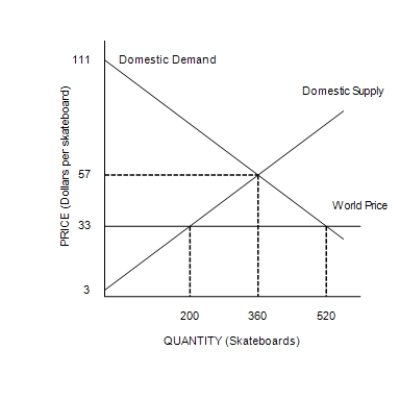
-Refer to Figure 9-2. Total surplus with trade exceeds total surplus without trade by
-Refer to Figure 9-2. Total surplus with trade exceeds total surplus without trade by (Multiple Choice)
4.8/5 (75)
(75) For a given country, comparing the world price of aluminum and the domestic price of aluminum before trade indicates whether that country's demand for aluminum exceeds the demand for aluminum in other countries.
(True/False)
4.8/5 (81)
(81) Figure 9-1
Uganda
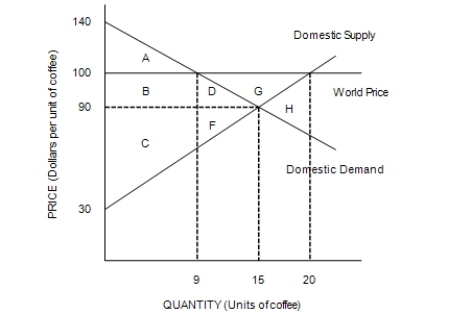 -Refer to Figure 9-1. In the absence of trade, total surplus in the Ugandan coffee market amounts to
 (Multiple Choice)
4.8/5 (73)
(73) Suppose New Zealand has a comparative advantage over other countries in producing almonds, but other countries have an absolute advantage over New Zealand in producing almonds. If trade in almonds is allowed, New Zealand
(Multiple Choice)
4.9/5 (91)
(91) Representative Vazquez cites the "jobs argument" when he argues before Congress in favor of restrictions on trade; he argues that everything can be produced at lower cost in other countries. The likely flaw in Representative Vazquez's reasoning is that he ignores the fact that
(Multiple Choice)
5.0/5 (73)
(73) Figure 9-9
The following diagram shows the domestic demand and domestic supply curves in a market.
-Refer to Figure 9-9. With no trade allowed, what are the equilibrium price and equilibrium quantity in this market?
-Refer to Figure 9-9. With no trade allowed, what are the equilibrium price and equilibrium quantity in this market? (Essay)
4.9/5 (84)
(84) Characterize the two different approaches a nation can take to achieve free trade. Does one approach have an advantage over the other?
(Essay)
4.8/5 (81)
(81)  -Refer to Figure 9-6. The tariff
Free trade causes job losses in industries in which a country does not have a comparative advantage, but it also causes job gains in industries in which the country has a comparative advantage.
(True/False)
4.9/5 (89)
(89) Since a tariff can increase employment in an industry, the result is a net increase in total surplus.
(True/False)
4.8/5 (73)
(73) Suppose Ecuador imposes a tariff on imported bananas. If the increase in producer surplus is $50 million, the reduction in consumer surplus is $150 million, and the deadweight loss of the tariff is $30 million, then the tariff generates $130 million in revenue for the government.
(True/False)
5.0/5 (76)
(76) Figure 9-5
-Refer to Figure 9-5. Producer surplus in this market after trade is
-Refer to Figure 9-5. Producer surplus in this market after trade is (Multiple Choice)
4.9/5 (85)
(85) Figure 9-2
-Refer to Figure 9-2. If this country allows free trade in skateboards,
-Refer to Figure 9-2. If this country allows free trade in skateboards, (Multiple Choice)
4.7/5 (75)
(75) A multilateral approach to free trade has greater potential to increase the gains from trade than a unilateral approach, because the multilateral approach can reduce trade restrictions abroad as well as at home.
(True/False)
4.9/5 (74)
(74) 
Filters
- Essay(0)
- Multiple Choice(0)
- Short Answer(0)
- True False(0)
- Matching(0)