



 Chat with AI
Exam 21: Accounting Changes

Exam 12: Financial Liabilities and Provisions78 Questions
Exam 13: Financial Instruments: Long-Term Debt74 Questions
Exam 14: Shareholders Equity181 Questions
Exam 15: Financial Instruments: Complex Debt and Equity135 Questions
Exam 16: Corporate Income Tax122 Questions
Exam 17: Tax Losses98 Questions
Exam 18: Leases234 Questions
Exam 19: Post-Employment Benefits92 Questions
Exam 20: Earnings Per Share153 Questions
Exam 21: Accounting Changes157 Questions
Exam 22: Financial Statement Analysis165 Questions
Select questions type


BVC began operations January 1, 20x1.Financial statements for the year ended December 31, 20x1, and 20x2, contained the following errors: 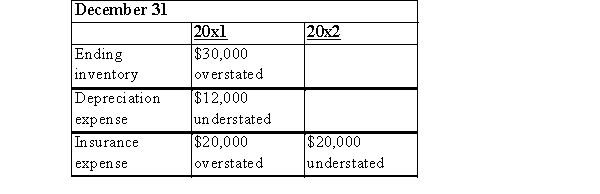 In addition, on December 26, 20x2, fully depreciated machinery was sold for $21,600 cash, but the sale was not recorded until 20x3. There were no other errors during 20x1 or 20x2, and no corrections have been made for any of the errors.
What is the total pre-tax effect of the errors on 20x2 net income?
In addition, on December 26, 20x2, fully depreciated machinery was sold for $21,600 cash, but the sale was not recorded until 20x3. There were no other errors during 20x1 or 20x2, and no corrections have been made for any of the errors.
What is the total pre-tax effect of the errors on 20x2 net income? (Multiple Choice)
5.0/5  (65)
(65) A change from inventory costing using FIFO to inventory costing using Weighted Average is an example of a change in accounting principle.
(True/False)
4.9/5 (93)
(93) Most changes in accounting principle are recognized by using the current approach.
(True/False)
4.8/5 (83)
(83) On comparative financial statements, all errors must be corrected for each year presented, rather than only for the current year.
(True/False)
4.9/5 (76)
(76) The concept of consistency is sacrificed in the accounting for which of the following items?
(Multiple Choice)
4.8/5 (81)
(81) The ending inventory of XZW was overstated by $6,000 in 20x4.The overstatement will cause XZW's:
(Multiple Choice)
4.9/5 (76)
(76) Accounting policy changes must always be handled retrospectively.
(True/False)
4.8/5 (77)
(77) If the estimated useful life of an asset was originally 10 years and then later changed to 12 years, the effects of this change should be:
(Multiple Choice)
4.8/5 (91)
(91) Ending inventory for 20x0 is overstated in error by $4,000 due to a faulty count and costing.The tax rate is 30%.Assume the same accounting methods for both financial reporting and taxes.The error is discovered late in 20x1.Retained earnings at 1/1/x0 was $20,000, and reported earnings (both before correction of error)are: 20x0, $5,000; 20x1, $6,000.
Prepare the comparative retained earnings statements for 20x0 and 20x1.The error overstates 20x0 earnings $4,000 before tax and $2,800 after tax.
(Essay)
4.7/5 (73)
(73) The following errors were discovered during January 20x3 (prior to any reversing entries) 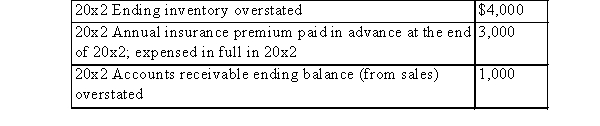 The accounting period ends December 31.What effect would these errors have on 20x3 pre-tax income?
 (Multiple Choice)
4.7/5 (82)
(82) A change from a non-GAAP procedure to a GAAP procedure usually is referred to as a change in accounting principle.
(True/False)
4.8/5 (77)
(77) At the beginning of the current year, a capital expenditure of $24,000 for equipment with an estimated useful life of six years (and no residual value)was debited erroneously to maintenance expense.Straight-line depreciation is used.This error will cause the current year's ending retained earnings to be:
(Multiple Choice)
4.7/5 (58)
(58) An asset that costs $4,000 on January 1, 20x1, is being depreciated on the basis of a 10% straight-line rate.On January 1, 20x2, an ordinary repair of $600 was debited to the asset account and also was depreciated in the same way.As a result, 20x2 pre-tax income was:
(Multiple Choice)
4.9/5 (101)
(101) On January 1, 2015, JTC changed to the weighted-average cost method from the first-in, first-out (FIFO)cost method for inventory cost flow purposes.JTC can justify this as a change in policy.The change will result in a $120,000 decrease in the beginning inventory at January 1, 2015.Ignoring income taxes, the cumulative effect of changing to the weighted-average method from the FIFO method must be reported by JTC in the 2015:
(Multiple Choice)
5.0/5 (69)
(69) A change from the sum-of-the-years'-digits depreciation method to the straight-line depreciation method should be accounted for as a(n):
(Multiple Choice)
4.9/5 (87)
(87) If a $1,000 purchase on credit last year was not recorded until this year and these goods purchased were not included in any year's ending inventory, the purchase error is counterbalancing.
(True/False)
4.8/5 (72)
(72) Which of the following types of errors will not self-correcting the next year?
(Multiple Choice)
4.8/5 (71)
(71) On January 1, 20x1, CR purchased a special machine for use in the business that cost $110,000.The estimated useful life was 10 years with no residual value.
Three separate and independent cases, involving accounting changes with respect to the machine, are given.For each case, two dates are specified upon which you are to give any required entry (if no entry is required, so state).Disregard income taxes.
CASE A: At the end of the fifth year, it was discovered that no depreciation had ever been recorded.Assume the straight-line method is used and that the adjusting entries for 20x5 have not been made.
(1)Entry at the date the omission was discovered:
(2)Entry at December 31, 20x5, the end of the accounting period:
CASE B: At the end of the fifth year, the estimated life was changed from 10 to 15 years.Assume th straight-line method is used and that the adjusting entries for 20x5 have not been made.
(1)Entry at the date the decision to change was made:
(2)Entry at December 31, 20x5, the end of the accounting period:
CASE C: At the end of the fifth year, the company changed from the straight-line depreciation method to sum-of-the-years'-digits depreciation method.The adjusting entries for 20x5 have not bee made.
(1)Entry at the date of the change.
(2)Entry at December 31, 20x5 the end of the accounting period.
(Essay)
4.9/5 (80)
(80) Early adoption of involuntary changes in accounting policy is prohibited under IFRS.
(True/False)
4.8/5 (88)
(88) 
Filters
- Essay(0)
- Multiple Choice(0)
- Short Answer(0)
- True False(0)
- Matching(0)