



 Chat with AI
Exam 21: Accounting Changes

Exam 12: Financial Liabilities and Provisions78 Questions
Exam 13: Financial Instruments: Long-Term Debt74 Questions
Exam 14: Shareholders Equity181 Questions
Exam 15: Financial Instruments: Complex Debt and Equity135 Questions
Exam 16: Corporate Income Tax122 Questions
Exam 17: Tax Losses98 Questions
Exam 18: Leases234 Questions
Exam 19: Post-Employment Benefits92 Questions
Exam 20: Earnings Per Share153 Questions
Exam 21: Accounting Changes157 Questions
Exam 22: Financial Statement Analysis165 Questions
Select questions type


KEC has a machine that cost $75,000 (no residual value)that was being depreciated over a 15-year estimated life, using SL.On the basis of more experience, during the 9th year, management decided to use a revised total estimate of 20 years.
(a)What kind of accounting change does this represent? _.
(b)Give entry in 9th year to reflect the change; if none is required, explain.
(c)Give the depreciation entry (year-end adjusting entry)for the 9th year.Show computations.

Free
(Essay)
4.8/5  (90)
(90) Correct Answer: Verified
(a)Change in estimate.
(b)None required for a change in estimate.The effects are reflected prospectively.(c)  Computations:
Undepreciated balance: $75,000 7/15 = $35,000.Depreciation per period: $35,000 12 years = $2,917.
MMC changed depreciation methods from straight-line to sum-of-the-years'-digits on two of its machines.Data on the machines are as follows:  If MMC makes the change at the beginning of Year 2 of the life on each machine, what is the total amount of the catch-up adjustment for this change?
Free
(Multiple Choice)
4.8/5 (68)
(68) Correct Answer:Verified
VerifiedD
The effects for a change in accounting principle would usually be reported on the face of the income statement for a change:
Free
(Multiple Choice)
4.8/5 (97)
(97) Correct Answer:Verified
VerifiedE
On January 1, Year 1, XYZ Inc.paid three years' worth of rent in the amount of $36,000.The entire amount was expensed in Year 1.Assuming that the Year 2 books are now closed, which of the following best describes the required adjustment to the company's December 31st, Year 2 books? Assume a tax rate of 20%.
(Multiple Choice)
4.8/5 (89)
(89) In 20x2, a firm changed from the completed contract (CC)method of accounting for revenue on long-term contracts to the percentage of completion (PC)method.The firm's 20x1 and 20x2 comparative financial statements will reflect which method or methods. 
(Multiple Choice)
4.8/5 (101)
(101) Indicate how the following errors would affect income and owners' equity.Use the symbol + (plus)for Overstated, - (minus)for Understated by, and 0 (zero)for no effect or error offset. 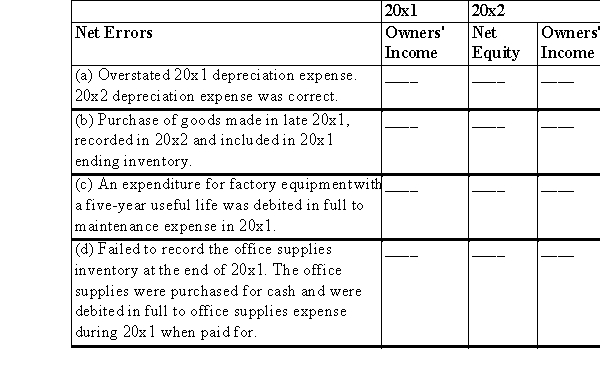 (e)Failed to accrue 20x1 wages payable at ____ ____ ____ ____
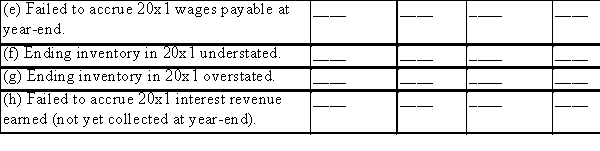
(e)Failed to accrue 20x1 wages payable at ____ ____ ____ ____ (Essay)
4.7/5 (69)
(69) Information for a firm making an accounting change follows:  Tax rate: 30%
Common shares outstanding entire year for both years: 100; Retained earnings, 1/1/x0: $6,000
The firm changes from SYD to SL depreciation in 20x1 for financial reporting purposes only.
 Required:
(a)The 20x1 entries to record the accounting change and depreciation expense for 20x1.
(b)The comparative 20x0 and 20x1 income statements including pro forma disclosures if needed, EPS, and any disclosure footnote required.
Tax rate: 30%
Common shares outstanding entire year for both years: 100; Retained earnings, 1/1/x0: $6,000
The firm changes from SYD to SL depreciation in 20x1 for financial reporting purposes only. Required:
(a)The 20x1 entries to record the accounting change and depreciation expense for 20x1.
(b)The comparative 20x0 and 20x1 income statements including pro forma disclosures if needed, EPS, and any disclosure footnote required. (Essay)
4.9/5 (76)
(76) An asset cost $190,000; it is being depreciated, straight-line, $30,000 residual value, over 10 years.A the start of Year 7, it was decided that the residual value should be $14,000.Give the entries required on the following dates (if none explain why):
January 1, Year 7:
December 31, Year 7:
(Essay)
4.9/5 (70)
(70) Listed below are a number of errors.Indicate the effect of each error on the reported net income for 20x1 and 20x2; use an "X" to respond. 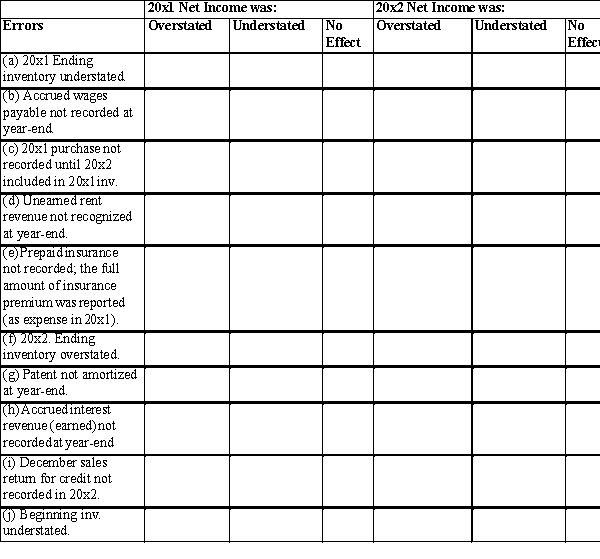
(Essay)
4.9/5 (71)
(71) On January 1, Year 1, XYZ Inc.paid three years' worth of rent in the amount of $36,000.The entire amount was expensed in Year 1.Assuming that the Year 2 books are still open, which of the following best describes the required adjustment to the company's December 31st, Year 2 books? Assume a tax rate of 20%.
(Multiple Choice)
4.9/5 (62)
(62) A change in an accounting estimate should be reported on the financial statements on a retrospective basis.
(True/False)
4.8/5 (78)
(78) All changes in accounting estimates should be accounted for only in the period of the change; there is no effect on future periods.
(True/False)
4.7/5 (87)
(87) With respect to a retrospectively applied change in accounting policy, the effects on prior years' income is treated as an adjustment to opening retained earnings.
(True/False)
4.8/5 (99)
(99) ABC Inc.is a publicly traded enterprise.The following were observed as at the end of Years 1 and 2
Year-end inventories were understated by $40,000 at the end of Year 1 and overstated by $60,000 at the end of Year 2.
The company took out a 2-year insurance policy on January 1st, Year 1 for $10,000.This entire amount was expensed during Year 1.
Effective January 1st, Year 2, the company decided to move from straight line amortization to declining balance amortization.The company recorded its straight line amount of depreciation expense for year 2 in the amount of $10,000.Declining balance amortization for the year would have been $20,000.
The company is subject to a tax rate of 20%.
Required:
1.For each of Years 1 and 2, prepare the journals entry for each of the above, OR, if no entry is required, state why.Assume that the company's Year 2 books are still open.
2.Repeat part 1 above this time assuming that the books are closed.
(Essay)
5.0/5 (78)
(78) Change in accounting estimate requires that a "catch-up adjustment" be recorded and reported in the year of the change.
(True/False)
4.8/5 (79)
(79) In 20x2, a firm changed from the straight-line (SL)method of depreciation to double declining balance (DDB)to conform to long-standing industry practice.The firm's 20x1 and 20x2 comparative financial statements will reflect which method or methods. 
(Multiple Choice)
4.9/5 (76)
(76) A company has been using straight-line depreciation over the last several years, which has amounted to a total of $20,000 depreciation before tax for those past years.This year, it decided to change to units of production, which would have caused $30,000 of depreciation to be recognized in those past years, before tax.The tax rate has always been 40%.This year's depreciation under both methods is: Straight-Line = $5,000
Units of Production = $6,000
The cumulative effect account resulting from this change will decrease net income by:
(Multiple Choice)
4.9/5 (91)
(91) An increase in assets relating to a retrospective change in accounting policy will result in a credit to the related future tax accounts.
(True/False)
4.9/5 (84)
(84) Depreciation expense for the most recent fiscal year on equipment purchased a few years ago is
$10,000.The balance sheet at the end of the same year disclosed the following:  The asset is not expected to have a salvage value and the firm depreciates the asset on the straight-lin basis.In March of the NEXT year (the year of change), the firm decided to reduce the original total useful life 20% and that a salvage value of $30,000 is a reasonable estimate.The firm also decided that the double declining balance method is a more appropriate depreciation method for this asset.
Required:
(a)The entry to record the accounting change.
(b)The entry to record depreciation expense in the year of change.
The asset is not expected to have a salvage value and the firm depreciates the asset on the straight-lin basis.In March of the NEXT year (the year of change), the firm decided to reduce the original total useful life 20% and that a salvage value of $30,000 is a reasonable estimate.The firm also decided that the double declining balance method is a more appropriate depreciation method for this asset.
Required:
(a)The entry to record the accounting change.
(b)The entry to record depreciation expense in the year of change. (Essay)
4.8/5 (83)
(83) 
Filters
- Essay(0)
- Multiple Choice(0)
- Short Answer(0)
- True False(0)
- Matching(0)