



 Chat with AI
Exam 13: The Federal Reserve System

Exam 1: What Economics Is About174 Questions
Exam 2: Production Possibilities Frontier Framework156 Questions
Exam 3: Supply and Demand Theory224 Questions
Exam 4: Prices Free Controlled and Relative122 Questions
Exam 5: Supply Demand and Price Applications76 Questions
Exam 6: Macroeconomic Measurements Part I Prices and Unemployment151 Questions
Exam 7: Macroeconomic Measurements Part II Gdp and Real Gdp150 Questions
Exam 8: Aggregate Demand and Aggregate Supply204 Questions
Exam 9: Classical Macroeconomics and the Self Regulating Economy172 Questions
Exam 10: Keynesian Macroeconomics and Economic Instability a Critique of the Self Regulating Economy200 Questions
Exam 11: Fiscal Policy and the Federal Budget167 Questions
Exam 12: Money Banking and the Financial System150 Questions
Exam 13: The Federal Reserve System180 Questions
Exam 14: Money and the Economy150 Questions
Exam 15: Monetary Policy185 Questions
Exam 16: Expectations Theory and the Economy150 Questions
Exam 17: Economic Growth Resources Technology Ideas and Institutions103 Questions
Exam 18: Debates in Macroeconomics Over the Role and Effects of Government100 Questions
Exam 19: Elasticity204 Questions
Exam 20: Consumer Choice and Behavioral Economics179 Questions
Exam 21: Production and Costs245 Questions
Exam 22: Perfect Competition187 Questions
Exam 23: Monopoly195 Questions
Exam 24: Monopolistic Competition Oligopoly and Game Theory172 Questions
Exam 25: Government and Product Markets Antitrust and Regulation158 Questions
Exam 26: Factor Markets With Emphasis on the Labor Market184 Questions
Exam 27: Wages Unions and Labor138 Questions
Exam 28: The Distribution of Income and Poverty99 Questions
Exam 29: Interest Rent and Profit198 Questions
Exam 30: Market Failure Externalities Public Goods and Asymmetric Information187 Questions
Exam 31: Public Choice and Special Interest Group Politics135 Questions
Exam 32: Building Theories to Explain Everyday Life From Observations to Questions to Theories to Predictions62 Questions
Exam 33: International Trade152 Questions
Exam 34: International Finance122 Questions
Exam 35: The Economic Case for and Against Government Five Topics Considered87 Questions
Exam 36: Stocks Bonds Futures and Options110 Questions
Select questions type


Exhibit 13-1
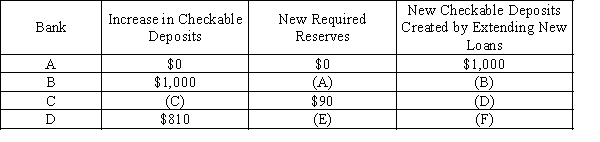
Assume that the required reserve ratio is 10%, that there are no cash leakages, and that banks hold zero excess reserves.
-Refer to Exhibit 13-1. Suppose that the Federal Reserve conducts open market operations by purchasing $1,000 worth of government securities from Bank A. As a result, Bank A finds itself with $1,000 in excess reserves that it lends out and those funds end up in Bank B. The loan made by Bank B ends up in Bank C. What dollar value goes in blanks (C) and (D), respectively?.
Assume that the required reserve ratio is 10%, that there are no cash leakages, and that banks hold zero excess reserves.
-Refer to Exhibit 13-1. Suppose that the Federal Reserve conducts open market operations by purchasing $1,000 worth of government securities from Bank A. As a result, Bank A finds itself with $1,000 in excess reserves that it lends out and those funds end up in Bank B. The loan made by Bank B ends up in Bank C. What dollar value goes in blanks (C) and (D), respectively?. (Multiple Choice)
4.9/5  (74)
(74) When the Fed purchases securities from a bank, it __________ reserves and ____________ the money supply.
(Multiple Choice)
4.9/5 (72)
(72) The Banking Act of 1935 changed the name of the _______________ to the Board of Governors of the Federal Reserve System.
(Multiple Choice)
5.0/5 (81)
(81) The __________ rate is the interest rate one bank pays another bank for a loan.
(Multiple Choice)
4.8/5 (73)
(73) Controlling the nation's money supply is the most important duty of the Federal Reserve.
(True/False)
4.9/5 (81)
(81) Raising the required reserve ratio __________ the simple deposit multiplier which will __________ the economy's money supply.
(Multiple Choice)
4.8/5 (72)
(72) When one commercial bank borrows from another commercial bank, it pays the __________ rate.
(Multiple Choice)
4.8/5 (78)
(78) If the Fed ______________________, the money supply will ultimately __________.
(Multiple Choice)
4.7/5 (82)
(82) A decrease in the required reserve ratio __________ the money supply; an open market purchase __________ the money supply.
(Multiple Choice)
4.9/5 (81)
(81) Which of the following Fed actions will increase the money supply?
(Multiple Choice)
4.9/5 (78)
(78) Which of the following is not a function of the Federal Reserve System?
(Multiple Choice)
4.9/5 (65)
(65) Here is how an open market purchase works: The Fed __________ government securities to (from) a commercial bank, which raises the bank's deposits at the __________ and increases the bank's __________.
(Multiple Choice)
4.9/5 (81)
(81) Which of the following actions is most likely to lead to an increase in the money supply?
(Multiple Choice)
5.0/5 (81)
(81) If the Fed purchases government securities from Bank A, __________ in the banking system __________ and the money supply __________.
(Multiple Choice)
4.9/5 (75)
(75) The major policy-making group within the Fed is the __________ Committee.
(Multiple Choice)
4.9/5 (71)
(71) 
Filters
- Essay(0)
- Multiple Choice(0)
- Short Answer(0)
- True False(0)
- Matching(0)