



 Chat with AI
Exam 13: The Federal Reserve System

Exam 1: What Economics Is About174 Questions
Exam 2: Production Possibilities Frontier Framework156 Questions
Exam 3: Supply and Demand Theory224 Questions
Exam 4: Prices Free Controlled and Relative122 Questions
Exam 5: Supply Demand and Price Applications76 Questions
Exam 6: Macroeconomic Measurements Part I Prices and Unemployment151 Questions
Exam 7: Macroeconomic Measurements Part II Gdp and Real Gdp150 Questions
Exam 8: Aggregate Demand and Aggregate Supply204 Questions
Exam 9: Classical Macroeconomics and the Self Regulating Economy172 Questions
Exam 10: Keynesian Macroeconomics and Economic Instability a Critique of the Self Regulating Economy200 Questions
Exam 11: Fiscal Policy and the Federal Budget167 Questions
Exam 12: Money Banking and the Financial System150 Questions
Exam 13: The Federal Reserve System180 Questions
Exam 14: Money and the Economy150 Questions
Exam 15: Monetary Policy185 Questions
Exam 16: Expectations Theory and the Economy150 Questions
Exam 17: Economic Growth Resources Technology Ideas and Institutions103 Questions
Exam 18: Debates in Macroeconomics Over the Role and Effects of Government100 Questions
Exam 19: Elasticity204 Questions
Exam 20: Consumer Choice and Behavioral Economics179 Questions
Exam 21: Production and Costs245 Questions
Exam 22: Perfect Competition187 Questions
Exam 23: Monopoly195 Questions
Exam 24: Monopolistic Competition Oligopoly and Game Theory172 Questions
Exam 25: Government and Product Markets Antitrust and Regulation158 Questions
Exam 26: Factor Markets With Emphasis on the Labor Market184 Questions
Exam 27: Wages Unions and Labor138 Questions
Exam 28: The Distribution of Income and Poverty99 Questions
Exam 29: Interest Rent and Profit198 Questions
Exam 30: Market Failure Externalities Public Goods and Asymmetric Information187 Questions
Exam 31: Public Choice and Special Interest Group Politics135 Questions
Exam 32: Building Theories to Explain Everyday Life From Observations to Questions to Theories to Predictions62 Questions
Exam 33: International Trade152 Questions
Exam 34: International Finance122 Questions
Exam 35: The Economic Case for and Against Government Five Topics Considered87 Questions
Exam 36: Stocks Bonds Futures and Options110 Questions
Select questions type


When the Fed was created, its governing body was called the Federal Reserve Board, but it was later officially renamed the Board of Governors of the Federal Reserve System.
(True/False)
4.8/5  (92)
(92) Suppose that the Fed undertakes an open market purchase of $25 million worth of securities from a bank. If the required reserve ratio is 9%, what is the resulting change in checkable deposits (or the money supply), assuming that there are no cash leakages and that banks hold zero excess reserves?
(Multiple Choice)
4.8/5 (66)
(66) When a bank repays a _________________ loan, the Fed _____________________ the bank's reserve account.
(Multiple Choice)
4.9/5 (80)
(80) Exhibit 13-1
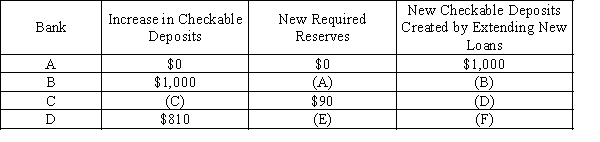
Assume that the required reserve ratio is 10%, that there are no cash leakages, and that banks hold zero excess reserves.
-Refer to Exhibit 13-1. Suppose that the Federal Reserve conducts open market operations by purchasing $1,000 worth of government securities from Bank A. At the end of this process of money creation, what is the total amount of new checkable deposits?
Assume that the required reserve ratio is 10%, that there are no cash leakages, and that banks hold zero excess reserves.
-Refer to Exhibit 13-1. Suppose that the Federal Reserve conducts open market operations by purchasing $1,000 worth of government securities from Bank A. At the end of this process of money creation, what is the total amount of new checkable deposits? (Multiple Choice)
4.8/5 (75)
(75) If banks are currently holding zero excess reserves and the Fed lowers the required reserve ratio, which of the following will happen?
(Multiple Choice)
4.8/5 (69)
(69) One of the Fed's functions is to be the government's banker. This function means that the
(Multiple Choice)
4.7/5 (69)
(69) There is an inverse relationship between the required reserve ratio and the money supply.
(True/False)
4.8/5 (81)
(81) Exhibit 13-2
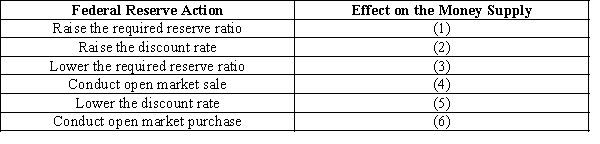 -Refer to Exhibit 13-2. What word (up or down) should go in the place of blank (5) and blank (6), respectively?
 (Multiple Choice)
4.7/5 (81)
(81) Suppose that the current federal funds rate is below the federal funds target rate. In order to raise the federal funds rate the Fed will ________________ securities on the open market which will ________________ the supply of reserves in the market for reserves, pushing the rate closer to the target rate.
(Multiple Choice)
4.9/5 (76)
(76) The Federal Open Market Committee (FOMC) is composed of the seven members of the Board of Governors,
(Multiple Choice)
4.8/5 (80)
(80) The Board of Governors of the Federal Reserve is part of a larger policy-making group called the
(Multiple Choice)
4.9/5 (86)
(86) Suppose that the Fed undertakes an open market purchase of $15 million worth of securities from a bank. If the required reserve ratio is 12%, what is the resulting change in checkable deposits (or the money supply), assuming that there are no cash leakages and that banks hold zero excess reserves?
(Multiple Choice)
4.9/5 (78)
(78) Lowering the required reserve ratio __________ the simple deposit multiplier which will __________ the economy's money supply.
(Multiple Choice)
4.7/5 (83)
(83) If the Fed wants to decrease the money supply, it can __________ the required reserve ratio, conduct an open market __________, or __________ the discount rate.
(Multiple Choice)
4.7/5 (68)
(68) Although the Fed can destroy money, it is impossible for the Fed to create money out of thin air.
(True/False)
4.9/5 (81)
(81) A bank is less likely to borrow from the Fed when the __________ falls relative to the __________.
(Multiple Choice)
5.0/5 (72)
(72) 
Filters
- Essay(0)
- Multiple Choice(0)
- Short Answer(0)
- True False(0)
- Matching(0)