



 Chat with AI
Exam 13: The Federal Reserve System

Exam 1: What Economics Is About174 Questions
Exam 2: Production Possibilities Frontier Framework156 Questions
Exam 3: Supply and Demand Theory224 Questions
Exam 4: Prices Free Controlled and Relative122 Questions
Exam 5: Supply Demand and Price Applications76 Questions
Exam 6: Macroeconomic Measurements Part I Prices and Unemployment151 Questions
Exam 7: Macroeconomic Measurements Part II Gdp and Real Gdp150 Questions
Exam 8: Aggregate Demand and Aggregate Supply204 Questions
Exam 9: Classical Macroeconomics and the Self Regulating Economy172 Questions
Exam 10: Keynesian Macroeconomics and Economic Instability a Critique of the Self Regulating Economy200 Questions
Exam 11: Fiscal Policy and the Federal Budget167 Questions
Exam 12: Money Banking and the Financial System150 Questions
Exam 13: The Federal Reserve System180 Questions
Exam 14: Money and the Economy150 Questions
Exam 15: Monetary Policy185 Questions
Exam 16: Expectations Theory and the Economy150 Questions
Exam 17: Economic Growth Resources Technology Ideas and Institutions103 Questions
Exam 18: Debates in Macroeconomics Over the Role and Effects of Government100 Questions
Exam 19: Elasticity204 Questions
Exam 20: Consumer Choice and Behavioral Economics179 Questions
Exam 21: Production and Costs245 Questions
Exam 22: Perfect Competition187 Questions
Exam 23: Monopoly195 Questions
Exam 24: Monopolistic Competition Oligopoly and Game Theory172 Questions
Exam 25: Government and Product Markets Antitrust and Regulation158 Questions
Exam 26: Factor Markets With Emphasis on the Labor Market184 Questions
Exam 27: Wages Unions and Labor138 Questions
Exam 28: The Distribution of Income and Poverty99 Questions
Exam 29: Interest Rent and Profit198 Questions
Exam 30: Market Failure Externalities Public Goods and Asymmetric Information187 Questions
Exam 31: Public Choice and Special Interest Group Politics135 Questions
Exam 32: Building Theories to Explain Everyday Life From Observations to Questions to Theories to Predictions62 Questions
Exam 33: International Trade152 Questions
Exam 34: International Finance122 Questions
Exam 35: The Economic Case for and Against Government Five Topics Considered87 Questions
Exam 36: Stocks Bonds Futures and Options110 Questions
Select questions type


A commercial bank can receive a loan from another commercial bank in the
(Multiple Choice)
4.9/5  (94)
(94) Exhibit 13-2
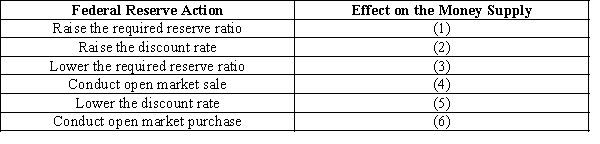 -Refer to Exhibit 13-2. What word (up or down) should go in the place of blank (1) and blank (2), respectively?
 (Multiple Choice)
4.8/5 (73)
(73) If the Fed purchases government securities from commercial banks, the reserves of the banking system will immediately
(Multiple Choice)
4.9/5 (85)
(85) The supply curve of reserves has two kinks in it: one at the _________________ and the other at the ____________________ rate.
(Multiple Choice)
4.8/5 (85)
(85) When the Fed sells government securities to a bank, the securities will be
(Multiple Choice)
4.7/5 (97)
(97) The interest rate that a commercial bank pays when it borrows from the Fed is the __________ rate.
(Multiple Choice)
4.7/5 (73)
(73) Explain the major differences between the Federal Reserve and the U.S. Treasury.
(Essay)
4.7/5 (85)
(85) To deal with the financial crisis of 2007-2009, the Fed extended its lender of last resort function to include institutions other than banks.
(True/False)
4.7/5 (64)
(64) If a bank has zero excess reserves and one of its creditworthy customers applies for a loan, the bank may be able to grant the loan if it can
(Multiple Choice)
4.9/5 (69)
(69) Assuming no cash leakages and no excess reserves held by banks, a required reserve ratio of 0 percent would mean that the simple deposit multiplier is
(Multiple Choice)
4.8/5 (88)
(88) The Board of Governors of the Federal Reserve is comprised of
(Multiple Choice)
4.8/5 (75)
(75) Exhibit 13-1
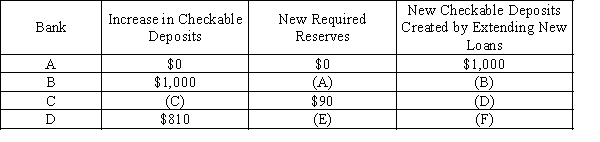
Assume that the required reserve ratio is 10%, that there are no cash leakages, and that banks hold zero excess reserves.
-Refer to Exhibit 13-1. Suppose that the Federal Reserve conducts open market operations by purchasing $1,000 worth of government securities from Bank A. As a result, Bank A finds itself with $1,000 in excess reserves that it lends out and those funds end up in Bank B. What dollar value goes in blanks (A) and (B), respectively?.
Assume that the required reserve ratio is 10%, that there are no cash leakages, and that banks hold zero excess reserves.
-Refer to Exhibit 13-1. Suppose that the Federal Reserve conducts open market operations by purchasing $1,000 worth of government securities from Bank A. As a result, Bank A finds itself with $1,000 in excess reserves that it lends out and those funds end up in Bank B. What dollar value goes in blanks (A) and (B), respectively?. (Multiple Choice)
4.8/5 (80)
(80) The Fed is one of the largest departments within the U.S. Treasury.
(True/False)
4.9/5 (90)
(90) If the Fed raises the discount rate at the same time it conducts an open market sale, it follows that the money supply will
(Multiple Choice)
4.7/5 (91)
(91) Suppose the Fed sells a $50,000 U.S. Treasury security to Martha, a member of the public. If Martha writes a check to the Fed in order to buy this security, the money in her checking account will be transferred to
(Multiple Choice)
4.8/5 (81)
(81) The chairman of the Board of Governors of the Fed is designated by ____________________ to serve a _______ year term as chairman.
(Multiple Choice)
4.9/5 (79)
(79) 
Filters
- Essay(0)
- Multiple Choice(0)
- Short Answer(0)
- True False(0)
- Matching(0)