



 Chat with AI
Exam 19: Elasticity

Exam 1: What Economics Is About174 Questions
Exam 2: Production Possibilities Frontier Framework156 Questions
Exam 3: Supply and Demand Theory224 Questions
Exam 4: Prices Free Controlled and Relative122 Questions
Exam 5: Supply Demand and Price Applications76 Questions
Exam 6: Macroeconomic Measurements Part I Prices and Unemployment151 Questions
Exam 7: Macroeconomic Measurements Part II Gdp and Real Gdp150 Questions
Exam 8: Aggregate Demand and Aggregate Supply204 Questions
Exam 9: Classical Macroeconomics and the Self Regulating Economy172 Questions
Exam 10: Keynesian Macroeconomics and Economic Instability a Critique of the Self Regulating Economy200 Questions
Exam 11: Fiscal Policy and the Federal Budget167 Questions
Exam 12: Money Banking and the Financial System150 Questions
Exam 13: The Federal Reserve System180 Questions
Exam 14: Money and the Economy150 Questions
Exam 15: Monetary Policy185 Questions
Exam 16: Expectations Theory and the Economy150 Questions
Exam 17: Economic Growth Resources Technology Ideas and Institutions103 Questions
Exam 18: Debates in Macroeconomics Over the Role and Effects of Government100 Questions
Exam 19: Elasticity204 Questions
Exam 20: Consumer Choice and Behavioral Economics179 Questions
Exam 21: Production and Costs245 Questions
Exam 22: Perfect Competition187 Questions
Exam 23: Monopoly195 Questions
Exam 24: Monopolistic Competition Oligopoly and Game Theory172 Questions
Exam 25: Government and Product Markets Antitrust and Regulation158 Questions
Exam 26: Factor Markets With Emphasis on the Labor Market184 Questions
Exam 27: Wages Unions and Labor138 Questions
Exam 28: The Distribution of Income and Poverty99 Questions
Exam 29: Interest Rent and Profit198 Questions
Exam 30: Market Failure Externalities Public Goods and Asymmetric Information187 Questions
Exam 31: Public Choice and Special Interest Group Politics135 Questions
Exam 32: Building Theories to Explain Everyday Life From Observations to Questions to Theories to Predictions62 Questions
Exam 33: International Trade152 Questions
Exam 34: International Finance122 Questions
Exam 35: The Economic Case for and Against Government Five Topics Considered87 Questions
Exam 36: Stocks Bonds Futures and Options110 Questions
Select questions type


Cross elasticity of demand measures consumer responsiveness to a change in the price of one good, in terms of the quantity demanded of some other good.
(True/False)
4.8/5  (70)
(70) Exhibit 19-7
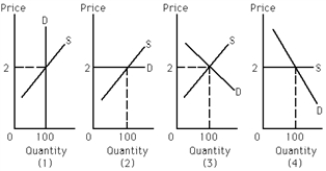 -Refer to Exhibit 19-7. As a producer, if you had a choice, which of the depicted markets would you operate in?
 (Multiple Choice)
4.8/5 (65)
(65) If the cross elasticity of demand for good A with respect to good B is +2.7, then good A is
(Multiple Choice)
4.9/5 (75)
(75) Exhibit 19-2
 -Refer to Exhibit 19-2. The market for good X is initially in equilibrium at $5. The government then places a per-unit tax on good X, as shown by the shift of S1 to S2. Approximately what percentage of the tax do producers end up paying?
 (Multiple Choice)
5.0/5 (82)
(82) If the price of good X falls and the demand for good X is unit elastic, then the percentage rise in quantity demanded is __________ the percentage fall in price, and total revenue __________.
(Multiple Choice)
4.8/5 (81)
(81) If the demand for health care is elastic and health care co-payments are lowered, the percentage change in the quantity demanded of health care will be _______________ than the percentage decrease in co-payments, and the total dollar amount spent on health care will ___________.
(Multiple Choice)
4.8/5 (86)
(86) All other things being equal, the __________ substitutes for a good, the __________ the price elasticity of demand.
(Multiple Choice)
4.9/5 (85)
(85) A good will tend to have a low price elasticity of demand if
(Multiple Choice)
4.9/5 (70)
(70) Exhibit 19-6
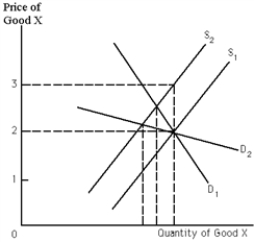 -Refer to Exhibit 19-6. Suppose the three equilibrium quantities are 700, 800, and 900, and the two equilibrium prices are $2.20 and $2.75. What is the tax revenue collected from the tax that shifted S1 to S2 when D1 is the relevant demand curve?
 (Multiple Choice)
4.8/5 (82)
(82) Exhibit 19-1
 -Refer to Exhibit 19-l. The demand for the good represented by demand curve D2 is
 (Multiple Choice)
5.0/5 (92)
(92) The price elasticity of demand for a given good is 2.3. This implies that if price
(Multiple Choice)
4.8/5 (78)
(78) As price rises from $22 to $26, quantity supplied rises from 100 to 110 units and quantity demanded falls from 90 units to 65 units. It follows that supply is __________ and demand is __________.
(Multiple Choice)
4.8/5 (76)
(76) Exhibit 19-3
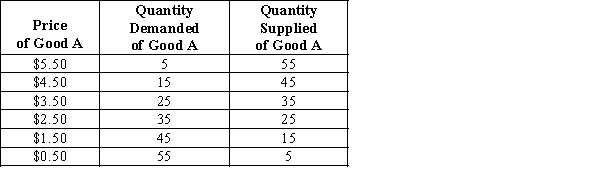 -Refer to Exhibit 19-3. If price increases from $2.50 to $3.50, total revenue along the demand curve
 (Multiple Choice)
4.9/5 (64)
(64) Demand for a given good is elastic, which means that the percentage change in __________ is greater than the percentage change in __________.
(Multiple Choice)
4.9/5 (72)
(72) If the demand for a good is inelastic and the price of the good decreases, then
(Multiple Choice)
4.9/5 (80)
(80) Exhibit 19-9
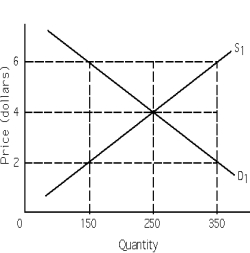 -Refer to Exhibit 19-9. What is the price elasticity of demand between $4 and $6?
 (Multiple Choice)
4.8/5 (72)
(72) When the price of a good rises, total revenue will fall if the good is elastic in demand.
(True/False)
4.8/5 (86)
(86) 
Filters
- Essay(0)
- Multiple Choice(0)
- Short Answer(0)
- True False(0)
- Matching(0)